
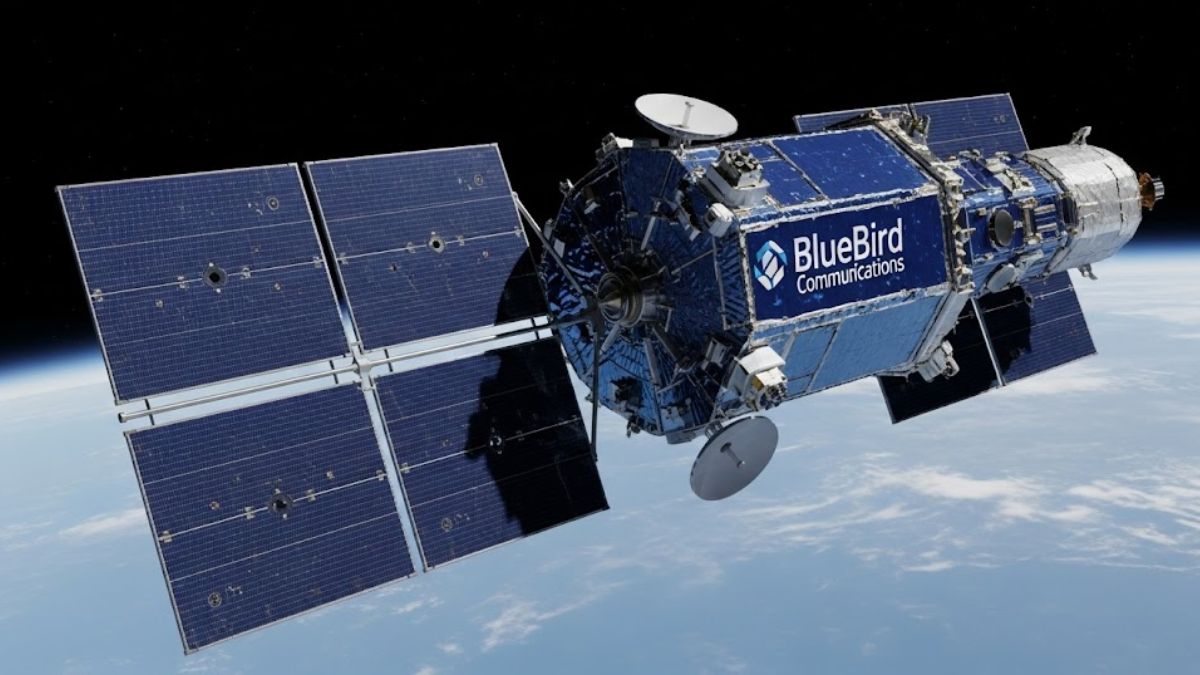
Just days after the successful launch of the NISAR Earth Observation Satellite, the Indian Space Research Organisation (ISRO) is gearing up for its next Indo-U.S. collaboration. The mission involves launching the Block 2 BlueBird communications satellite, developed by U.S.-based AST SpaceMobile, from the Satish Dhawan Space Centre, Sriharikota, using ISRO’s most powerful launch vehicle, the LVM3 (formerly GSLV-Mk III).
BlueBird Satellite: A Major Step in Indo-U.S. Space Ties
According to ISRO Chairman V. Narayanan, the 6,500 kg BlueBird satellite is expected to arrive in India by September 2025, with the launch scheduled within three to four months. Although its delivery faced a delay of three months due to developmental issues, the mission is now on track. The BlueBird satellite is expected to significantly expand communication capabilities, strengthening India’s standing in the global space market.
From NISAR to BlueBird
The announcement follows the successful launch of the NASA-ISRO Synthetic Aperture Radar (NISAR) mission on July 30, 2025, aboard a GSLV-F16. NISAR, a landmark Earth observation project, has now entered a critical 90-day commissioning phase, marking another milestone in Indo-U.S. cooperation in space exploration.
Focus on Gaganyaan Human Spaceflight
Alongside the BlueBird project, ISRO is pressing ahead with preparations for its ambitious Gaganyaan programme. The first uncrewed mission is slated for December 2025, followed by two more in 2026, ahead of India’s first crewed space mission scheduled for early 2027. Mr. Narayanan confirmed that the human-rating of the launch vehicle has been completed and the crew escape system is nearing completion, while the orbital module development is in an advanced stage.
India’s Space Station Plans
Looking further ahead, ISRO has reiterated its plans for India’s own space station — Bharatiya Antariksh Station. The 52-tonne facility will be built in five modules, with the first module expected to be placed in orbit by 2028. The entire station is planned to be operational by 2035, cementing India’s place among the world’s leading spacefaring nations.
Confidence in Indo-U.S. Cooperation
Addressing concerns about possible impacts of U.S. trade policies under President Donald Trump, Mr. Narayanan reassured that India’s technology contracts with the U.S. would be executed without disruption, underscoring the strength of the strategic partnership in science and technology.


 Meet MAI-Transcribe-1: Microsoft’s Fast,...
 What is Outer Space Treaty 1967? Princip...
 What Is Mission Mitra? ISRO’s New Experi...











