
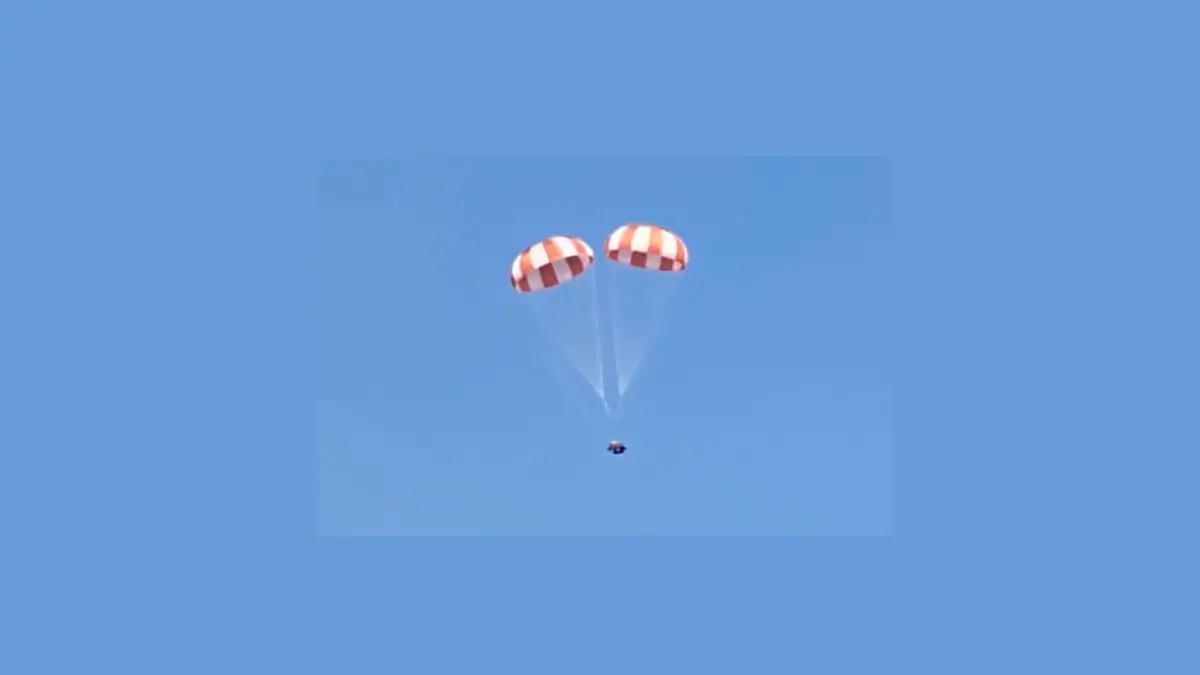
India’s first human spaceflight mission Gaganyaan has achieved another major milestone. The Indian Space Research Organization (ISRO) has successfully completed a series of drogue parachute qualification tests for the Gaganyaan Crew Module. These tests are critical to ensuring the safe return of astronauts to Earth after spaceflight. The tests were conducted on December 18 and 19, 2025 at the Rail Track Rocket Sled (RTRS) facility in Chandigarh.
Objective and Outcome of the Test Series
The main aim of this test series was to rigorously evaluate the drogue parachutes under extreme conditions that simulate real mission scenarios. ISRO stated that all test objectives were met successfully.
The tests confirmed,
- Structural strength of the parachutes
- Reliable deployment sequence
- Stable performance despite large variations in flight conditions
This proves the robustness of the parachute system which is essential for qualifying it for human spaceflight.
Where and How Were the Tests Conducted?
- The qualification tests were carried out at the RTRS facility of the Terminal Ballistics Research Laboratory (TBRL).
- Which functions under the Defense Research and Development Organization (DRDO).
- ISRO confirmed through an official statement that the tests successfully demonstrated the performance and reliability of the drogue parachutes under varying and extreme flight conditions.
- This ensures that the system can work even if actual mission conditions differ from expected parameters.
What Are Drogue Parachutes?
Drogue parachutes are small but powerful parachutes that play a crucial role during the re entry phase of the space mission. When a crew module re enters Earth’s atmosphere at very high speed, it must be stabilised and slowed down gradually.
In the Gaganyaan mission, drogue parachutes help in,
- Stabilising the Crew Module after re entry
- Reducing its speed before main parachutes are deployed
- Ensuring smooth and controlled descent
Without a reliable drogue parachute system, a safe landing would not be possible.
Parachute Deceleration System Explained
According to ISRO, the deceleration system of the Gaganyaan Crew Module is highly complex and consists of 10 parachutes of four different types, deployed in a fixed sequence.
The descent process works as follows,
- First, two apex cover separation parachutes remove the protective cover of the parachute compartment
- Next, two drogue parachutes are deployed to stabilise and slow down the module
- After the drogue parachutes are released, three pilot parachutes are deployed
- These pilot parachutes pull out three main parachutes, which finally slow the Crew Module to a safe landing speed
- This multi-stage system ensures maximum safety for astronauts during descent and splashdown.
Collaborative Effort Behind the Success
The successful tests were the result of close coordination between several leading Indian research institutions. These included,
- Vikram Sarabhai Space Centre (VSSC)
- Aerial Delivery Research and Development Establishment (ADRDE)
- Terminal Ballistics Research Laboratory (TBRL)
- Teams from ISRO and DRDO
Such collaboration highlights India’s growing capability in handling complex technologies needed for human space missions.
About the Gaganyaan Mission
- The Gaganyaan programme aims to send a three-member Indian crew to low Earth orbit at about 400 km for three days and safely bring them back to Earth.
- The mission will end with a splashdown in Indian waters, making the reliability of the parachute-based recovery system absolutely critical.
Key Takeaways
- ISRO completed drogue parachute tests for the Gaganyaan Crew Module on December 18–19, 2025
- Tests were conducted at RTRS facility, TBRL, Chandigarh under DRDO
- The Gaganyaan deceleration system uses 10 parachutes of four types
- Drogue parachutes stabilise and slow the Crew Module during re-entry
- The mission will send three astronauts to 400 km orbit for three days
Question
Q. How many parachutes are used in the Gaganyaan deceleration system?
A. 4
B. 6
C. 8
D. 10


 Meet MAI-Transcribe-1: Microsoft’s Fast,...
 What is Outer Space Treaty 1967? Princip...
 What Is Mission Mitra? ISRO’s New Experi...











