
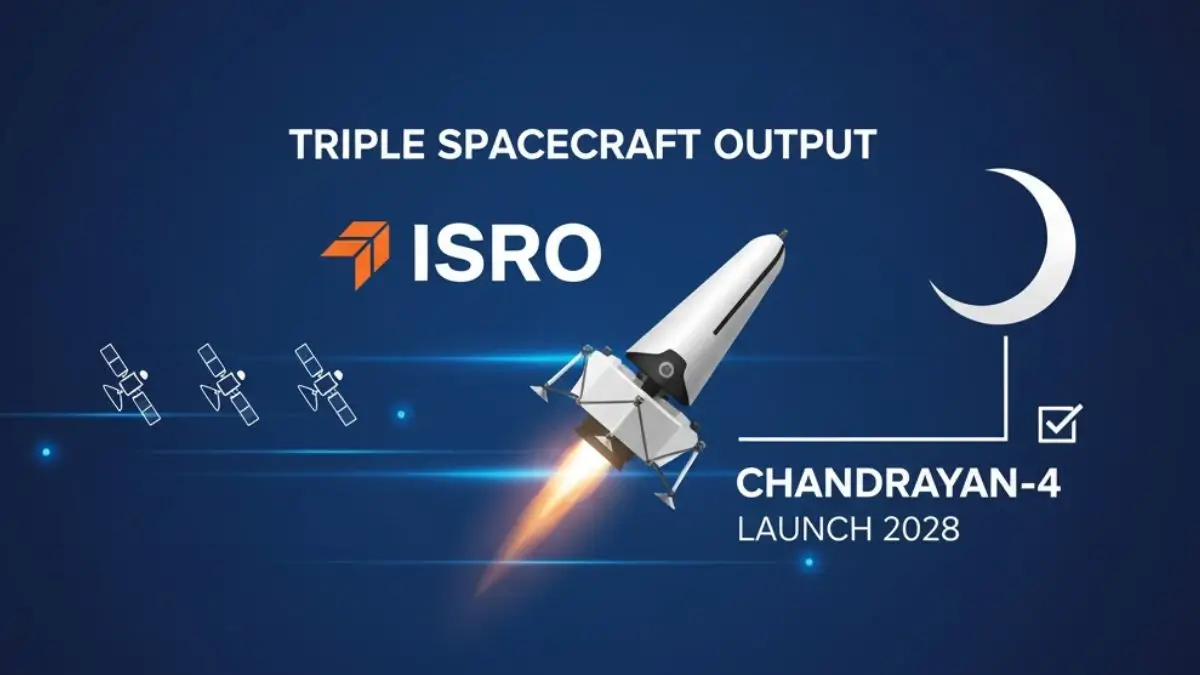
India’s space program is entering a new era of growth and innovation. The Indian Space Research Organisation (ISRO) has unveiled a robust expansion plan, setting ambitious goals for the next decade. With a focus on lunar exploration, human spaceflight, and building a space station, ISRO is working to significantly enhance its global standing and domestic capabilities. These developments not only strengthen India’s scientific and strategic presence in space but also open up vast economic and technological opportunities.
ISRO’s Roadmap: Scaling Up Missions and Production
ISRO has announced its intent to triple the production of spacecraft over the next three years to meet the growing demand for launches and scientific missions. The agency plans to conduct seven more launches in the current financial year, including,
- Commercial communication satellites
- PSLV and GSLV missions
The first fully industry-manufactured PSLV
This scale-up aligns with India’s goal of expanding its presence in the global space market and increasing private sector participation.
Chandrayaan-4
Scheduled for 2028, Chandrayaan-4 will be India’s first lunar sample-return mission, making it the country’s most advanced moon exploration project to date.
Key Features
- Designed to collect and return lunar soil and rock samples
- Will make India the fourth nation to achieve this milestone, after the US, Russia, and China
- Forms a vital part of India’s long-term human space exploration plan
Human Spaceflight: Gaganyaan and Lunar Aspirations
ISRO is also progressing steadily on Gaganyaan, India’s first crewed space mission, slated for 2027.
- Preceded by three uncrewed missions to ensure safety and reliability
- Training and module development are underway
- Marks India’s entry into the elite group of nations with human spaceflight capability
The government has further tasked ISRO with the goal of sending Indian astronauts to the moon and bringing them back safely by 2040, strengthening India’s strategic and exploratory ambitions.
Indian Space Station by 2035
- Another ambitious project in ISRO’s pipeline is the creation of an Indian Space Station, with the first module expected to be launched by 2028.
- Full completion targeted by 2035
- India aims to become the third country to operate an independent space station
- Will support long-duration missions and advanced research
Expanding India’s Space Economy
India’s current share in the global space economy stands at 2%, valued at approximately USD 8.2 billion.
Future Targets
- Increase market share to 8% by 2030
- Projected growth to USD 44 billion by 2033
- Enhanced private participation with 450+ industries and 330 startups now involved in the Indian space ecosystem
This growth is being driven by space sector reforms introduced in 2020, which opened the doors for private entities in rocket manufacturing, satellite development, and launch services.
Strategic Collaborations and Missions
- LUPEX: India-Japan joint mission to explore water ice at the Moon’s south pole
- Expanded collaboration with global space agencies and industrial partners
These missions and collaborations are crucial in building India’s reputation as a reliable space partner and technology leader.
Key Static Facts
- Chandrayaan-4 Mission: Scheduled for 2028
- Human Spaceflight (Gaganyaan): Crewed mission in 2027
- Indian Space Station: First module by 2028; full station by 2035
- Spacecraft Production Goal: Tripled in 3 years
- India’s Space Economy Share: Targeting 8% by 2030
- Private Participation: Over 450 industries and 330 startups involved
- Global Space Economy Size: USD 630 billion (2025); expected to reach USD 1.8 trillion by 2035


 Meet MAI-Transcribe-1: Microsoft’s Fast,...
 What is Outer Space Treaty 1967? Princip...
 What Is Mission Mitra? ISRO’s New Experi...











