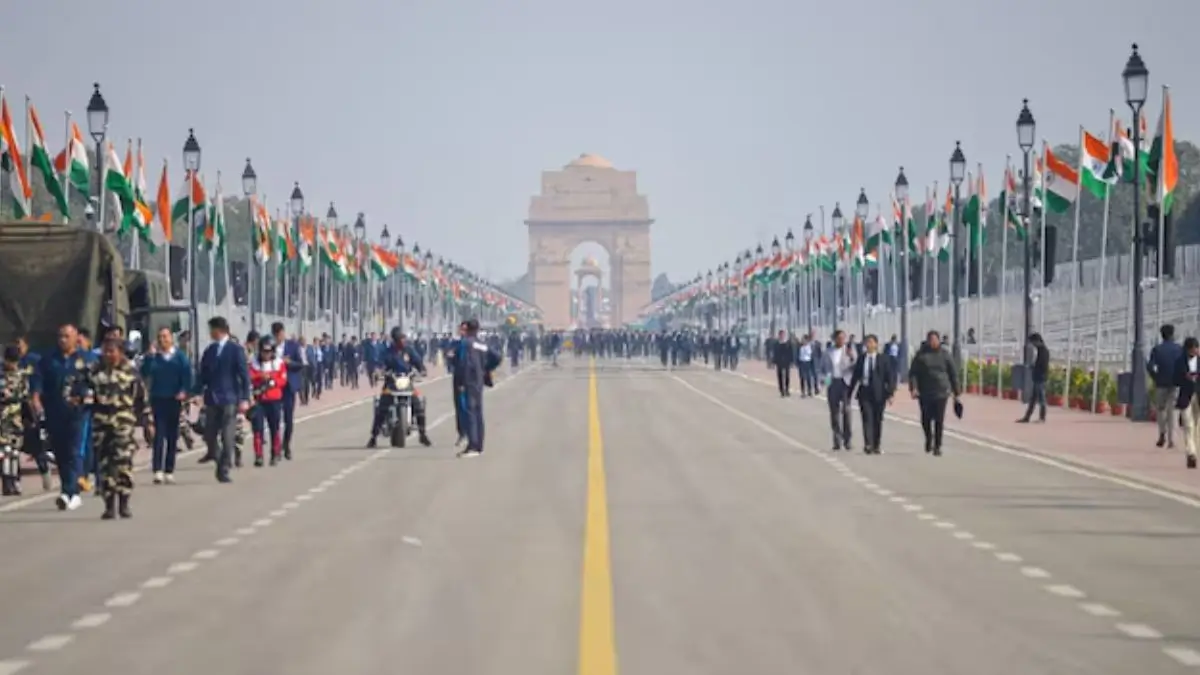
Kartavya Path, located in the heart of New Delhi, stands as a powerful symbol of India’s democratic evolution. Earlier called Rajpath, this grand boulevard connects Rashtrapati Bhavan to India Gate and represents India’s journey from colonial rule to a democracy rooted in duty, responsibility, and citizen participation.
Historical Evolution of Kartavya Path
- Kartavya Path has undergone a significant transformation reflecting India’s political journey.
- During British rule, it was designed by Edwin Lutyens and Herbert Baker as King’s Way, symbolizing imperial authority.
- It connected the Viceroy’s House (now Rashtrapati Bhavan) with India Gate, showcasing the grandeur of the British Empire.
- After Independence in 1947, King’s Way was renamed Rajpath and became the ceremonial avenue for Republic Day parades and national events.
- Despite independence, its colonial symbolism remained prominent until 2022, when it was renamed Kartavya Path, marking a decisive ideological shift.
Symbolism of ‘Kartavya’ (Duty) in Indian Democracy
- The term Kartavya means duty, a concept deeply rooted in Indian philosophy and governance.
- Indian traditions, including teachings of the Bhagavad Gita, emphasize selfless performance of duty.
- The Constitution reflects this idea through Article 51A, which lists the Fundamental Duties of citizens.
- Kartavya Path symbolizes that rights gain meaning only when accompanied by responsibilities.
- It underscores shared accountability between the state and citizens in nation-building.
- The renaming represents a move away from ruler-centric authority to citizen-centric democracy.
Kartavya Path and the Central Vista Redevelopment Project
- Kartavya Path is the central axis of the ambitious Central Vista Redevelopment Project.
- The project aims to modernize New Delhi’s administrative and ceremonial core.
- Kartavya Path stretches from Rashtrapati Bhavan to India Gate, forming its ceremonial spine.
- The redevelopment replaced aging colonial infrastructure with modern, sustainable facilities.
- Citizen-friendly features such as wide walkways, green lawns, seating areas, and water features were added.
- Underground utilities and eco-friendly lighting enhanced aesthetics and functionality.
- The redesign supports smooth organization of national events like the Republic Day Parade.
Question
Q. Kartavya Path was earlier known as:
A) Janpath
B) King’s Way
C) Lokpath
D) Vijay Path


 India's First Digital Census 2027 Begins...
 PM Modi Launches Kaynes Semiconductor Pl...
 India Census 2027 Digital: Phase 1 Start...