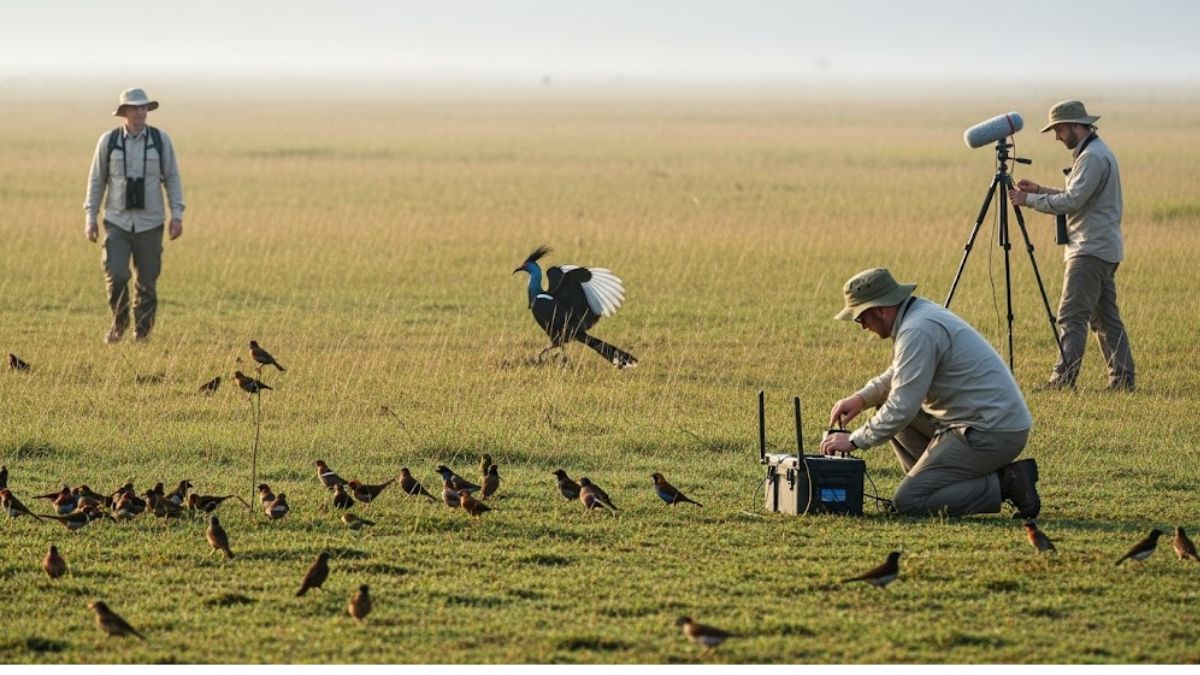
The Kaziranga National Park in Assam has conducted India’s first-ever Grassland Bird Census (March–May 2025), using acoustic technology to identify and monitor bird species. Conducted by forest officials, researchers, and conservationists, the survey recorded 43 species, including critically endangered and endemic birds like Finn’s Weaver. The census marks a breakthrough in biodiversity monitoring, highlighting both conservation successes and ongoing threats like habitat loss and climate change.
Context and Significance
In his Mann Ki Baat address, the Prime Minister of India mentioned the initiative, noting its innovative use of acoustic monitoring technology and its importance for conservation of grassland ecosystems. This is a landmark census in India because grassland birds — unlike forest or wetland species — are often underrepresented in conventional bird surveys, making them harder to monitor and protect.
About the First-ever Grassland Bird Census
When Was It Conducted?
Conducted between March 18 and May 25, 2025, coinciding with the breeding season of many grassland birds.
Where?
Kaziranga National Park, Assam — a UNESCO World Heritage Site, globally known for its one-horned rhinoceroses and diverse ecosystems.
Who Conducted It?
A joint initiative of,
- Forest Department Officials
- Researchers (including INSPIRE fellow Chiranjib Bora)
- Conservationists and Kaziranga Park Authorities
Objectives of the Census
- Monitor populations of grassland-dwelling bird species
- Identify rare, endemic, and globally threatened species
- Map breeding patterns and assess habitat health
- Provide data-driven insights to strengthen conservation planning
Methodology and Innovation
Passive Acoustic Monitoring
- Recorders placed on tall trees captured birdcalls round the clock.
- Monitoring conducted in 29 locations using six recorders in three-day cycles.
Technology Tools Used
- Spectrogram Analysis: Visualized sound frequencies of birdcalls.
- AI-based BirdNET Software: Identified species based on bird songs.
- Enabled recognition of species that are often difficult to spot visually.
Key Findings of the Census
- 43 bird species recorded in total.
Among them,
- 1 Critically Endangered species
- 2 Endangered species
- 6 Vulnerable species (as per IUCN Red List).
Conservation Breakthrough
- Discovery of over 85 nests of Finn’s Weaver, a rare and endangered bird, endemic to the Brahmaputra floodplains.
- This was a major achievement, as Finn’s Weaver sightings are extremely rare.
Ecological Indicator Role
- Presence of grassland birds acts like a BMI (Body Mass Index) for habitats — indicating the overall health of the ecosystem.
Challenges Highlighted by the Census
The census also brought attention to serious threats faced by grassland birds,
- Habitat Loss: Due to ecological succession and conversion of grasslands into forests or farmlands.
- Overgrazing: Domestic cattle disrupting natural breeding habitats.
- Cultivation: Expansion of agriculture reduces natural grassland cover.
- Climate Change: Altering rainfall and flood patterns in the Brahmaputra valley.
Why This Census Matters
- First-of-its-kind in India: Grassland-focused bird census.
- Data-Driven Conservation: Provides scientific evidence for policy and habitat management.
- Protects Threatened Species: Especially vital for Finn’s Weaver and other grassland specialists.
- Global Benchmark: Combines traditional conservation efforts with cutting-edge AI tools.


 Parliament Rejects Impeachment of Chief ...
 Against All Odds: Indian Cyclist Divya S...
 India’s Most Advanced Atomic Reactor Att...