
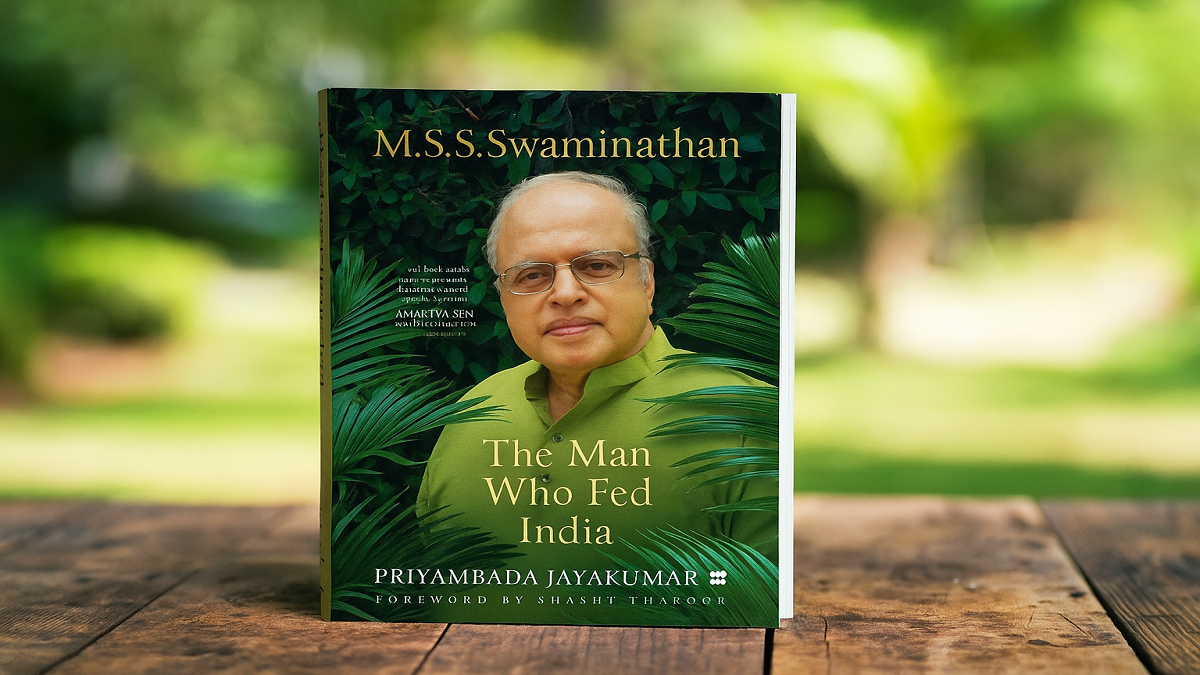
Introduction to the Book
The book M.S. Swaminathan: The Man Who Fed India is a powerful tribute to one of India’s greatest agricultural scientists. Written by Priyambada Jayakumar and published by HarperCollins, it offers a deeply human and inspiring portrait of M.S. Swaminathan, the visionary who played a pivotal role in making India self-sufficient in food during the Green Revolution.
The narrative blends history, personal anecdotes, and scientific milestones to show how Swaminathan’s work transformed India from a nation facing acute food shortages to one that could feed its people. The book captures his journey from a young man with dreams to a global agricultural leader whose work saved millions from hunger.
Essence of the Book
The book takes readers through three major phases of Swaminathan’s life, his formative years, his scientific journey, and his role in shaping India’s food security.
Witness to India’s Freedom and Tragedy
In 1947, Swaminathan experienced India’s independence in a memorable way. On his way to Pondicherry to meet Sri Aurobindo, he was caught up in the celebrations at Marina Beach, Madras. There, he heard Jawaharlal Nehru’s “Tryst with Destiny” speech, surrounded by crowds celebrating a free India.
Just a year later, he found himself at Birla House on the tragic day Mahatma Gandhi was assassinated. Attending an all-faith prayer meeting at the last moment, he heard the shocking cry that “Gandhiji has been shot!” This moment left a deep emotional mark on him.
The Call for Agricultural Self-Reliance
In the early days of independence, India faced serious food shortages. Nehru’s famous words, “Everything else can wait but not agriculture”, underlined the urgency of the situation.
In 1948, Nehru visited Indian Agricultural Research Institute (IARI), where Swaminathan was a postgraduate student, to discuss ways to increase food production. Many experts had ideas — from better crop varieties to pest control, fertilizer use, and rat control, but the real problem was lack of coordination between different agricultural disciplines.
This discussion planted the seeds for an interdisciplinary approach, which decades later would lead to the Green Revolution, a movement Swaminathan would spearhead.
Choosing Science Over the Civil Service
By 1949, Swaminathan had graduated with distinction in cytogenetics. Pressured by his family, he appeared for the civil services exam and passed on his first try, being selected for the Indian Police Service (IPS). But fate had other plans.
He received a UNESCO fellowship to study plant genetics in Holland. Choosing agricultural science over a secure government job, Swaminathan began a journey that would change the course of India’s farming forever.
About the Author
Priyambada Jayakumar is a writer and researcher known for her engaging storytelling style. In this biography, she combines meticulous research with vivid narration to bring alive the life and times of M.S. Swaminathan. Her work captures not just the scientific achievements of Swaminathan but also his humanity, his values, and his vision for India.
By drawing from personal stories, historical events, and scientific milestones, Priyambada gives readers an intimate look at how one man’s dedication and vision helped feed a nation and inspire future generations.


 Sudha Murty Book 'Tides of Time' Highlig...
 CM Bhupendra Patel Releases Gujarati Bio...
 VP C. P. Radhakrishnan Unveils 'Atal Bih...











