
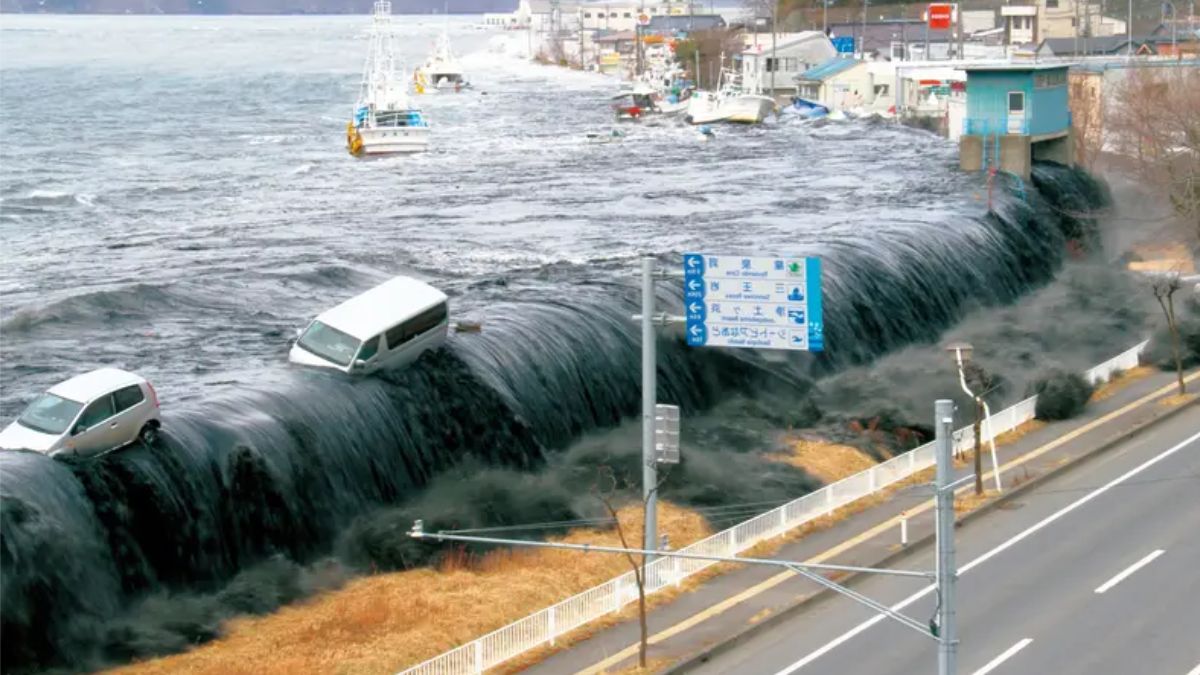
A powerful earthquake measuring 8.7 magnitude struck off Russia’s Kamchatka Peninsula early 30th July (Wednesday), sending shockwaves across the Pacific and prompting widespread tsunami warnings in Japan, Alaska, Hawaii, and several Pacific nations. Authorities ordered evacuations in parts of Russia and Japan, while the US Tsunami Warning Center issued alerts for coastal areas in the US West Coast. While no major casualties have been reported so far, officials confirmed minor injuries and property damage, raising concerns in vulnerable coastal regions.
Epicentre and Scale of the Quake
The US Geological Survey (USGS) initially measured the quake at 8.0, later upgrading it to 8.7, making it one of the strongest earthquakes in decades in the region.
- Depth: 19.3 km (shallow, increasing tsunami risk)
- Location: Around 125 km southeast of Petropavlovsk-Kamchatsky, a city of 165,000 people on Avacha Bay
- Governor Vladimir Solodov called it the “strongest in decades”
- Local officials reported damage to buildings, including a kindergarten, but no large-scale destruction.
Tsunami Impact in Kamchatka
The Russian Ministry for Emergency Situations confirmed tsunami waves measuring 3 to 4 metres in parts of the Kamchatka region. “Stay away from the coastline in tsunami-prone areas and follow announcements on loudspeakers. Authorities in Severo-Kurilsk ordered immediate evacuations after warnings of potential high waves. Emergency services also reported ongoing aftershocks, though stronger tremors are not expected.
Tsunami Alerts Across the Pacific
The quake triggered a chain reaction of tsunami warnings in multiple countries,
Japan
- Japan Meteorological Agency issued a tsunami advisory for its Pacific coastline.
- Predicted wave heights: up to 1 metre.
- Quake mildly felt in Hokkaido, but no reported damages.
United States (Alaska & Hawaii)
- US Tsunami Warning System warned of hazardous waves.
- Parts of the Aleutian Islands placed under immediate warning.
- Watches extended to California, Oregon, Washington, and Hawaii.
New Zealand
- Civil Defence advised citizens to stay away from beaches, warning of strong and unusual currents.
Other Pacific Nations
- South Korea, North Korea, Taiwan: wave heights below 0.3 metres.
- Philippines, Marshall Islands, Palau: 0.3–1 metre waves.
- Guam, Hawaii, parts of Japan: 1–3 metre waves.
- Northwestern Hawaiian Islands & Russian coast: waves exceeding 3 metres.
- Seismologists warned that shallow epicentres like this one increase the risk of far-reaching tsunamis, even at distant shorelines.
Injuries and Local Response
- While no deaths have been reported, Oleg Melnikov, Kamchatka’s health minister, confirmed some minor injuries.
- Some people were hurt while running outside.
- One patient was injured after jumping from a window.
- Another was injured inside a new airport terminal.
- All injured are reported to be in satisfactory condition.
Historical Context of Kamchatka’s Seismic Activity
- Kamchatka lies in the Pacific Ring of Fire, one of the world’s most active seismic and volcanic zones.
- Earlier in July 2025, the region experienced five significant quakes, the strongest at 7.4 magnitude.
- On November 4, 1952, a 9.0 magnitude earthquake off Kamchatka triggered 9.1-metre waves in Hawaii. Despite the destruction, no fatalities were reported.
- This history underscores the region’s vulnerability and the constant threat of massive earthquakes and tsunamis.


 Newcastle Disease Spread in Europe 2026:...
 Mongolia Gets New Prime Minister Amid Po...
 Myanmar Military Chief Min Aung Hlaing B...











