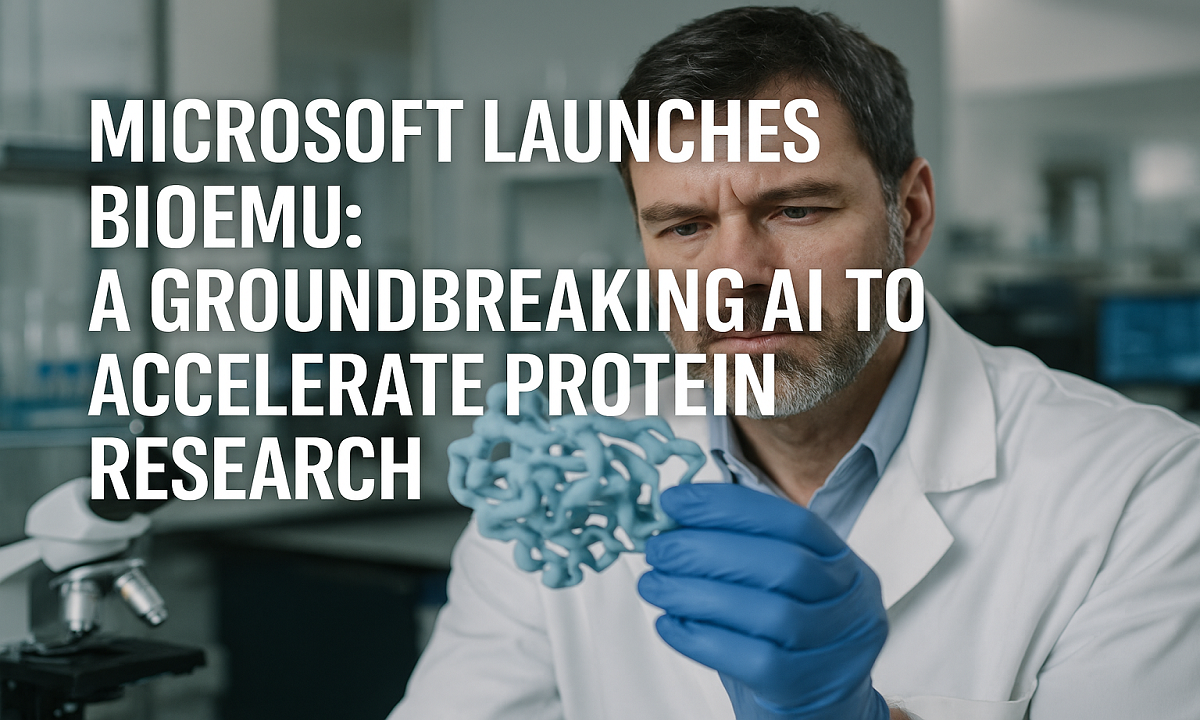
In a major scientific and technological breakthrough, Microsoft has launched BioEmu, a powerful AI-based system designed to revolutionize how we study proteins — the tiny building blocks that drive every process in the human body. Announced by Microsoft Chairman and CEO Satya Nadella, BioEmu aims to speed up what used to be a slow, complex, and expensive process of understanding protein movement and behavior.
Nadella described it as a tool that delivers insights in hours instead of the years of computer simulation previously required.
Why Are Proteins So Important?
Proteins are essential molecules that carry out almost every function inside living organisms. From repairing tissues to digesting food and defending against viruses, proteins are involved in it all. What makes them tricky to study is that they are not static — they constantly change shape and move, a process scientists call “conformational changes.”
Understanding these shifts in structure is critical to:
- Learning how diseases form
- Designing new drugs
- Advancing genetic and synthetic biology
But until now, studying these movements has been extremely time-consuming and required supercomputers and expensive simulations.
What Is BioEmu and What Does It Do?
Developed by Microsoft Research’s AI for Science team, BioEmu is an AI system built to simulate how proteins move and behave inside the human body. It can predict protein structures, how they shift over time, and even identify hidden features within them — something that traditional methods often miss.
What Makes BioEmu Unique?
-
It uses deep learning models trained on massive datasets including:
- Over 200 milliseconds of molecular dynamics simulations
- More than 500,000 protein stability experiments
- Vast amounts of 3D structural data
-
Instead of taking years, BioEmu can generate these predictions in just a few hours.
-
It’s capable of detecting “cryptic binding pockets” — hidden parts of proteins that could become new drug targets.
These features make BioEmu vastly faster and more efficient than traditional methods.
How Accurate Is BioEmu?
According to Microsoft Research, BioEmu version 1.1 can closely match real-world experimental results:
- Its prediction error is less than 1 kcal/mol, which means it’s incredibly precise.
- It shows strong correlation scores above 0.6 when tested against large datasets of protein behavior.
This level of accuracy proves that BioEmu isn’t just fast — it’s also reliable and scientifically valid.
What Problems Does It Solve?
Traditionally, understanding how a single protein behaves could take months or even years of using powerful GPUs (graphics processing units) to run molecular dynamics simulations. These simulations are complex because they need to calculate how every atom moves over time.
BioEmu eliminates this bottleneck by predicting the entire range of movements a protein can take — called a “structural ensemble” — without the need for such long simulations.
It can even capture large domain shifts, local unfolding, and other complex movements that are often key to a protein’s function in disease or healing.
Impact on Drug Development and Medical Research
One of the most exciting uses of BioEmu is in drug discovery. Many drugs work by attaching to proteins and changing their behavior. But if we don’t fully understand how a protein changes shape, it’s hard to make a drug that fits perfectly.
BioEmu helps solve this problem by:
- Revealing new drug-binding sites
- Helping design better-targeted therapies
- Speeding up the early stages of medical research and development
This means that scientists can go from idea to testing in a fraction of the time, potentially speeding up how quickly new treatments reach the public.
A Tool for the Future of Science
BioEmu isn’t just useful in healthcare. It also opens doors in fields like:
- Synthetic biology (designing new proteins from scratch)
- Genetics and DNA engineering
- Basic biological research in universities and labs
Because BioEmu is based on generative AI, it can imagine a wide range of possible protein behaviors and predict unseen possibilities, just like AI can generate text or images.
Its speed and intelligence are expected to redefine what’s possible in life sciences.
Published and Peer-Reviewed
The science behind BioEmu has already been peer-reviewed and published in the prestigious journal Science, showing that the technology has passed rigorous checks from experts in the field. This confirms that BioEmu isn’t just a tech demo — it’s a scientifically proven tool ready for real-world use.


 Meet MAI-Transcribe-1: Microsoft’s Fast,...
 What is Outer Space Treaty 1967? Princip...
 What Is Mission Mitra? ISRO’s New Experi...