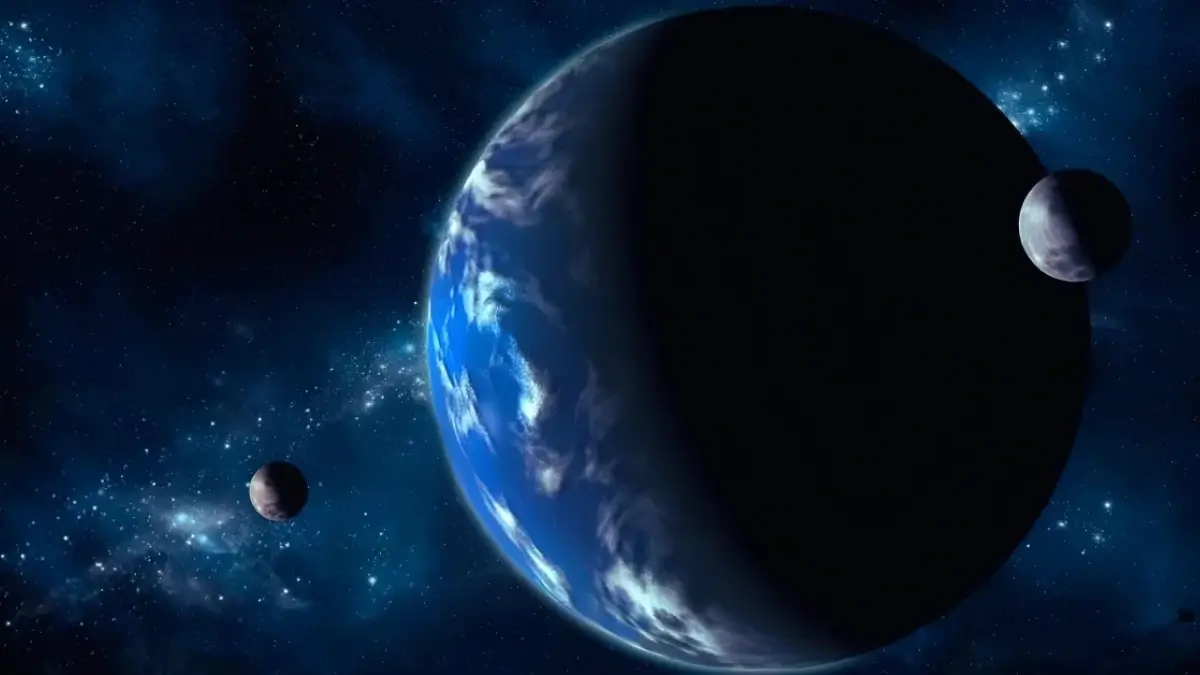
Earth has a new space companion — a small asteroid named 2025 PN7, recently confirmed by NASA. Though it’s not a real moon, it travels around the Sun in almost the same orbit as Earth, making it look like it’s following our planet through space.
This “quasi-moon”, first discovered by astronomers at the University of Hawaii, is estimated to be 18 to 36 metres wide — about the height of a small building. While tiny by space standards, its discovery is fascinating for scientists studying how asteroids move near Earth.
What makes 2025 PN7 Special?
The asteroid 2025 PN7 is not directly orbiting Earth like our natural moon. Instead, it travels around the Sun on a path that nearly matches Earth’s. This unique movement makes it appear as if it’s staying close to us, even though it’s actually an independent traveler in space.
NASA scientists describe it as being like “a friendly runner keeping pace on the same track — close enough to notice but never touching.”
Researchers believe 2025 PN7 has been moving near Earth’s orbit for almost 60 years, and it may continue to do so until around 2083, before eventually drifting away into deep space.
How close Is it to Earth?
At its closest point, the asteroid comes within about 4 million kilometres of Earth — nearly 10 times farther than our moon. At its farthest, it moves out to 17 million kilometres, depending on how the Sun’s and planets’ gravity affect its orbit.
This makes 2025 PN7 a safe visitor — it poses no danger to Earth, as it stays far outside our atmosphere and cannot collide with our planet.
Discovery of the Quasi-Moon
Astronomers at the University of Hawaii first noticed the object during a routine sky survey in 2025. It appeared as a small, faint dot slowly moving against the background of stars.
After weeks of observation and orbital analysis, NASA confirmed that the asteroid’s path was nearly identical to Earth’s, officially classifying it as a quasi-moon — a rare type of object that temporarily shares our planet’s orbit around the Sun.
What is a Quasi-Moon?
A quasi-moon (or quasi-satellite) is a small celestial body that:
- Orbits the Sun, not Earth.
- Follows a path very similar to Earth’s orbit.
- Appears to “follow” or “shadow” Earth through space.
- Is not gravitationally bound to our planet, unlike the real Moon.
These orbits are temporary. Eventually, gravitational forces from the Sun or other planets pull the asteroid away, ending its close companionship with Earth.
Why Scientists Study Quasi-Moons?
Quasi-moons like 2025 PN7 are rare — NASA has confirmed only eight such objects so far. Studying them helps scientists understand more about:
- How asteroids move and interact with Earth’s gravity.
- Orbital mechanics in the solar system.
- Potential space mission targets, since quasi-moons are easier to reach than other distant asteroids.
Researchers believe that these small companions could serve as testing grounds for future spacecraft, helping develop technology for asteroid mining or deep-space exploration.
A Rare but Harmless Visitor
Although 2025 PN7 won’t stay forever, it gives scientists a unique opportunity to observe a natural phenomenon that doesn’t happen often. Its presence reminds us that Earth’s neighborhood in space is active and constantly changing.
The asteroid’s long stay — possibly lasting until 2083 — will allow astronomers to study it closely for decades, helping them learn more about how our planet interacts with the solar system around it.


 How many Nuclear Power Plants in India? ...
 India's First Quantum Computer to be Lau...
 List of Important Days in April 2026, Na...