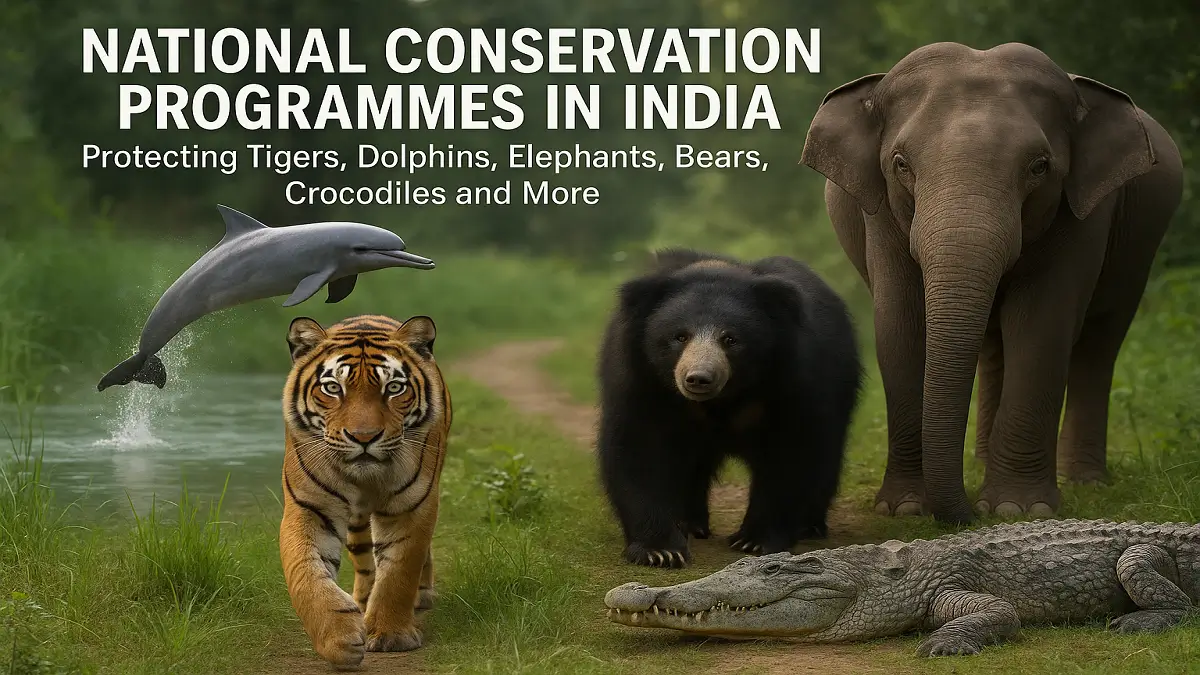
India hosts nearly 8% of the world’s biodiversity, making conservation crucial for ecological balance and national heritage. To prevent extinction of threatened species, the government launched several dedicated conservation programmes. These are widely asked in competitive exams, especially in Environment, Current Affairs and GS topics.
National Conservation Programmes in India: Protecting Tigers, Dolphins, Elephants, Bears, Crocodiles and More
| Project / Programme | Year Launched | Target Species | Key Regions / States | Main Objectives / Highlights |
|---|---|---|---|---|
| Project Tiger | 1973 | Bengal Tiger | Across India (50+ Tiger Reserves) | Habitat protection, anti-poaching, population recovery under NTCA |
| Project Elephant | 1992 | Asian Elephant | Assam, Kerala, Karnataka, Tamil Nadu, Odisha | Reduce conflict, secure corridors, census and monitoring |
| Asiatic Lion Conservation Programme / Lion Landscape Development | 1972 onward | Asiatic Lion | Gir Forest, Gujarat | Expanding habitat, reducing genetic risks and conflict |
| Project Dolphin | 2020 | Ganges River Dolphin & Indian Ocean Humpback Dolphin | River Ganga, Brahmaputra & coastal areas | Habitat protection, clean rivers, awareness and research |
| Project Crocodile | 1975 | Gharial, Mugger & Saltwater Crocodile | Chambal, Odisha, Gujarat | Captive breeding, release programmes, wetland protection |
| Project Gharial | 2008 | Gharial (Critically Endangered) | Chambal, Son, Gandak Rivers | Species restoration, breeding and monitoring |
| Project Snow Leopard | 2009 | Snow Leopard | Himalayan States (J&K, HP, Uttarakhand, Arunachal, Sikkim) | Climate-sensitive conservation and community inclusion |
| Project Hangul | — | Kashmir Stag / Hangul Deer | Jammu & Kashmir | Focused protection in Dachigam National Park |
| Project Sloth Bear | 2009–10 | Sloth Bear | MP, Odisha, Karnataka, Chhattisgarh, Gujarat | Conflict mitigation, corridor safety and tracking |
| Project Great Indian Bustard | — | Great Indian Bustard | Rajasthan, Gujarat | Breeding centres, habitat restoration, saving grasslands |
| Project Red Panda | — | Red Panda | Sikkim, Arunachal Pradesh | Habitat recovery, monitoring, breeding |
| Project Blackbuck | — | Blackbuck | Gujarat, Rajasthan, Odisha | Grassland management, translocation and patrolling |
| Project Vulture | 2006–07 | Indian Vultures (several species) | UP, Haryana, Assam, MP | Ban on diclofenac, breeding facilities, awareness |
| Rhino Vision 2020 / Assam Rhino Programme | 2005 | One-Horned Rhino | Kaziranga, Pobitora, Orang (Assam) | Translocation, anti-poaching and habitat strengthening |
Project Tiger: A Landmark Initiative
Launched in 1973, Project Tiger is one of India’s most successful wildlife protection programmes. It began with nine tiger reserves and now covers over 50 reserves across India.
Objectives of Project Tiger
-
Increase tiger population
-
Protect forest habitats
-
Reduce poaching
-
Support community participation in conservation
Thanks to this initiative, India now hosts more than 75% of the world’s tigers, making it a global leader in wildlife conservation.
Tigers in India: A Success Story
India is home to the Royal Bengal Tiger, an iconic species known for strength and beauty. According to the latest estimation reports, tiger numbers in India have grown significantly due to strict protection measures and habitat restoration.
Many tiger reserves like Ranthambore, Sundarbans, Jim Corbett, and Bandhavgarh attract global wildlife lovers, creating eco-tourism jobs for local communities.
Project Lion / Asiatic Lion Conservation (1972 onward)
Although not officially called “Project Lion”, the Asiatic Lion Conservation Programme is centred in Gir, Gujarat.
Highlights
- India hosts the only wild population of Asiatic Lions.
- Focus on habitat expansion and reducing genetic bottleneck risk.
- The Lion Landscape Development Project is strengthening this effort.
Project Dolphin (2020)
A recent initiative announced in 2020.
Coverage
- Ganges River Dolphin
- Indian Ocean Humpback Dolphin
It focuses on clean rivers, anti-poaching, community engagement and ecosystem restoration.
Dolphins: India’s Friendly Water Mammals
India is home to the Ganges River Dolphin, declared the National Aquatic Animal of India in 2009.
To protect dolphins, the government launched ‘Project Dolphin’ in 2020, focusing on:
- Cleaning river habitats
- Monitoring dolphin populations
- Protecting breeding grounds
Dolphins play a key role in maintaining river health, making their conservation vital.
Project Crocodile (1975)
Project Crocodile began in 1975 to protect three crocodilian species:
- Gharial
- Mugger Crocodile
- Saltwater Crocodile
Key Measures
- Captive breeding and release
- Establishment of National Chambal Sanctuary
- Wetland protection
Project Gharial (2008)
Launched specifically for the critically endangered Gharial, strengthening earlier crocodile efforts.
Focus Areas
- Monitoring nests and riverbanks
- Captive breeding
- Release in Chambal, Son, Gandak and Girwa Rivers
Project Snow Leopard (2009)
Started in 2009 to protect the elusive snow leopard in Himalayan states:
- Jammu & Kashmir
- Himachal Pradesh
- Uttarakhand
- Arunachal Pradesh
- Sikkim
It involves community-based conservation and climate-sensitive research.
Project Hangul (Kashmir Stag Conservation)
A programme focused on the endangered Hangul deer of the Kashmir Valley.
Concerns
- Habitat loss
- Predation and small population size
Conservation is concentrated inside Dachigam National Park.
Project Sloth Bear
Started formally around 2009–10.
Aim
- Protect vulnerable sloth bear habitats
- Reduce human–bear conflict
- Monitor populations in forests of Madhya Pradesh, Chhattisgarh, Odisha, Karnataka and Gujarat
Project Great Indian Bustard
India’s critically endangered grassland bird, protected via:
- Captive breeding in Rajasthan
- Habitat restoration
- Protection from power line collisions
Rajasthan and Gujarat are the main focus.
Project Red Panda
Focused primarily in the Himalayan region of:
- Sikkim
- Arunachal Pradesh
It includes habitat mapping, captive breeding and monitoring.
Project Blackbuck
Conducted mainly in:
- Gujarat
- Rajasthan
- Odisha
Efforts include protected areas, grassland recovery and translocation.
Project Vulture
Started around 2006–2007 after sharp declines due to diclofenac poisoning.
Actions
- Ban on veterinary diclofenac
- Captive breeding centres
- Community education
Project Rhino (Assam Rhino Vision 2020)
Mainly run in Assam, focused on Indian One-Horned Rhino.
Measures
- Protection in Kaziranga, Pobitora and Orang
- Translocation to newer sites
- Anti-poaching squads
Why These Projects Matter
These initiatives:
- Protect endangered species
- Restore ecological balance
- Provide livelihoods through eco-tourism
- Strengthen India’s global conservation leadership


 Who Invented the QR Code? Check Here
 Who is known as the Father of Microbiolo...
 Which City is known as the City of Thous...