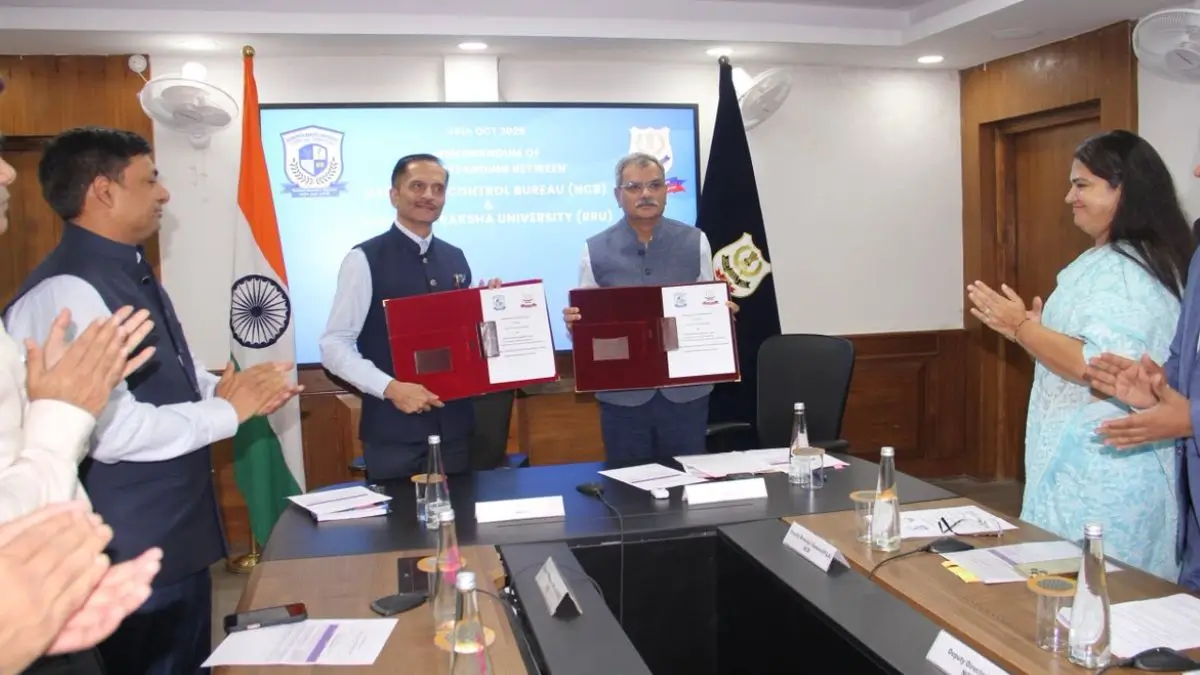
In a major step toward enhancing India’s fight against narcotics and cyber-enabled drug crimes, the Narcotics Control Bureau (NCB) and the Rashtriya Raksha University (RRU) have signed a Memorandum of Understanding (MoU) to collaborate in research, training, and capacity building. The agreement, signed in New Delhi, focuses on integrating academic research, technological innovation, and field-level enforcement to combat the growing threat of drug trafficking through digital and cyber platforms.
Details of the MoU Signing
The MoU was formally signed between Anurag Garg, Director General of NCB, and Prof. Bimal N. Patel, Vice Chancellor of RRU.
The partnership aims to promote cooperation in the fields of,
- Research and innovation in narcotics control
- Training and skill development for NCB officers
- Technology-based solutions to trace drug-related crimes
- Capacity building for cyber-enabled crime prevention
This collaboration marks a new chapter in building a data-driven and knowledge-based enforcement system for narcotics control in India.
Key Focus Areas of Collaboration
Under the agreement, NCB and RRU will jointly explore emerging and high-risk areas that have become central to modern drug crime investigations.
The collaboration will emphasize,
- Darknet Narcotics Markets: Studying online drug trading platforms to improve surveillance and enforcement.
- Cryptocurrency Tracing: Tracking illegal financial transactions and crypto-based payments used in drug networks.
- Cyber Threat Intelligence: Enhancing real-time data analysis and monitoring capabilities.
- Innovation in Digital Investigation Tools: Developing indigenous software for digital forensics and online investigations.
Training and Capacity Building Initiatives
A major component of this MoU is the joint training of NCB officers in emerging technologies.
The NCB and RRU will organize specialized training programmes in,
- Cyber Forensics and Blockchain Forensics
- Open-Source Intelligence (OSINT)
- Behavioural Profiling of Offenders
- Digital Evidence Collection and Analysis
These programmes will enable law enforcement officers to tackle complex cybercrime cases, especially those involving dark web operations and cryptocurrency-based transactions.
Establishment of Centre of Excellence
Both institutions have also agreed to establish a Centre of Excellence in Cybercrime Investigation and Drug Intelligence.
This centre will serve as a hub for advanced research, innovation, and collaboration between academia and law enforcement agencies. It will facilitate,
- Research on drug trafficking patterns
- Development of AI-based detection tools
- Policy formulation for cyber-enabled narcotics control
- Knowledge sharing among national and international stakeholders
The proposed centre reflects the government’s focus on integrating technology and policy to strengthen India’s internal security framework.
Significance of the MoU
This MoU is a crucial milestone for India’s narcotics control and cybercrime prevention framework. It is expected to,
- Enhance intelligence gathering and data analysis capabilities.
- Promote technology-driven enforcement mechanisms.
- Strengthen inter-agency collaboration between academia and law enforcement.
- Equip officers with advanced digital investigation skills.
- Support policy formulation and legal frameworks for modern narcotics control.
The partnership aligns with the broader goals of the Digital India and Safe and Secure India initiatives, ensuring that the nation’s enforcement mechanisms remain ahead of emerging criminal trends.
Static Facts
- Full Form of NCB: Narcotics Control Bureau
- Full Form of RRU: Rashtriya Raksha University
- MoU Signed On: October 2025
- Signed By: Anurag Garg (DG, NCB) and Prof. Bimal N. Patel (Vice Chancellor, RRU)
- Venue: New Delhi
- Objective: Enhance cooperation in research, training, and capacity building on narcotics and cyber-enabled drug crimes


 IIT Bombay & Honeywell Launch Sustai...
 Indian Army and Ladakh Forest Department...
 India and Sweden Deepen AI Partnership T...