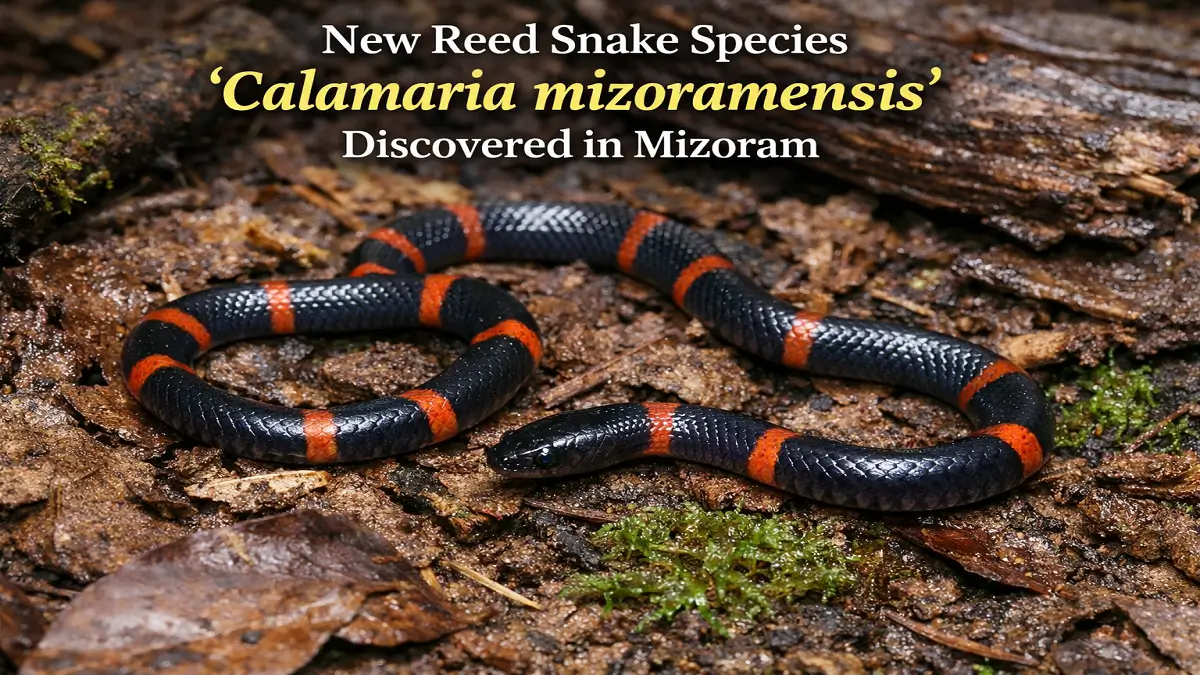
In January 2026, the world of herpetology witnessed a significant breakthrough as scientists from Mizoram University, collaborating with international researchers from Russia, Germany, and Vietnam, unveiled a previously unknown reed snake species. Named Calamaria mizoramensis, this discovery represents a major addition to India’s reptilian biodiversity and has been formally documented in the prestigious international scientific journal Zootaxa. This groundbreaking finding is crucial for competitive exam aspirants studying Indian fauna, biodiversity, and environmental science.
Key Facts for Competitive Exams: Quick Reference Guide
- What: New reed snake species discovered in Mizoram
- Scientific Name: Calamaria mizoramensis
- Location: Mizoram, India
- Published In: Zootaxa (International scientific journal)
- Conservation Status: Least Concern (IUCN – tentative assessment)
- Global Impact: Brings total Calamaria species count to 70 worldwide
- National Significance: Adds to India’s reptile species diversity
- State Update: Updates Mizoram’s herpetofauna to 169 species
How Was the Species Identified and Discovered?
The discovery of Calamaria mizoramensis came through meticulous scientific investigation that corrected a long-standing taxonomic misidentification. Specimens of this species were first collected in 2008, but were initially misclassified as representatives of a widely distributed Southeast Asian species. Through detailed morphological examinations and comprehensive DNA analysis, researchers confirmed that the Mizoram population represents a distinct evolutionary lineage. Genetic comparisons revealed that the Mizoram reed snake differs by over 15 percent from its closest known relatives—a level of divergence scientifically recognized as sufficient to establish a new species. This correction represents a triumph of modern molecular biology in wildlife classification.
Physical Characteristics and Identification Features
Calamaria mizoramensis possesses distinctive morphological features that make it identifiable among other reptile species. The snake exhibits small body size with dark brown to blackish coloration featuring faint stripes running along its body. The underside or ventral surface displays a contrasting yellow color, providing a clear identification marker. As a non-venomous species, it poses no threat to humans and is therefore safe for both research and incidental encounters in its natural habitat.
Behavioral Traits and Lifestyle
Understanding the behavioral characteristics of Calamaria mizoramensis is essential for ecology and animal behavior studies. The species is primarily nocturnal, meaning it is active during nighttime hours and remains concealed during daylight. Additionally, it is classified as semi-fossorial, indicating it spends considerable time burrowing in soil and leaf litter. These behavioral adaptations enable the snake to thrive in its specialized microhabitat and avoid predators while hunting for small invertebrate prey.
Habitat and Geographic Distribution
Calamaria mizoramensis exhibits a preference for specific environmental conditions that reflect its specialized ecological niche. The species inhabits humid, forested hill regions, thriving in areas with dense vegetation and high moisture levels. Elevations form a critical factor in its distribution, with confirmed presence between 670 and 1,295 meters above sea level. This altitudinal range indicates the species’ adaptation to montane forest ecosystems typical of Northeast India’s geography.
The species has been confirmed in multiple locations throughout Mizoram, including:
- Aizawl (State capital and largest city)
- Reiek
- Sihphir
- Sawlêng
- Mamit
- Kolasib
These confirmed localities span various districts of Mizoram, suggesting the species may have a broader distribution across the state than initially documented.
Potential Geographic Range Beyond Mizoram
Scientists studying Calamaria mizoramensis indicate that its presence is not necessarily restricted to Mizoram’s borders. The species’ occurrence in neighboring regions cannot be ruled out, particularly in states such as Manipur, Nagaland, and Assam. Additionally, extension of its natural range into Bangladesh’s Chittagong region remains a possibility that requires further investigation. This transboundary distribution pattern is common among forest-dependent species in the Northeast Indian biodiversity hotspot.
Conservation Status and IUCN Assessment
The International Union for Conservation of Nature (IUCN) has tentatively assigned Calamaria mizoramensis a conservation status of Least Concern. This classification reflects the species’ occurrence across multiple localities within Mizoram, indicating a reasonably distributed population that currently faces no immediate extinction threat. However, the “tentative” nature of this assessment suggests that further research and monitoring are necessary to confirm its long-term population viability and conservation needs.
Significance for India’s Biodiversity and Herpetofauna
This discovery carries profound implications for understanding India’s reptilian biodiversity. The addition of Calamaria mizoramensis to India’s species list contributes to a more complete inventory of the nation’s wildlife heritage. On a global scale, the identification of this new species brings the total count of recognized Calamaria species to 70 species worldwide, underscoring the genus’s diversity in tropical and subtropical regions.
For the state of Mizoram specifically, this discovery updates the region’s herpetofauna count to 169 species, making it one of India’s hotspots for reptile diversity. Mizoram’s rich reptilian fauna reflects its varied topography, humid climate, and extensive forest cover, making it an ideal location for herpetological research.
Collaborative Research Excellence: International Scientific Cooperation
The discovery of Calamaria mizoramensis exemplifies the importance of international scientific collaboration in biodiversity research. The research team comprising scientists from Mizoram University, Russia, Germany, and Vietnam brought together diverse expertise in taxonomy, molecular biology, and field herpetology. This collaborative approach, with findings published in the prestigious international journal Zootaxa, ensures that the discovery receives peer review from leading herpetologists worldwide and contributes to global scientific knowledge.
Exam-Focused Summary: Key Takeaways
For competitive exam preparation, focus on these essential points:
- Discovery Date: January 2026
- Lead Institution: Mizoram University
- Species Name: Calamaria mizoramensis (new species, genus Calamaria, family Calamariidae)
- Key Identifier: Corrected 2008 misidentification; 15% genetic difference from closest relatives
- Physical Features: Small, dark brown-blackish with faint stripes, yellow underside, non-venomous
- Behavioral Traits: Nocturnal and semi-fossorial
- Habitat Type: Humid, forested hill regions
- Elevation Range: 670-1,295 meters above sea level
- Confirmed Locations: Six Mizoram locations (Aizawl, Reiek, Sihphir, Sawlêng, Mamit, Kolasib)
- Conservation Status: Least Concern (IUCN – tentative)
- Global Significance: 70th Calamaria species worldwide
- National Significance: Adds to India’s reptile count
- Regional Significance: Updates Mizoram’s herpetofauna to 169 species


 Shah Rukh Khan Debuts in Hurun Global Ri...
 A Tribe With No Word for "Time"? Inside ...
 NIM–JIM&WS Team Successfully Summits...