
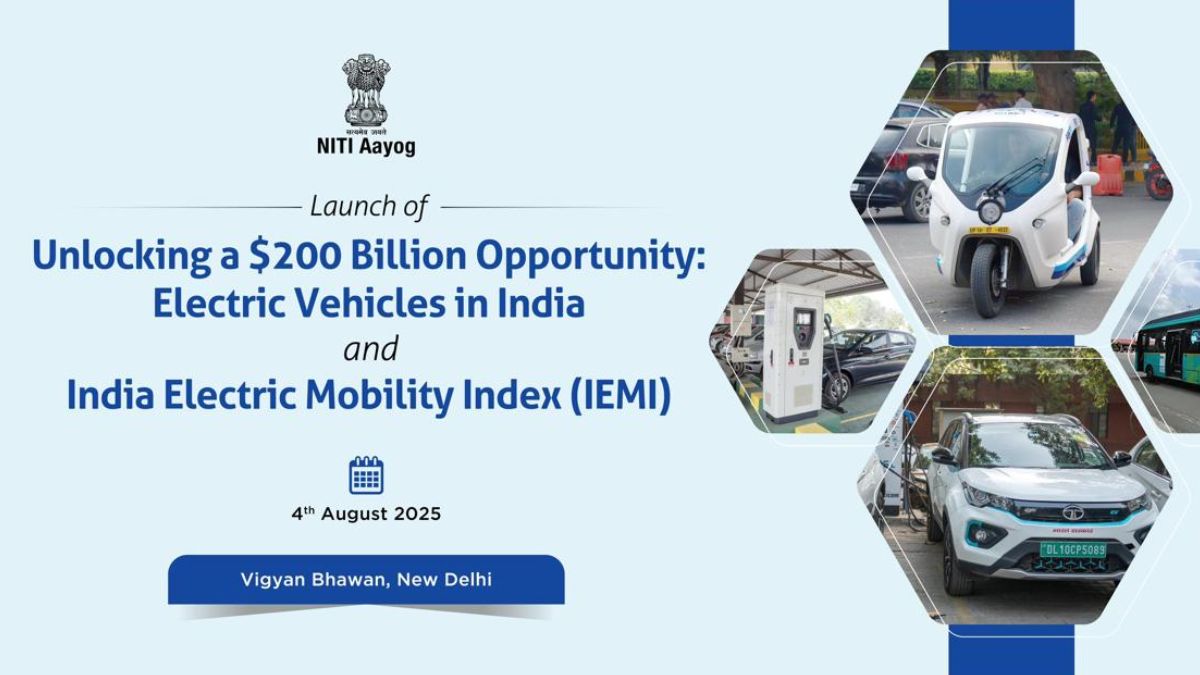
In a significant move towards accelerating India’s clean mobility mission, NITI Aayog has launched a landmark report titled “Unlocking a $200 Billion Opportunity: Electric Vehicles in India.” Released on 4th August 2025 in New Delhi, the report presents a comprehensive roadmap for enhancing India’s Electric Vehicle (EV) transition. It highlights the current progress, identifies challenges, and provides strategic recommendations to position India as a global leader in the EV sector.
Report Launch and Key Dignitaries
The report was officially released by Shri Rajiv Gauba, Member, NITI Aayog, in the presence of several prominent leaders,
- Shri B.V.R. Subrahmanyam, CEO, NITI Aayog
- Shri Kamran Rizvi, Secretary, Ministry of Heavy Industries
- Shri O.P. Agarwal, Distinguished Fellow, NITI Aayog
- Shri Sudhendu Sinha, Programme Director – E-Mobility, NITI Aayog
Their participation reflected the government’s high-level commitment to shaping India’s EV ecosystem into a robust and sustainable sector.
India’s Ambitious EV Goals
India has set a target of achieving 30% EV sales by 2030 across all vehicle categories. The journey so far indicates steady progress,
- EV sales in India rose from 50,000 in 2016 to 2.08 million in 2024.
- Global EV sales grew from 918,000 in 2016 to 18.78 million in 2024.
- While India’s EV penetration in 2020 was only one-fifth of the global level, it improved to over two-fifth in 2024, signaling accelerating growth.
- However, the report emphasizes that India’s transition, though improving, remains slower compared to global benchmarks. Stronger measures are required to push adoption, improve infrastructure, and boost consumer confidence.
Development of the Report
The report is the result of extensive stakeholder consultations organized by NITI Aayog through seven dedicated convenings. These consultations brought together experts from the government, industry, and research sectors to identify key obstacles and devise solutions. The report stands out for being a blueprint for India’s EV future, offering a structured plan to achieve both economic growth and environmental sustainability.
Key Focus of the Report
The report identifies barriers, unlocks, and actionable recommendations that can transform India’s EV sector. Its primary objectives include, Highlighting current challenges in EV adoption such as high costs, limited charging infrastructure, and supply chain issues. Providing strategic unlocks to address these barriers, including incentives for manufacturers and consumers, investments in charging networks, and support for battery production. Promoting data-driven decision-making to ensure policies are aligned with market needs. Strengthening cross-sector collaboration among government, private industry, and technology partners for a unified national effort.


 UV Index Explained: The Hidden Health Ri...
 QS World University Rankings 2026: India...
 Best Airlines in the World 2026: Best Fu...











