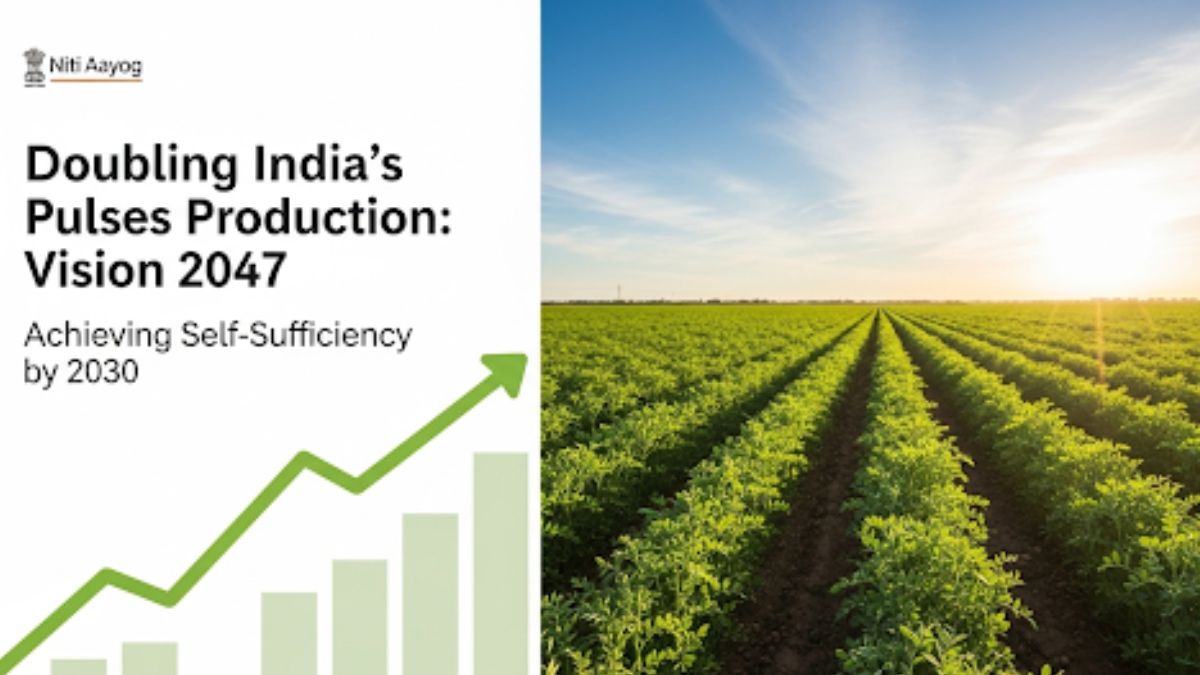
In a major step toward agricultural self-reliance, Niti Aayog has released a comprehensive strategy to make India self-sufficient in pulses by 2030 and double its production by 2047. The report outlines a roadmap that integrates technological, ecological, and socio-economic interventions, aiming to transform the pulses sector into a pillar of India’s food and nutritional security.
Currently producing 26.06 million tonnes (MT) of pulses (as of 2022), India is projected to increase production to 34.45 MT by 2030 and further to 51.57 MT by 2047, marking a potential surplus scenario in the coming decades.
The Strategic Targets
Niti Aayog’s vision is anchored around two major targets,
- Achieve self-sufficiency in pulses by 2030
- Double national pulses production by 2047
The projections have been carefully estimated using both aggregate and crop-specific models, providing production estimates of 32.1 MT by 2030 and 50.7 MT by 2047—closely aligning with the national production targets.
Key Recommendations in the Report
1. Cluster-Based Cultivation
A major thrust is on “One Block, One Seed Village” models in 111 high-potential districts, focusing on,
- Crop-specific clustering
- Localized agronomic practices
- Community seed banks and treatment kits
This decentralised approach is expected to increase seed quality, production efficiency, and farmer participation.
2. Technology Adoption Across Agro-Ecological Zones
Niti Aayog recommends tailored technological packages suited to diverse agro-climatic regions, enabling farmers to,
- Use region-specific high-yielding varieties
- Access precision farming tools
- Implement best irrigation and soil health practices
3. Climate-Smart Agriculture
To mitigate risks from climate change, the report urges,
- Adoption of drought-resistant pulse varieties
- Integrated pest and disease management
- Contingency cropping strategies
These measures aim to sustain yields in climate-stressed regions, ensuring long-term resilience.
4. Data-Led Decision Making
The creation of a decision support system using real-time data, satellite imagery, and AI is advised to,
- Track productivity
- Forecast shortages
- Inform policy in dynamic agro-markets
Demand-Supply Analysis and Future Surplus
According to the report’s demand-supply analysis,
Supply (adjusted for seed, feed, wastage) will reach,
- 30.6 MT by 2030
- 45.8 MT by 2047
Demand Projections based on ICMR-NIN nutrition guidelines suggest,
- A surplus of 3.79 MT by 2030
- A surplus of 16.48 MT by 2047
This potential surplus could position India as a global player in pulses exports, reducing reliance on imports and boosting farmer incomes.
Promoting Healthy Pulse Consumption
Niti Aayog also emphasizes the nutritional importance of pulses in Indian diets, urging,
- Awareness campaigns aligned with ICMR guidelines
- School meal and public distribution inclusion
- Efforts to overcome regional consumer biases against pulses
By improving domestic demand quality, India can ensure a balanced and nutritious food system while supporting its agricultural sector.
Key important facts for exam
- Current production: 26.06 MT (2022)
- Target by 2030: 34.45 MT (self-sufficiency)
- Target by 2047: 51.57 MT (doubling)
- Key schemes: One Block One Seed Village, high-quality seeds, climate adaptation
- Projected surplus: 3.79 MT by 2030; 16.48 MT by 2047


 Western Dedicated Freight Corridor Compl...
 ECINet KYC Feature Explained: How Voters...
 BIRAC-BioNEST Incubation Centre Inaugura...