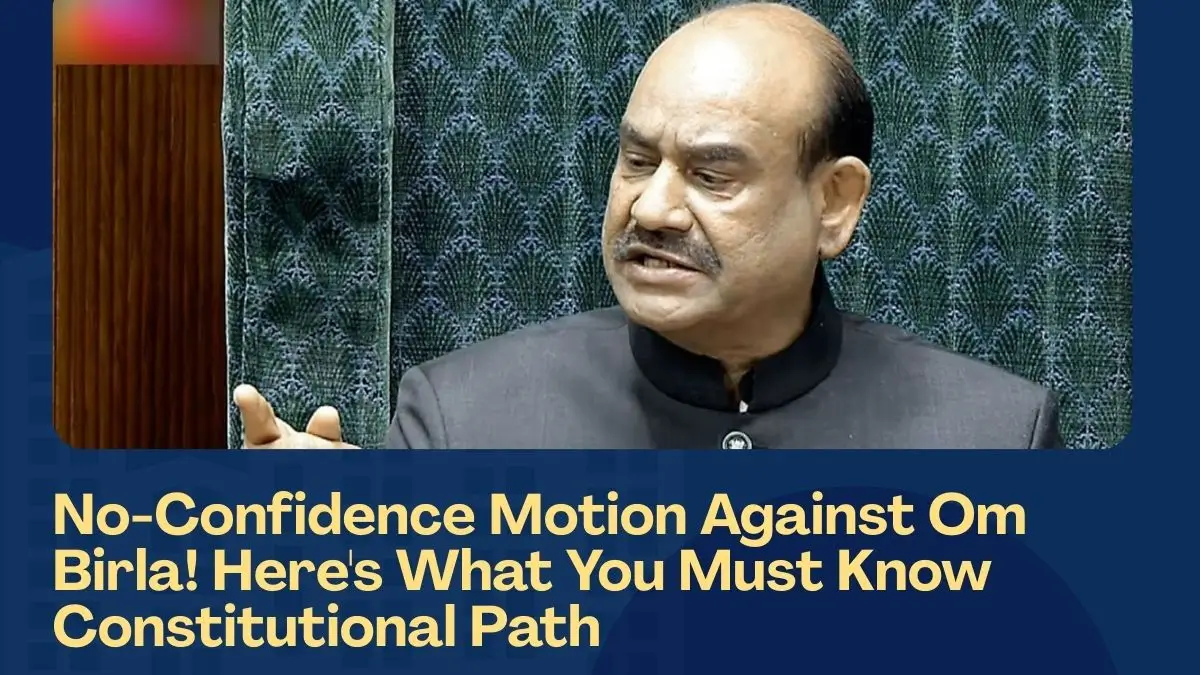
The Opposition has moved a no-confidence motion against Lok Sabha Speaker Om Birla on February 10, 2026. The motion will now be examined and processed according to parliamentary rules. The move comes amid criticism from Opposition parties over decisions taken by the Speaker during proceedings in the House. The Constitution clearly lays down the process for removal of the Lok Sabha Speaker. Unlike a no-confidence motion against the government, this involves a special resolution with strict conditions.
Can the Lok Sabha Speaker Be Removed?
- The removal of the Speaker of the Lok Sabha is provided under Article 94(c) of the Constitution of India.
- According to this provision, the Speaker can be removed by a resolution passed by a majority of all the then members of the House.
- This process applies only to the Lok Sabha and not to the Rajya Sabha.
- The constitutional framework ensures that while the Speaker holds a high constitutional office, they remain accountable to the House.
What Does Article 94 Say?
Article 94 lays down three conditions under which the Speaker vacates office,
- If they cease to be a Member of the Lok Sabha.
- If they resign by writing to the Deputy Speaker.
- If they are removed by a resolution passed by a majority of all the then members of the House.
The key requirement here is an absolute majority, meaning more than half of the total strength of the House at that time.
Step by Step Procedure for Removal
- The removal process follows Rules 200 to 203 of the Rules of Procedure and Conduct of Business in Lok Sabha.
- First, a member must give a written notice to the Secretary-General of the Lok Sabha.
- At least 14 days notice is mandatory before the motion can be taken up.
- After the notice period, the motion is listed for consideration.
- When it is taken up, at least 50 members must rise in support of the motion for it to be admitted.
- If fewer than 50 members support it, the motion fails at the initial stage.
What Happens If the Motion Is Admitted?
If 50 or more members stand in support, the presiding officer grants leave, and the motion is scheduled for discussion within 10 days.
During the discussion,
- Debate is limited strictly to the charges mentioned.
- The member moving the motion may speak for up to 15 minutes.
- The Speaker has the right to participate in the debate.
- The Speaker can vote in the first instance but cannot cast a deciding vote in case of a tie.
- The motion is passed only if it receives a majority of all the then members of the House.
Has This Happened Before?
Yes, no-confidence motions against Lok Sabha Speakers have been moved three times in history,
- 1954 – Against Ganesh Vasudev Mavalankar
- 1966 – Against Hukam Singh
- 1987 – Against Balram Jakhar
However, none of these motions succeeded. No Lok Sabha Speaker has ever been removed through this process.
Role of the Speaker During the Process
If a motion for removal is under consideration, the Speaker does not preside over the sitting. However, they retain the right to,
- Speak during the debate.
- Participate in proceedings.
- Vote in the first instance.
Importantly, even if the Lok Sabha is dissolved, the Speaker continues in office until just before the first meeting of the newly elected House.
Background of Office of the Lok Sabha Speaker
- The Speaker of the Lok Sabha is elected by members of the House and presides over its proceedings.
- The office is central to maintaining order, deciding on points of procedure, and ensuring smooth functioning of legislative business.
- The Speaker is also the final authority in interpreting rules of the House.
Question
Q. Removal of the Lok Sabha Speaker is provided under which Article of the Constitution?
A. Article 75
B. Article 94
C. Article 110
D. Article 123


 Indian Railways New Ticket Cancellation ...
 India Forms 7 Empowered Committees on We...
 PM Modi Addressed Parliament on Middle E...