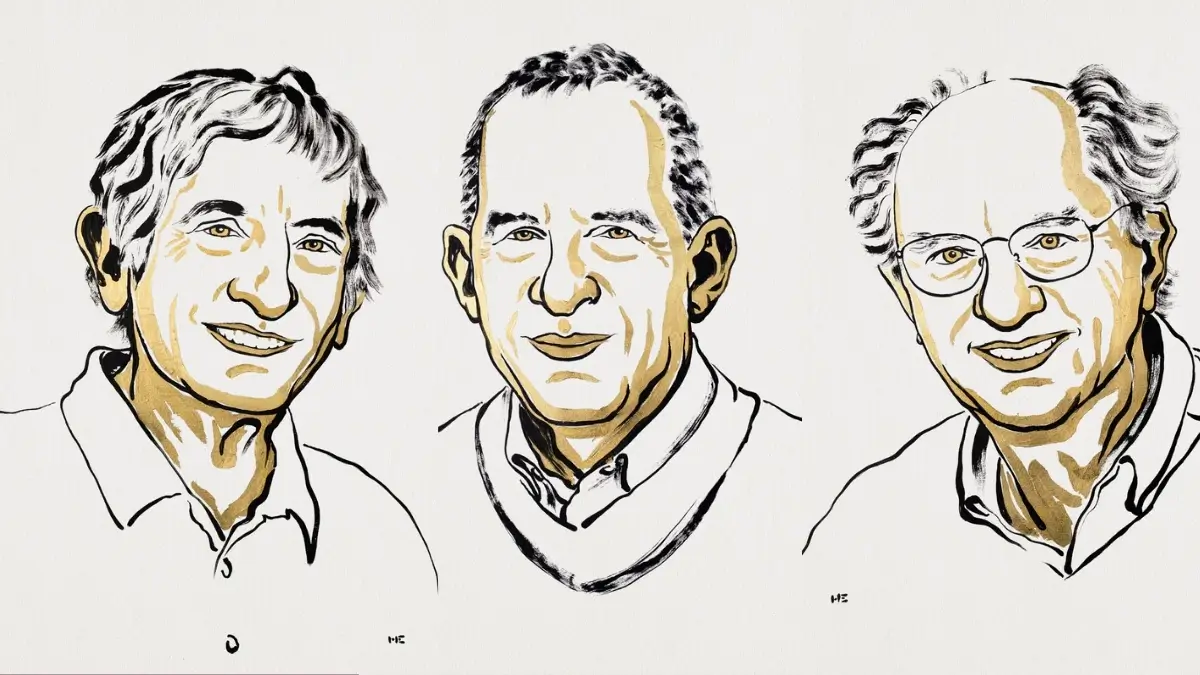
The Nobel Prize in Physics 2025 has been awarded to John Clarke, Michel H. Devoret, and John M. Martinis for their groundbreaking discovery of macroscopic quantum mechanical tunnelling and energy quantisation in an electric circuit. Their work proved that quantum phenomena can occur even in large-scale systems, bridging the gap between the quantum and classical worlds and paving the way for advanced technologies like quantum computing, cryptography, and sensors.
Nobel Laureates and Their Contribution
2025 Nobel Physics Winners
- John Clarke – University of California, Berkeley, USA
- Michel H. Devoret – Yale University, New Haven, CT / University of California, Santa Barbara, USA
- John M. Martinis – University of California, Santa Barbara, USA
Research Topic: “For the discovery of macroscopic quantum mechanical tunnelling and energy quantisation in an electric circuit”
Quantum Physics Made Visible: The Breakthrough
The Central Question: Size and Quantum Behavior
- One of the fundamental questions in modern physics is: How large can a system be and still exhibit quantum mechanical effects?
- Traditionally, quantum behavior is observable only at the atomic or subatomic scale.
- However, the 2025 Nobel laureates shattered this boundary by demonstrating quantum phenomena in a macroscopic electrical circuit, proving that the laws of quantum mechanics apply even to systems visible to the naked eye.
What is Quantum Physics?
- Quantum physics, also known as quantum mechanics, is a fundamental branch of physics that explains the behavior of matter and energy at the smallest scales — such as atoms, electrons, and photons.
- Unlike classical physics, which describes predictable and continuous behavior, quantum physics reveals a world where particles can exist in multiple states at once, move through barriers, and exchange energy in discrete packets (called quanta).
The Josephson Junction Experiment
- The laureates constructed an electronic circuit using superconductors, materials that allow current to flow without electrical resistance.
- These superconductors were separated by a thin non-conductive barrier, forming a Josephson junction — a device known for its quantum properties.
- By precisely controlling and measuring the properties of this circuit, they could observe quantum tunnelling and energy quantisation on a macroscopic scale.
Key Discoveries and Insights
1. Macroscopic Quantum Tunnelling
- In quantum mechanics, particles can “tunnel” through barriers that they classically shouldn’t be able to cross.
- In the laureates’ experiment, the entire superconducting system behaved like a single particle, initially trapped in a zero-voltage state.
- Through quantum tunnelling, it escaped this state — a shift detectable by the appearance of a voltage — proving that tunnelling is possible even in large, collective systems.
2. Energy Quantisation
- Quantum systems absorb or emit discrete amounts of energy, not continuous values.
- The team demonstrated that their macroscopic system followed this rule exactly, behaving in accordance with quantum predictions.
- This finding confirmed that quantum principles govern not just electrons and photons, but even collective states involving billions of particles.
Implications for Quantum Technology
This discovery goes beyond theoretical physics — it has practical implications for emerging technologies,
- Quantum Computing – Enables stable and controllable qubits for faster computation.
- Quantum Cryptography – Paves the way for unbreakable communication systems.
- Quantum Sensors – Offers unprecedented precision in measurement and detection.
“It is wonderful to celebrate how century-old quantum mechanics still offers new surprises,” said Olle Eriksson, Chair of the Nobel Committee for Physics. “This discovery opens doors to a future defined by quantum technology.”
About the Laureates
- John Clarke – Born 1942, Cambridge, UK. PhD (1968), University of Cambridge. Professor, University of California, Berkeley.
- Michel H. Devoret – Born 1953, Paris, France. PhD (1982), Paris-Sud University. Professor, Yale University and UC Santa Barbara.
- John M. Martinis – Born 1958, USA. PhD (1987), University of California, Berkeley. Professor, UC Santa Barbara.


 International Booker Prize 2026 Shortlis...
 19-Year-Old Sheetal Devi Honoured as Wor...
 Ramnath Goenka Awards 2026 Winners List:...