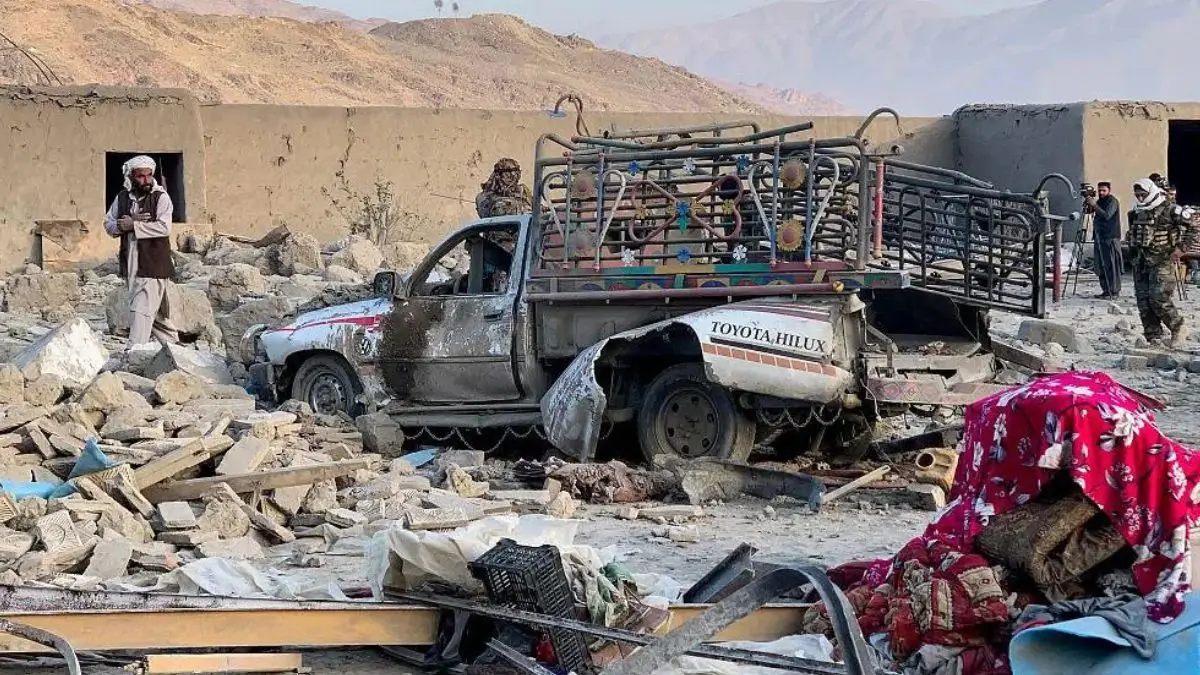
Pakistan has launched a major cross-border military offensive dubbed Operation Ghazab lil-Haq, marking a dramatic escalation in tensions with Afghanistan. The operation began in the early hours of Friday on 26th February 2026 after Islamabad accused the Afghan Taliban of initiating “unprovoked firing” along multiple sectors of the volatile border. Pakistani officials described the move as a decisive response to months of growing hostilities and cross-border militant activity. Airstrikes were reportedly carried out in several Afghan cities, including Kabul, as both nations traded sharp accusations. The development signals one of the most serious confrontations between the two neighbors in recent years.
What Is Operation Ghazab lil-Haq?
Operation Ghazab lil-Haq, which loosely translates to “Wrath for Justice,” is a large-scale military campaign launched by Pakistan against alleged Afghan Taliban positions. According to Pakistan’s information ministry, the operation was initiated after cross-border firing targeted multiple locations in Khyber Pakhtunkhwa’s Chitral, Khyber, Mohmand, Kurram, and Bajaur sectors.
Pakistan’s state broadcaster reported that the armed forces carried out coordinated airstrikes on what it described as key Taliban military installations in Kabul, Kandahar, and Paktia. An ammunition depot in Nangarhar province was also reportedly destroyed during the strikes.
Officials stated that two Pakistani security personnel were killed in the clashes, while 133 Afghan Taliban operatives were claimed to have been neutralized. Independent verification of these figures remains pending.
What Triggered the Latest Pakistan-Afghanistan Conflict?
The latest escalation follows days of cross-border hostilities,
- Pakistan earlier conducted air strikes inside Afghanistan.
- Islamabad claimed the targets were militant camps linked to recent suicide bombings on Pakistani soil.
- Afghan authorities said civilian homes and a religious school were hit, alleging women and children were killed.
- The Taliban announced a “large-scale” retaliatory operation late Thursday (26th February, 2026) night.
Residents in Kabul reported hearing loud explosions, while border communities in Pakistan’s north-west reported heavy exchanges of fire.
Casualties and Conflicting Claims
- Pakistan confirmed that two of its soldiers were killed and three injured during border clashes in Khyber Pakhtunkhwa province.
- Taliban spokesperson Zabihullah Mujahid claimed that numerous Pakistani soldiers were killed and some captured, and that several military posts were seized.
- However, Pakistan’s Prime Minister Shehbaz Sharif’s office denied these claims stating that all aggression would receive an “immediate and effective response.”
- Islamabad also reported heavy casualties on the Afghan side, though independent verification remains limited.
Fragile Ceasefire Under Strain
- The escalation comes despite a fragile ceasefire agreement reached in October following deadly cross-border clashes.
- The Pakistan–Afghanistan border stretches approximately 1,600 miles (2,574 km) across rugged mountainous terrain.
- The region has long been a hotspot for militancy, smuggling, and insurgent movements.
Recent clashes have,
- Forced residents near Torkham border crossing to evacuate.
- Led to temporary suspension of Afghan deportations.
- Closed border crossings to refugees and traders.
The repeated breakdown of ceasefire arrangements underscores the volatility of relations between Islamabad and Kabul.
Strategic and Security Implications
The renewed Pakistan-Afghanistan conflict raises serious regional security concerns.
Pakistan accuses Afghan-based militant groups of launching cross-border attacks. Kabul, on the other hand, alleges repeated violations of Afghan sovereignty by Pakistani forces.
Key implications include,
- Increased instability in border regions.
- Disruption of trade and refugee movement.
- Risk of broader regional escalation.
- Strained diplomatic relations.
Both countries have accused each other of miscalculations and border violations, deepening mistrust.
Historical Context of Border Disputes
- The Pakistan-Afghanistan border, commonly referred to as the Durand Line, has historically been disputed.
- The Taliban government does not formally recognize it as an international boundary.
- Border skirmishes have intensified since the Taliban returned to power in Afghanistan in 2021.
- Pakistan has frequently demanded stronger action against militant groups allegedly operating from Afghan territory.


 Preeti Saran Re-Elected as UN Committee ...
 Global Trade Hits New High in 2025: Key ...
 Iran–US Ceasefire: Iran’s 10 Conditions ...