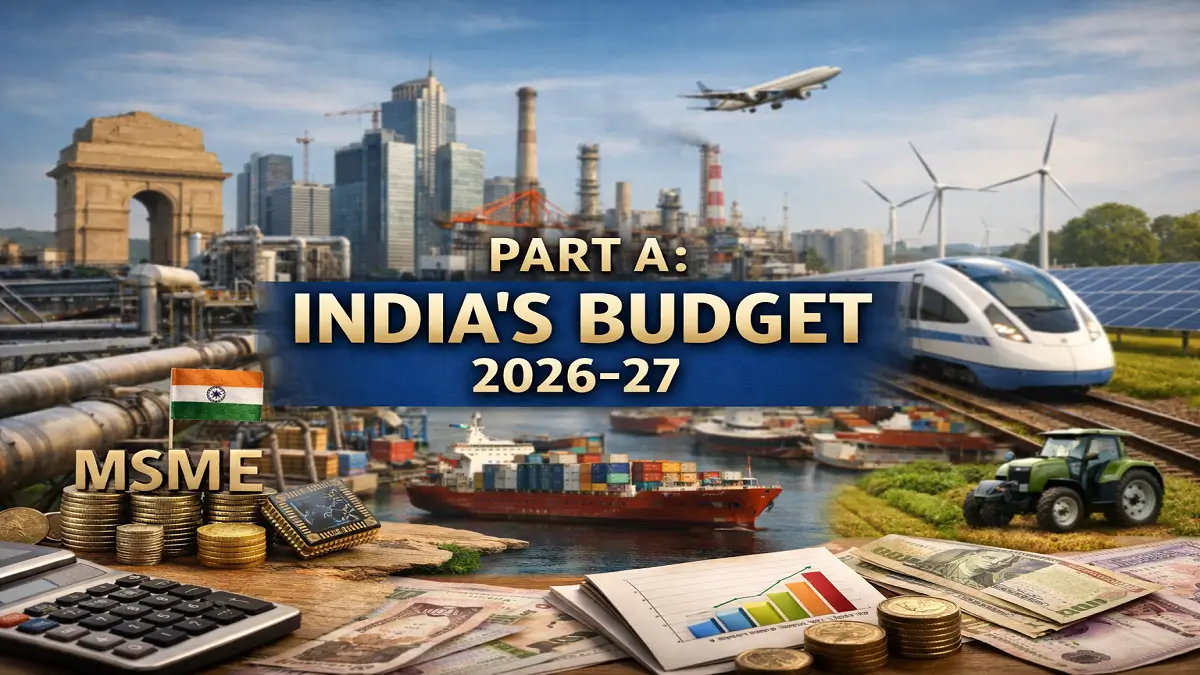
PART A: FOUNDATIONAL VISION
Government’s Core Commitment (Sankalp)
• Transform aspirations into tangible achievements and unlock potential across all sectors • Ensure prosperity dividends reach every stakeholder: farmers, marginalized communities, youth, women, and vulnerable populations • Budget prepared at Kartavya Bhawan—driven by youth ideas from Viksit Bharat Young Leaders Dialogue 2026
Three Pillars of Growth (Kartavya Framework)
Kartavya 1: Accelerate Sustainable Economic Growth
- Enhance productivity and competitiveness across sectors
- Build resilience against volatile global market dynamics
- Maintain structural reforms momentum—continuous, adaptive, and forward-looking
Kartavya 2: Fulfill Aspirations & Build Capacity
- Empower people as strong partners in India’s prosperity journey
- Create meaningful employment and skill development opportunities
- Already lifted 25 crore individuals out of multidimensional poverty
Kartavya 3: Inclusive Development (Sabka Sath, Sabka Vikas)
- Ensure universal access to resources, amenities, and opportunities
- Focus on equitable regional, sectoral, and community development
- Enable meaningful participation across all segments
Supporting Ecosystem Requirements
• Continuous structural economic reforms • Robust, resilient financial sector for capital allocation and risk management • Cutting-edge technologies (AI, automation) as governance force multipliers
REFORM EXPRESS: 350+ ROLLOUTS
Key Achievements Post-Independence Day 2025 Announcement:
- GST simplification framework
- Labour Codes notification and implementation
- Rationalized Quality Control Orders
- Deregulation initiatives via High-Level Committees
- Central-State coordination on compliance reduction
STRATEGIC INTERVENTIONS FOR ECONOMIC GROWTH
1. SCALING UP MANUFACTURING IN 7 STRATEGIC SECTORS
A. Biopharma SHAKTI (Strategy for Healthcare Advancement through Knowledge, Technology, Innovation)
Outlay: ₹10,000 crore (5-year period)
Objective: Position India as global biologic and biosimilar manufacturing hub
Key Components:
- Build domestic ecosystem for biologics and biosimilar production
- Establish 3 new National Institutes of Pharmaceutical Education & Research (NIPER)
- Upgrade 7 existing NIPER institutions
- Create network of 1,000+ accredited clinical trial sites
- Strengthen Central Drugs Standard Control Organisation for global-standard approvals
- Dedicated scientific review cadre and specialist recruitment
Rationale: Rising non-communicable disease burden (diabetes, cancer, autoimmune disorders) requiring affordable biologic solutions
B. India Semiconductor Mission (ISM) 2.0
Building on: ISM 1.0’s foundational capability expansion
New Focus Areas:
- Manufacture semiconductor equipment and materials domestically
- Design full-stack Indian intellectual property solutions
- Fortify supply chains for self-reliance
- Industry-led research and training centres
- Develop skilled workforce in semiconductor technology
C. Electronics Components Manufacturing Scheme
Previous Outlay: ₹22,919 crore (launched April 2025) Current Achievement: Investment commitments at 2x target level Proposed Enhancement: Increase outlay to ₹40,000 crore to capitalize on momentum
D. Rare Earth Permanent Magnets Scheme
Launch Timeline: November 2025
New Initiative—Rare Earth Corridors:
- Support mineral-rich states: Odisha, Kerala, Andhra Pradesh, Tamil Nadu
- Integrated focus: mining → processing → research → manufacturing
- Create dedicated corridor infrastructure
E. Dedicated Chemical Parks Scheme
Objective: Enhance domestic chemical production; reduce import dependency
Structure:
- Support 3 dedicated chemical parks through challenge route
- Cluster-based plug-and-play model
- State-level implementation with central coordination
F. Capital Goods Capability Building
Hi-Tech Tool Rooms (CPSE-led):
- Establish at 2 locations as digitally-enabled automated service bureaus
- Locally design, test, and manufacture high-precision components
- Lower costs, higher quality at scale
Construction & Infrastructure Equipment (CIE) Scheme:
- Strengthen domestic manufacturing of advanced CIE
- Include: lifts, fire-fighting equipment, tunnel-boring equipment, high-altitude road machinery
Container Manufacturing Scheme: Outlay: ₹10,000 crore (5-year period)
- Create globally competitive ecosystem
- Support indigenous manufacturing capacity
G. Textile Sector—Integrated Programme (5 Sub-Components)
1. National Fibre Scheme:
- Achieve self-reliance in natural fibres (silk, wool, jute)
- Support man-made and new-age fibres development
2. Textile Expansion & Employment Scheme:
- Modernize traditional clusters
- Capital support for machinery and technology upgradation
- Establish common testing and certification centres
3. National Handloom & Handicraft Programme:
- Integrate and consolidate existing schemes
- Targeted support for weavers and artisans
- Global market linkage facilitation
4. Tex-Eco Initiative:
- Promote globally competitive, sustainable textiles and apparels
- Environmental standards compliance
5. Samarth 2.0:
- Modernize textile skilling ecosystem
- Industry and academic institution collaboration
Additional Textile Support:
- Mega Textile Parks in challenge mode with value-addition focus for technical textiles
- Mahatma Gandhi Gram Swaraj Initiative for khadi, handloom, handicrafts
- Global branding and market linkage support
- Benefit: weavers, village industries, One District-One Product, rural youth
H. Sports Goods Manufacturing Initiative
Vision: Position India as global hub for quality, affordable sports goods
Focus Areas:
- Equipment design and innovation
- Material sciences development
- Research infrastructure
2. REJUVENATION OF LEGACY INDUSTRIAL CLUSTERS
Scheme Overview:
- Target: 200 legacy industrial clusters
- Strategy: Infrastructure and technology upgradation
- Goal: Improve cost competitiveness and operational efficiency
3. CREATING “CHAMPION SMEs” & SUPPORTING MICRO ENTERPRISES
A. EQUITY SUPPORT
SME Growth Fund:
- Outlay: ₹10,000 crore
- Purpose: Create future Champion enterprises
- Mechanism: Incentives based on select performance criteria
Self-Reliant India Fund Top-Up:
- Additional Allocation: ₹2,000 crore
- Focus: Continue micro-enterprise support
- Benefit: Maintain access to risk capital
B. LIQUIDITY SUPPORT
TReDS (Trade Receivables e-Discounting System) Enhancement:
- Current Availability: ₹7 lakh crore to MSMEs
- Goal: Leverage full potential through 4 measures:
- Mandatory CPSE Integration: Make TReDS settlement platform mandatory for all CPSE purchases from MSMEs (benchmark for corporates)
- Credit Guarantee Mechanism: Introduce CGTMSE credit guarantees for invoice discounting on TReDS
- GeM-TReDS Linkage: Connect Government e-Marketplace with TReDS for better financing visibility and cheaper, quicker credit
- Secondary Market Development: Launch TReDS receivables as asset-backed securities to enhance liquidity and transaction settlement
C. PROFESSIONAL SUPPORT
Corporate Mitras Programme:
- Facilitate Professional Institutions (ICAI, ICSI, ICMAI) to design short-term, modular courses
- Develop accredited para-professional cadre
- Target: Tier-II and Tier-III towns
- Benefit: Affordable compliance support for MSMEs
4. INFRASTRUCTURE DEVELOPMENT
Public Capital Expenditure Growth:
- FY2014-15: ₹2 lakh crore
- FY2025-26: ₹11.2 lakh crore
- FY2026-27 Proposal: ₹12.2 lakh crore (continued momentum)
Key Initiatives:
Infrastructure Risk Guarantee Fund
- Purpose: Strengthen private developer confidence
- Mechanism: Prudently calibrated partial credit guarantees to lenders
- Benefit: Reduce construction-phase risk perception
CPSE Real Estate Monetization (REIT-based)
- Accelerate recycling of significant CPSE real estate assets
- Set up dedicated REITs for systematic asset optimization
Sustainable Cargo Movement
Dedicated Freight Corridors:
- New corridor: Dankuni (East) to Surat (West)
- Modal preference: Environmentally sustainable
National Waterways Expansion:
- Operationalize 20 new National Waterways over 5 years
- Priority Start: NW-5 in Odisha (connects Talcher-Angul industrial areas to Paradeep/Dhamra ports)
- Regional Centres of Excellence for manpower development
- Youth employment and skill acquisition along waterway corridors
Ship Repair Ecosystem:
- Establish at Varanasi and Patna for inland waterways support
Coastal Cargo Promotion Scheme:
- Incentivize modal shift from rail/road to inland waterways and coastal shipping
- Target: Increase share from 6% to 12% by 2047
Last-Mile & Tourism Connectivity
Seaplane Initiatives:
- Incentivize indigenous seaplane manufacturing
- Seaplane VGF Scheme for operational support
- Benefit: Remote connectivity, tourism promotion
5. CARBON CAPTURE, UTILIZATION & STORAGE (CCUS)
Roadmap: Launched December 2025 Outlay: ₹20,000 crore (5-year period)
Scope:
- Scale CCUS technologies to higher industrial readiness levels
- Focus Sectors: Power, Steel, Cement, Refineries, Chemicals
- End-use application optimization across sectors
6. CITY ECONOMIC REGIONS (CERs)
Vision: Unlock urban economic potential through agglomeration-based development
Focus Cities: Tier-II, Tier-III cities, and temple towns
Approach:
- Map city economic regions based on specific growth drivers
- Allocation per CER: ₹5,000 crore over 5 years
- Financing Model: Challenge mode with reform-cum-results-based mechanism
High-Speed Rail Corridors (Growth Connectors)
Seven Proposed Corridors:
- Mumbai-Pune
- Pune-Hyderabad
- Hyderabad-Bengaluru
- Hyderabad-Chennai
- Chennai-Bengaluru
- Delhi-Varanasi
- Varanasi-Siliguri
Purpose: Environmentally sustainable passenger systems linking growth centres
FINANCIAL SECTOR REFORMS
Current Sector Health
- Strong balance sheets across banking sector
- Historic profitability highs
- Improved asset quality
- Coverage: 98%+ villages with banking services
Proposed Measures
High-Level Committee on Banking for Viksit Bharat
Mandate: Comprehensively review banking sector and align with India’s next growth phase while safeguarding:
- Financial stability
- Inclusion objectives
- Consumer protection
NBFCs (Non-Banking Financial Companies) Strategy
Vision: Clear targets for credit disbursement and technology adoption
Restructuring Initiative:
- Restructure Power Finance Corporation (PFC)
- Restructure Rural Electrification Corporation (REC)
- Goal: Achieve scale and improve efficiency in Public Sector NBFCs
Foreign Exchange Management (Non-debt Instruments) Rules
Objective: Modernize foreign investment framework
Action: Comprehensive review to create contemporary, user-friendly rules aligned with India’s evolving priorities
Corporate Bond Market Development
Market-Making Framework:
- Introduce market making for corporate bond indices
- Provide suitable access to funds and derivatives
- Launch total return swaps on corporate bonds
Municipal Bonds Incentive Scheme
High-Value Issuance Support:
- Incentive: ₹100 crore for single bond issuance >₹1,000 crore
- Existing Support: AMRUT scheme continues supporting issuances up to ₹200 crore for smaller/medium towns
Ease of Doing Business
Portfolio Investment Scheme (PIS) Liberalization:
Measure 1: Permit Persons Resident Outside India (PROI) to invest in listed company equity Measure 2: Increase individual PROI limit from 5% to 10% Measure 3: Raise overall PROI limit from 10% to 24%
EMERGING TECHNOLOGIES & AI INTEGRATION
Government Initiatives:
- AI Mission
- National Quantum Mission
- Anusandhan National Research Fund
- Research, Development & Innovation Fund
Vision: Technology adoption for all—farmers, women in STEM, upskilling youth, Divyangjan (persons with disabilities)
FULFILLING ASPIRATIONS & BUILDING CAPACITY (Kartavya 2)
High-Powered ‘Education to Employment and Enterprise’ Standing Committee
Purpose: Drive Services Sector as core growth driver
Objectives:
- Establish Global Leadership: 10% global services share by 2047
- Identify Priority Areas: Growth, employment, exports potential
- Assess AI & Emerging Tech Impact: Job creation and skill requirements
- Propose Supportive Measures
CREATION OF PROFESSIONALS FOR VIKSIT BHARAT
1. ALLIED HEALTH PROFESSIONALS (AHPs)
Current Action:
- Upgrade existing AHP institutions
- Establish new AHP institutions (private and government sectors)
Coverage: 10 selected disciplines
- Optometry, Radiology, Anesthesia
- OT Technology, Applied Psychology
- Behavioural Health, and others
Target: Add 100,000 AHPs over 5 years
Care Ecosystem Development:
- Build strong geriatric and allied care services network
- Develop NSQF-aligned multiskilled caregiver programmes
- Integrate: core care, wellness, yoga, medical/assistive device operation
- Year 1 Target: Train 1.5 lakh caregivers
2. MEDICAL VALUE TOURISM HUBS
Scheme: Support 5 Regional Medical Hubs via state partnerships with private sector
Hub Features:
- Integrated healthcare complexes combining medical, educational, research facilities
- AYUSH Centres
- Medical Value Tourism Facilitation Centres
- Diagnostics, post-care, rehabilitation infrastructure
Employment Impact: Diverse opportunities for health professionals (doctors, AHPs)
3. AYUSH (Ancient Indian Medicine Systems) Development
Context:
- Yoga: Global recognition through PM’s UN initiative; post-COVID Ayurveda gained international acceptance
Proposed Initiatives:
Infrastructure:
- Establish 3 new All India Institutes of Ayurveda
- Upgrade AYUSH pharmacies and Drug Testing Labs for certification standards
- Increase skilled personnel availability
Research & Excellence:
- Upgrade WHO Global Traditional Medicine Centre in Jamnagar
- Focus: Evidence-based research, training, awareness for traditional medicine
Farmer-Youth Benefit:
- Quality Ayurvedic product exports support herb-farming communities
- Youth employment in processing and value addition
4. ANIMAL HUSBANDRY SECTOR
Context: Livestock contributes 16% of farm income, including for poor/marginal households
Initiative: Loan-Linked Capital Subsidy Support Scheme
Coverage:
- Veterinary colleges in private sector
- Para-vet colleges
- Veterinary hospitals
- Diagnostic laboratories
- Breeding facilities
Target: Scale up veterinary professionals availability by 20,000+
Enhancement: Facilitate Indian-foreign institutional collaboration
5. ORANGE ECONOMY (AVGC Sector)
Animation, Visual Effects, Gaming & Comics (AVGC) Expansion
Market Need: 2 million professionals required by 2030
Initiative: Support Indian Institute of Creative Technologies, Mumbai
Action: Establish AVGC Content Creator Labs in:
- 15,000 secondary schools
- 500 colleges
6. DESIGN SECTOR DEVELOPMENT
Challenge: Shortage of Indian designers despite industry expansion
Proposal: Establish new National Institute of Design via challenge route Regional Focus: Eastern India (address geographic concentration)
7. HIGHER EDUCATION—UNIVERSITY TOWNSHIPS
Objective: Create integrated academic-industrial ecosystems
Initiative: Support 5 University Townships via challenge route
Location: Near major industrial and logistic corridors
Components:
- Multiple universities and colleges
- Research institutions
- Skill centres
- Residential complexes (planned academic zones)
8. GIRLS’ HOSTEL IN HIGHER STEM EDUCATION
Challenge: Prolonged study/lab hours pose difficulties for girl students
Solution: Establish 1 girls’ hostel per district
Financing: VGF (Viability Gap Funding) / capital support
9. ASTROPHYSICS & ASTRONOMY DEVELOPMENT
Immersive Experience Promotion: 4 telescope infrastructure upgrades/establishments
Facilities:
- National Large Solar Telescope
- National Large Optical-infrared Telescope
- Himalayan Chandra Telescope
- COSMOS2 Planetarium
10. TOURISM SECTOR EXPANSION
Context: Large potential for employment, forex earnings, local economy expansion
National Institute of Hospitality
Action: Upgrade National Council for Hotel Management & Catering Technology
Function: Bridge between academia, industry, government
Tourism Guide Upskilling Pilot
Scale: 10,000 guides at 20 iconic tourist sites Format: Standardized 12-week hybrid training course Partner: Indian Institute of Management
National Destination Digital Knowledge Grid
Objective: Digitally document culturally/spiritually/heritage-significant locations
Job Creation: Researchers, historians, content creators, technology partners
Sustainable Trekking & Hiking Infrastructure
Mountain Trails:
- Himachal Pradesh, Uttarakhand, Jammu & Kashmir
- Araku Valley (Eastern Ghats)
- Podhigai Malai (Western Ghats)
Turtle Trails:
- Coastal areas: Odisha, Karnataka, Kerala
Bird-Watching Trails:
- Pulikat Lake (Andhra Pradesh-Tamil Nadu border)
International Big Cat Alliance & Conservation
Context: Alliance established 2024 under PM’s leadership
Current Event: First-ever Global Big Cat Summit (2026) Participation: Heads of governments and ministers from 95 range countries Focus: Collective conservation strategies
11. HERITAGE & CULTURAL TOURISM DEVELOPMENT
Archaeological Sites Transformation: 15 sites into vibrant, experiential destinations
Key Sites: Lothal, Dholavira, Rakhigarhi, Adichanallur, Sarnath, Hastinapur, Leh Palace, and others
Approach:
- Open excavated landscapes to public via curated walkways
- Introduce immersive storytelling skills and technologies
- Enhance conservation labs, interpretation centres, guide training
12. SPORTS SECTOR TRANSFORMATION
Khelo India Mission (10-Year Vision)
Building on foundational Khelo India programme success
Mission Components:
Talent Development Pathway:
- Integrated system with multi-tier training centres
- Foundational, intermediate, elite-level training
Coaching & Support Infrastructure:
- Systematic coach development
- Professional support staff training
Sports Science & Technology Integration:
- Modern technology adoption
- Data-driven athlete development
Competition & League Structure:
- Regular competitions and leagues
- Sports culture promotion
- Performance platforms
Sports Infrastructure:
- Training facilities development
- Competition-standard venues
INCLUSIVE DEVELOPMENT INITIATIVES (Kartavya 3)
Three Focus Areas
- Farmer Income Enhancement through productivity and entrepreneurship
- Divyangjan Empowerment via livelihood and assistive technology access
- Vulnerable Population Support for mental health and trauma care
- Regional Focus: Purvodaya States and North-East acceleration
INCREASING FARMER INCOMES
1. FISHERIES SECTOR DEVELOPMENT
Integrated Reservoir Development:
- Develop 500 reservoirs and Amrit Sarovars
- Maximize aquaculture potential
Coastal Fisheries Value Chain:
- Strengthen supply chain infrastructure
- Enable market linkages with start-ups and women-led groups
- Fish Farmers Producer Organisations involvement
2. ANIMAL HUSBANDRY ENTREPRENEURSHIP
Comprehensive Support Programme:
Components:
- Credit-Linked Subsidy Scheme
- Livestock enterprise scaling and modernization
- Integrated value-chain development (livestock, dairy, poultry)
- Livestock Farmer Producers Organisations support
Benefit: Quality rural and peri-urban employment opportunities
3. HIGH-VALUE AGRICULTURE DIVERSIFICATION
Objective: Diversify output, boost productivity, enhance incomes, create employment
Coastal Area Focus:
- Coconut, sandalwood, cocoa, cashew
- Processing and value-addition opportunities
North-East Focus:
- Agar trees cultivation and value addition
Hilly Region Focus:
- Almonds, walnuts, pine nuts
Coconut Promotion Scheme
Context: India—world’s largest coconut producer; 30M people (10M farmers) dependent on coconuts
Objective: Enhance competitiveness and productivity
Mechanism: Old/non-productive tree replacement with new saplings/varieties in major producing states
Cashew & Cocoa Self-Reliance Programme
Goal: Dedicated cashew and cocoa development programme
Targets:
- Self-reliance in raw cashew and cocoa production/processing
- Export competitiveness enhancement
- Brand transformation: “Indian Cashew” and “Indian Cocoa” as premium global brands by 2030
Sandalwood Ecosystem Restoration
Heritage Link: Close connection to India’s social and cultural identity
Approach: Partner with State Governments for:
- Focused cultivation
- Post-harvest processing
- Ecosystem restoration
Walnut, Almond & Pine Nut Promotion
Strategy: Orchard rejuvenation and high-density expansion
Benefits:
- Enhanced farmer incomes
- Youth value-addition engagement in processing/marketing
4. BHARAT-VISTAAR (Virtually Integrated System to Access Agricultural Resources)
Technology: Multilingual AI tool
Integration: AgriStack portals + ICAR agricultural packages + AI systems
Farmer Benefits:
- Enhanced farm productivity
- Better decision-making support
- Risk reduction
- Customized advisory services
5. SHE-MARTS FOR RURAL WOMEN-LED ENTERPRISES
Building on: Lakhpati Didi Programme success (credit-led livelihoods)
Next Step: Transition from credit users to enterprise owners
Initiative: Self-Help Entrepreneur (SHE) Marts
Structure:
- Community-owned retail outlets
- Cluster-level federation integration
- Enhanced and innovative financing instruments
Impact: Scaled economic participation for rural women
EMPOWERING DIVYANGJAN (PERSONS WITH DISABILITIES)
1. DIVYANGJAN KAUSHAL YOJANA (Skills Programme)
Opportunity Sectors:
- IT sector (task-oriented roles)
- AVGC (Animation, Visual Effects, Gaming, Comics)
- Hospitality
- Food & Beverages
Approach: Industry-relevant, customized training per divyang group type
Outcome: Dignified livelihood opportunities aligned with capabilities
2. DIVYANG SAHARA YOJANA (Support for Assistive Devices)
Recognition: Timely access to quality assistive devices is fundamental need
ALIMCO Scaling (Artificial Limbs Manufacturing Corporation of India)
Measures:
- Scale up assistive device production
- Invest in R&D and AI integration
- Improve accessibility and functionality
Assistive Technology Marts
Concept: Modern retail-style centres for browsing and purchase
Target Users: Divyangjans and senior citizens
Features:
- See, try, purchase assistive products
- Strengthen PM Divyasha Kendras
- Technology-enabled service delivery
MENTAL HEALTH & TRAUMA CARE STRENGTHENING
1. NIMHANS-2 in North India
Gap: No national institutes for mental healthcare in north India
Action: Establish NIMHANS-2 facility
2. Regional Apex Institution Upgrades
Facilities:
- Upgrade National Mental Health Institute, Ranchi
- Upgrade National Mental Health Institute, Tezpur
Designation: Regional Apex Institutions
3. Emergency & Trauma Care Centre Expansion
Challenge: Unexpected expenses burden poor and vulnerable families
Solution: Strengthen and expand Emergency and Trauma Care Centres
Scale: 50% capacity increase in District Hospitals
FOCUS ON PURVODAYA STATES & NORTH-EAST REGION
PURVODAYA (Eastern Region) DEVELOPMENT
East Coast Industrial Corridor:
- Integrated corridor development
- Well-connected node at Durgapur
Tourism Destinations:
- Create 5 tourism destinations across 5 Purvodaya States
Electric Mobility:
- Provision of 4,000 e-buses for sustainable urban transport
BUDDHIST CIRCUIT DEVELOPMENT IN NORTH-EAST
Regional Context: Civilizational confluence of Theravada and Mahayana/Vajrayana traditions
Scheme Coverage: Arunachal Pradesh, Sikkim, Assam, Manipur, Mizoram, Tripura
Components:
- Temple and monastery preservation
- Pilgrimage interpretation centres
- Connectivity infrastructure
- Pilgrim amenities development
Impact: Cultural preservation, religious tourism, employment
FISCAL MANAGEMENT & BUDGET ALLOCATIONS
16th Finance Commission Implementation
Submission Date: 17 November 2025 to President
Government Action: Accepted Commission recommendation to retain vertical devolution share at 41%
Finance Commission Grants FY2026-27: ₹1.4 lakh crore
Grant Composition:
- Rural Local Body Grants
- Urban Local Body Grants
- Disaster Management Grants
FISCAL CONSOLIDATION STRATEGY
Debt-to-GDP Ratio Management
Target: 50±1% by 2030-31
Progress:
- BE 2026-27: 55.6% of GDP (vs. 56.1% in RE 2025-26)
- Declining trajectory frees resources for priority spending
- Reduces interest payment outgo
Fiscal Deficit Control
Achievement: Met FY2021-22 commitment—fiscal deficit below 4.5% by 2025-26
Status:
- FY2025-26 (RE): 4.4% of GDP
- FY2026-27 (BE): 4.3% of GDP
Trend: Strengthened fiscal prudence path toward debt consolidation
BUDGET ESTIMATES & FINANCING
Revised Estimates 2025-26
Non-Debt Receipts: ₹34 lakh crore
- Centre’s Net Tax Receipts: ₹26.7 lakh crore
Total Expenditure: ₹49.6 lakh crore
- Capital Expenditure: ~₹11 lakh crore
Budget Estimates 2026-27
Non-Debt Receipts: ₹36.5 lakh crore Total Expenditure: ₹53.5 lakh crore Centre’s Net Tax Receipts: ₹28.7 lakh crore
FINANCING THE FISCAL DEFICIT (2026-27)
Primary Financing Source:
- Net market borrowings (dated securities): ₹11.7 lakh crore
Secondary Financing Sources:
- Small savings allocations
- Other revenue sources
Gross Market Borrowings: ₹17.2 lakh crore
SUMMARY: KEY BUDGET PILLARS
| Pillar | Focus | Outcome |
|---|---|---|
| Kartavya 1 | Accelerate economic growth | Manufacturing scales, infrastructure builds, financial stability |
| Kartavya 2 | Fulfill aspirations & capacity | 25 crore from poverty; Services sector leadership; Skills ecosystem |
| Kartavya 3 | Inclusive prosperity | Farmer income growth; Divyangjan empowerment; Mental health; Regional development |
Budget Theme: Youth-driven, reform-oriented, growth-focused, and inclusively transformative


 India’s Forex Reserves Drop Sharply by $...
 India GDP Growth FY27: Assocham Forecast...
 OECD Projects 7.6% Growth for India in F...