
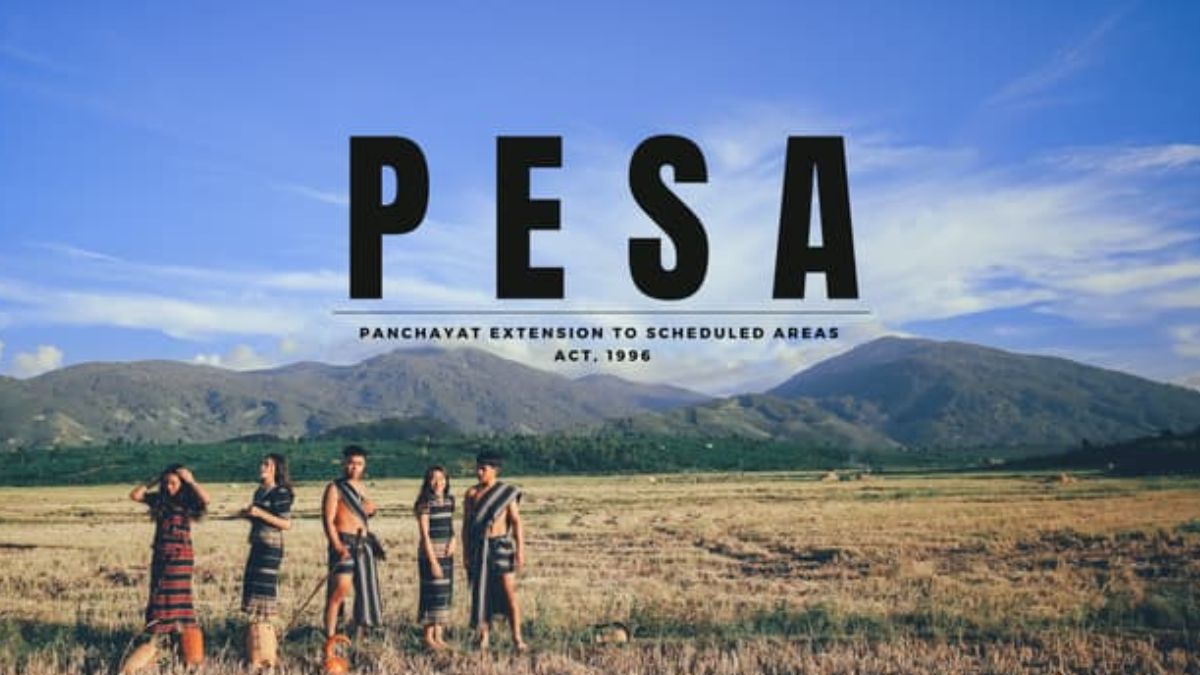
In a landmark move towards empowering tribal communities and strengthening grassroots governance, the Ministry of Panchayati Raj has collaborated with the Government of Madhya Pradesh and Indira Gandhi National Tribal University (IGNTU), Amarkantak to establish a Centre of Excellence on PESA. This initiative aims to transform the implementation of the Provisions of the Panchayats (Extension to the Scheduled Areas) Act, 1996 (PESA) by promoting participatory planning, preserving tribal culture, and building institutional capacity. It also signifies a concrete step in realizing the government’s commitment to inclusive development under the vision of Viksit Bharat.
Background
The Panchayats (Extension to the Scheduled Areas) Act, 1996, or PESA Act, extends the provisions of the 73rd Constitutional Amendment to the Fifth Schedule Areas, empowering tribal Gram Sabhas with self-governance. However, the implementation of PESA has been uneven and fraught with challenges, particularly in institutional capacity, awareness, and local planning. Recognizing this, the Ministry of Panchayati Raj initiated a focused effort by setting up a Centre of Excellence at IGNTU to bridge these critical gaps.
Significance of the Initiative
The establishment of this Centre is a historic and strategic move. IGNTU, located in Amarkantak—a tribal-dominated region—is well-placed to serve as a nerve centre for research, training, documentation, and community empowerment. The Centre will serve not only as a think tank but also as a practical arm to facilitate policy implementation, capacity building, and innovation in PESA districts. It aligns with Localized Sustainable Development Goals (LSDGs) and echoes the Prime Minister’s vision of tribal upliftment and self-reliance.
Objectives of the MoU
- Strengthen institutional mechanisms for effective PESA implementation.
- Build community capacities through training and awareness programs.
- Act as a hub for participatory planning, research, and policy innovation.
- Preserve tribal heritage, customs, and traditional knowledge systems.
- Promote grassroots democracy and leadership among tribal representatives.
Key Features and Functions
- Awareness Generation: Design and dissemination of IEC materials to spread PESA awareness.
- Participatory Planning: Support for tribal Gram Panchayats in preparing Gram Panchayat Development Plans (GPDPs).
- Leadership Development: Building capacities of elected tribal leaders to assert their governance rights.
- Customary Law Documentation: Preserve tribal legal systems, practices, and medicinal knowledge.
- Research and Innovation: Foster academic research and policy papers to support PESA implementation.
- Institutional Support: Enable state and district-level PESA resource centres with technical and research backup.
Launch of “PESA in Action” Compendium
At the inaugural event, the Ministry launched “PESA in Action: Stories of Strength and Self-Governance”, a compendium that showcases best practices, case studies, legal interpretations, and community-driven governance innovations from across PESA-implementing states. This document will serve as a reference manual and inspiration for future PESA implementation efforts.
Expected Outcomes
- More effective and consistent implementation of PESA provisions.
- Regular training modules for officials and tribal representatives.
- Rich documentation of traditional tribal knowledge and customs.
- Strengthened institutional ecosystems for sustainable and inclusive development.
- Empowered Gram Sabhas as engines of self-governance in tribal regions.


 India Launches AI-Driven Initiative to M...
 What the NPC-MoEFCC Agreement Means for ...
 IIT Bombay & Honeywell Launch Sustai...











