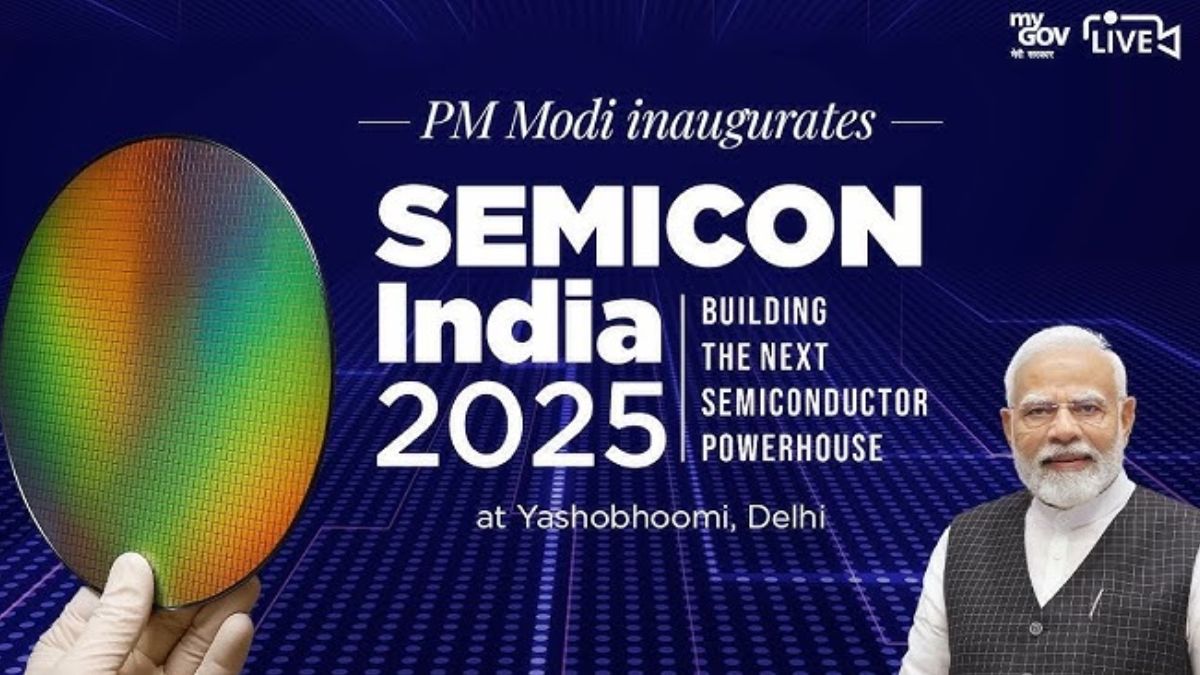
Prime Minister Narendra Modi inaugurated Semicon India 2025 at Yashobhoomi, New Delhi, marking a milestone in India’s quest to become a global semiconductor powerhouse. The event, attended by top industry leaders, international delegates, and thousands of students and start-ups, showcased India’s ambition to lead in chip design, manufacturing, and innovation.
1. Global Confidence, Indian Commitment
PM Modi welcomed delegates from over 40 countries, stating, “The world trusts India, the world believes in India, and the world is ready to build the semiconductor future with India.” This message reflected India’s emergence as a dependable and capable partner in the high-tech world order.
2. Chips Are the Digital Diamonds of the 21st Century
Drawing a powerful parallel, the Prime Minister said, “Oil was black gold. Chips are digital diamonds.” He emphasized that while oil fueled the previous century, semiconductors will define the future. With the global chip market already worth $600 billion, and expected to cross $1 trillion, India is positioning itself for a major share.
3. Speed Matters: From File to Factory
The importance of speed in semiconductor development, asserting, “The lesser the paperwork, the sooner wafer work can begin.” Through the National Single Window System, approvals have been streamlined, enabling investors to move from project proposal to production with minimal delays.
4. Building at Scale: India’s Semiconductor Timeline
India’s semiconductor journey has accelerated rapidly,
- 2021: India Semiconductor Mission launched
- 2023: First semiconductor fab approved
- 2024: Multiple fabs and design centers sanctioned
- 2025: 10 major projects underway with investments over ₹1.5 lakh crore
This scale of investment signals growing global trust and robust domestic preparedness.
5. A Full-Stack Semiconductor Ecosystem
Unlike traditional approaches focused on just fabrication, India is building a full-stack ecosystem covering chip design, fabrication, advanced packaging, and device integration. Design hubs in Noida and Bengaluru are working on next-generation chips with billions of transistors, aimed at powering immersive technologies.
6. Backbone of Chips: Critical Minerals & Skilled Talent
The role of critical minerals, noting that India is advancing domestic mining and processing capabilities under the National Critical Mineral Mission. Simultaneously, India contributes 20% of global semiconductor design talent, making human capital a key advantage in India’s chip mission.
7. Empowering Startups and MSMEs
Invited young entrepreneurs to lead the next phase of innovation. He announced the revamping of the Design Linked Incentive Scheme and highlighted the Chips-to-Startup Programme and National Research Fund, all designed to boost indigenous design, intellectual property, and entrepreneurship.
8. Future-Ready Infrastructure and State Involvement
States are actively participating by setting up plug-and-play semiconductor parks equipped with power, land, port connectivity, and skilled labor. The Prime Minister called on states to compete constructively to attract more investment and strengthen the nationwide semiconductor grid.
9. Reform, Perform, Transform: India’s Model
Reaffirming India’s commitment to structural reforms, PM Modi said the country is entering the next phase of semiconductor transformation. He invited investors by declaring, “Design is ready. Mask is aligned. Now is the time for precision execution and delivery at scale.”
Key points for exam prep
- Launched: September 2, 2025, in New Delhi by PM Modi
- Theme: Trust in India’s semiconductor future
- Market Goal: Contribute to the global $1 trillion chip industry
- Projects: 10 major fab and design initiatives, ₹1.5 lakh crore invested
- Initiatives: National Single Window System, PLI, DLI, Start-up grants
- Sectors: Design, packaging, critical minerals, AI, immersive tech


 India Pharma 2026 Conference: Advancing ...
 WTO MC14 2026 Explained: Agenda, Issues,...
 International Rail Coach Expo 2026 Inaug...