
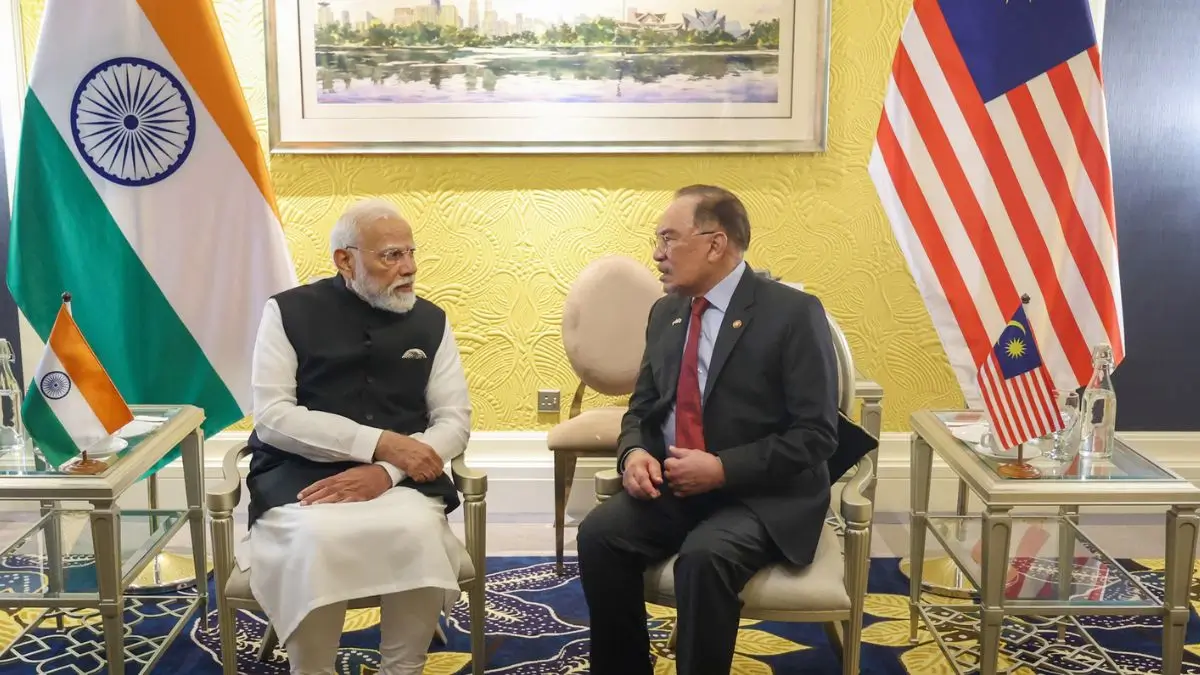
India and Malaysia have taken a major step to deepen bilateral ties. During Prime Minister Narendra Modi’s visit to Kuala Lumpur, both countries signed 11 important agreements covering trade, technology, payments and security. A key highlight was the strong push to promote local currency trade settlement using the Indian rupee and Malaysian ringgit. The visit signals a fresh momentum in India–Malaysia relations at a time of global economic uncertainty.
Overview of India-Malaysia Agreements
- India and Malaysia are in the spotlight after signing 11 bilateral agreements during Prime Minister Narendra Modi’s two-day visit to Malaysia.
- The agreements were finalised in Kuala Lumpur with Malaysian Prime Minister Anwar Ibrahim.
- Both sides agreed to expand trade beyond $18.6 billion, boost investments, and strengthen cooperation in defence, healthcare, tourism, and technology, marking a new phase in the India-Malaysia partnership.
Push for Rupee-Ringgit Trade Settlement
- A major outcome of the talks was the renewed push for local currency trade settlement.
- Both leaders appreciated cooperation between the Reserve Bank of India and Bank Negara Malaysia to promote invoicing and payments in Indian rupee and Malaysian ringgit.
- This move reduces dependence on third currencies, lowers transaction costs, and strengthens financial resilience in bilateral trade and investment flows.
Digital Payments and NPCI-PayNet Linkage
- India and Malaysia also announced a collaboration between NPCI International Limited and PayNet Malaysia.
- This partnership will establish bilateral payment linkages, enabling smoother cross-border digital payments.
- The step supports India’s fintech diplomacy and strengthens real-time retail payment connectivity between the two economies.
Semiconductors, Energy and Disaster Management
- Among the 11 pacts, cooperation in semiconductors and disaster management stand out.
- Both sides agreed to explore partnerships in semiconductor supply chains, an area of global strategic importance.
- In the energy sector, discussions included collaboration in large-scale solar energy projects.
- These initiatives align with clean energy goals and supply chain diversification in the Indo-Pacific region.
Palm Oil, Trade Access and Worker Mobility
- Malaysia reaffirmed its commitment as a reliable supplier of sustainable palm oil to India.
- Both sides discussed deeper cooperation in oil palm cultivation and value-added palm-based products.
- They also agreed on structured engagement to resolve market access issues and to streamline mobility of workers and professionals, helping businesses and skilled labour move more easily between the two countries.
Focus on Trade Agreements and ASEAN Ties
- Both leaders emphasized the importance of the Malaysia-India Comprehensive Economic Cooperation Agreement and the ASEAN-India Trade in Goods Agreement.
- They welcomed the ongoing review of AITIGA to make it more trade-facilitative and aligned with current global practices.
- India reiterated its commitment to deeper engagement with ASEAN, with Malaysia as a key partner.
Defense, Indo-Pacific and Strategic Trust
- On security, PM Modi said cooperation in counter-terrorism, intelligence sharing and maritime security will be strengthened.
- Both leaders underlined their shared commitment to peace and stability in the Indo-Pacific region.
- India also announced it will open a consulate in Sabah, Malaysia, further expanding diplomatic outreach.
- Modi described India-Malaysia ties as “special” and based on strategic trust.
Question
Q. Which two currencies are being promoted for India–Malaysia trade settlement?
A. Dollar and Euro
B. Rupee and Yen
C. Rupee and Ringgit
D. Yuan and Ringgit


 Preeti Saran Re-Elected as UN Committee ...
 Global Trade Hits New High in 2025: Key ...
 Iran–US Ceasefire: Iran’s 10 Conditions ...











