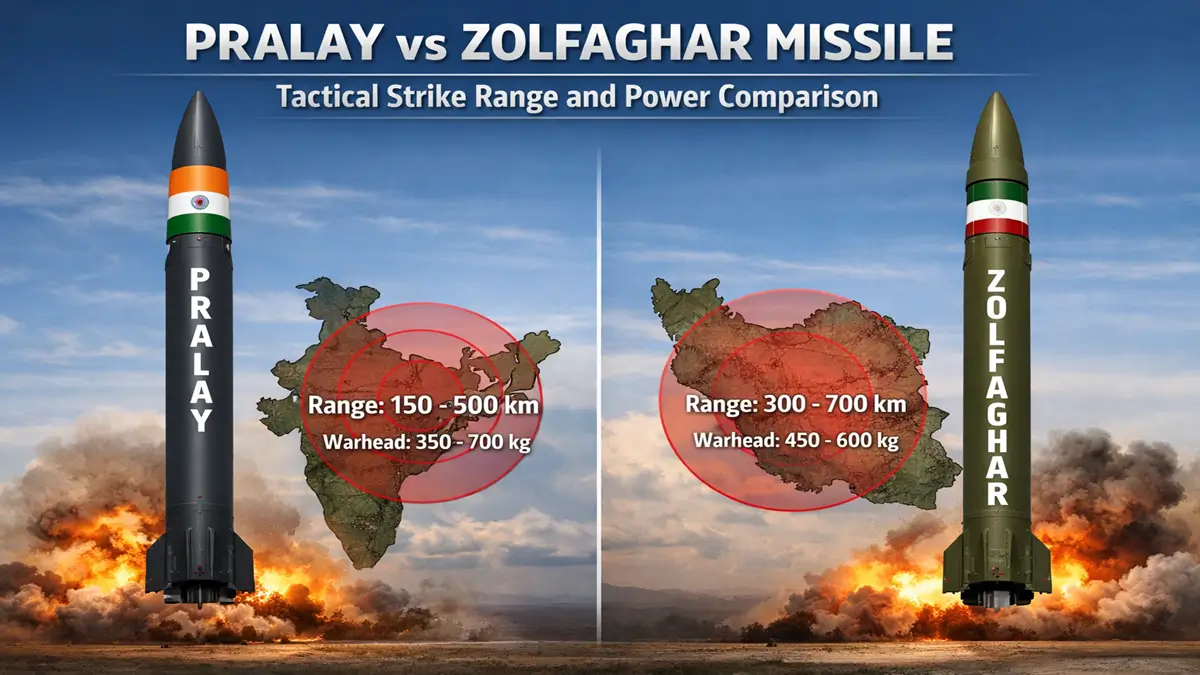
Tactical ballistic missiles are designed for battlefield strikes against high-value targets such as airbases, radar stations, command centers, and military infrastructure. Two notable missiles in this category are India’s Pralay missile and Iran’s Zolfaghar missile. Both systems are road-mobile and designed for precision strikes, but they differ in range, speed, payload capacity, and battlefield role.
Pralay Missile (India)
The Pralay missile is a tactical quasi-ballistic missile developed by India’s Defence Research and Development Organisation (DRDO). It was designed to strengthen India’s conventional strike capability against high-value enemy targets within regional distances.
Key Features
- Type: Tactical surface-to-surface ballistic missile
- Range: About 150–500 km
- Speed: Around Mach 5–6 in terminal phase
- Warhead Capacity: 350–700 kg conventional warhead
- Fuel Type: Solid-fuel propulsion
- Launch Platform: Road-mobile transporter erector launcher
- Guidance System: Advanced navigation with terminal guidance and high precision (less than 10 m CEP)
Pralay uses a quasi-ballistic trajectory, allowing it to maneuver during flight and making interception by enemy missile defenses more difficult. It is mainly designed for precision tactical strikes.
Zolfaghar Missile (Iran)
The Zolfaghar missile is a short-range ballistic missile developed by Iran as part of the Fateh missile family. It was unveiled in 2016 and is designed for regional battlefield strikes.
Key Features
- Type: Short-range ballistic missile
- Range: Around 700–750 km
- Speed: Approximately Mach 7+ during flight
- Warhead Capacity: Around 500–600 kg payload
- Fuel Type: Solid-fuel propulsion
- Launch Platform: Mobile ground launchers
- Special Capability: Can carry cluster or sub-munition warheads for wider target coverage.
The Zolfaghar missile focuses on longer reach within regional conflict zones, allowing Iran to strike targets deeper into enemy territory.
Tactical Strike Comparison
| Feature | Pralay (India) | Zolfaghar (Iran) |
|---|---|---|
| Missile Type | Tactical quasi-ballistic missile | Short-range ballistic missile |
| Range | 150–500 km | 700–750 km |
| Speed | Mach 5–6 | Around Mach 7+ |
| Warhead Capacity | 350–700 kg | Around 500–600 kg |
| Propulsion | Solid fuel | Solid fuel |
| Launch Platform | Road-mobile TEL | Mobile ground launcher |
| Primary Role | Precision tactical strike | Regional battlefield strike |
Key Differences
Range Advantage – Zolfaghar
Zolfaghar has a longer strike range, allowing it to hit targets up to around 700–750 km away.
Precision Advantage – Pralay
Pralay is designed for high-precision strikes, with advanced guidance systems and maneuverable flight paths.
Speed and Maneuverability
Both missiles travel at very high speeds, but Pralay’s quasi-ballistic trajectory allows it to change direction during flight, making interception more difficult.
Operational Role
- Pralay: Precision strike against strategic battlefield targets such as command centers and airbases.
- Zolfaghar: Regional strike missile capable of attacking multiple targets using cluster warheads.


 Indian Air Force to Equip MiG-29 Jets wi...
 Indian Navy Hosts IONS Maritime Exercise...
 Indian Army Gets First Batch of Prahar L...