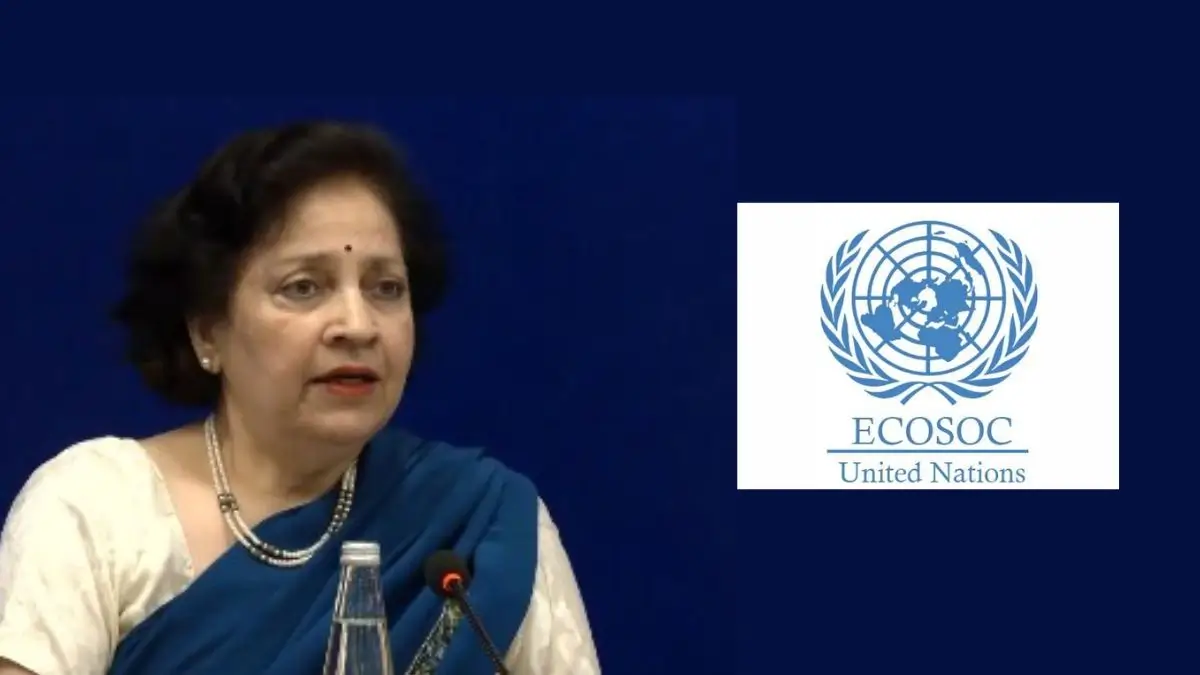
India has secured the unopposed victories in four key election to bodies under the United Nations Economic and Social Council (ECOSOC) in April 2026. This elections were held by acclamation which means that unanimous approval without the opposition. The main highlight was the re-election of veteran diplomat Preeti Saran as a major UN committee. This achievement indicates the India’s growing credibility and its influence in the global governance and multilateral institutions.
India’s Clean Sweep at UN ECOSOC Elections
India’s performance in the ECOSOC elections has stands out as it won all the four positions without contest and showcasing the strong international support.
The four important bodies in which India have secured representation includes the,
- Committee on Economic, Social and Cultural Rights (CESCR)
- Commission on Science and Technology for Development (CSTD)
- Committee on Non-Governmental Organisations
- Committee for Programme and Coordination (CPC)
This clean sweep reflect the country’s rising diplomatic strength and the trusted global image and specially in the areas of development, technology and governance.
Preeti Saran’s Re-election
The re-election of the Preeti Saran to the CESCR (Committee on Economic, Social and Cultural Rights) is the significant achievement. This position to be hold as an individual expert capacity and not as the government representative.
Mrs. Saran brings the decades of diplomatic experience and she already served as the,
- Secretary (East) in the Ministry of External Affairs
- Ambassador to Vietnam
- Diplomat in the cities like Geneva, Moscow, Cairo, Dhaka and Toronto
In the previous CESCR sessions her leadership has earned the global recognition and with this it making her re-election a indication of the India’s intellectual and diplomatic credibility.
What These UN Bodies Do
Committee on Economic, Social and Cultural Rights (CESCR)
The CESCR monitors the implementation of the International Covenant on Economic, Social and Cultural Rights and it guarantee the essential human rights such as education, health, housing and employment.
Commission on Science and Technology for Development (CSTD)
The committee focused on how the science and technology can drive the sustainable development. It also plays the crucial role to shaping the global discussions on innovation, digital transformation and the bridging technological gaps.
Committee on Non-Governmental Organizations
This committee evaluates the NGOs seeking the consultative status with the UN and also ensuring the only credible and accountable organizations participate in global policymaking.
Committee for Programme and Coordination (CPC)
The CPC reviews and coordinates the UN programmes and activities along with ensuring efficiency, alignment and the effective use of resources across different agencies.
Why This Victory Matters for India
As India’s unopposed election to multiple ECOSOC bodies is not just the symbolic but it has the real strategic importance.
It strengthens India’s ability to,
- Influence the global development policies
- Also to contribute to human rights frameworks
- To shape discussions on the technology and sustainability
This also signals the growing global confidence in the India’s role as a responsible and constructive international partner.
About United Nations Economic and Social Council
- It was established by the Charter of the United Nations in 1945 as one of the six principal organs of the United Nations.
- It is responsible for the direction and coordination of the economic, social, humanitarian, and cultural activities carried out by the UN.
- Decisions are taken by a simple majority vote. The presidency of ECOSOC changes annually.
- Members: It has 54 members and which are elected for three-year terms by the General Assembly.
- Headquarter: New York (USA)


 Global Trade Hits New High in 2025: Key ...
 Iran–US Ceasefire: Iran’s 10 Conditions ...
 Russia and China Veto UN Resolution to R...