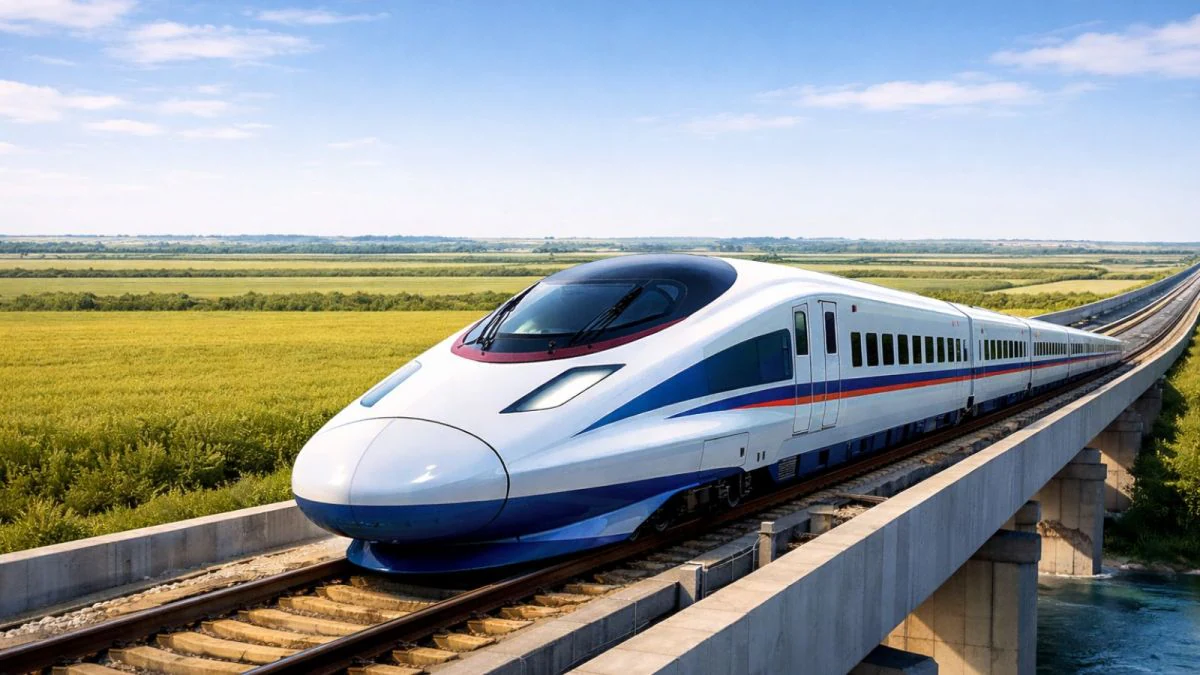
The Government of India has initiated a viability assessment for seven new high-speed rail corridors, popularly known as bullet train projects. The move follows the announcement made in the Union Budget to expand India’s high-speed rail network.
After a high-level meeting at the Railway Board, the National High Speed Rail Corporation Limited (NHSRCL) has been directed to accelerate preparatory work and ensure timely implementation.
Proposed High-Speed Rail Corridors
The seven proposed corridors, spanning nearly 4,000 kilometres, are estimated to cost around ₹16 trillion. These include:
- Mumbai–Pune
- Pune–Hyderabad
- Hyderabad–Bengaluru
- Hyderabad–Chennai
- Chennai–Bengaluru
- Delhi–Varanasi
- Varanasi–Siliguri
These corridors aim to strengthen connectivity between major economic and urban hubs.
Steps Initiated by Railways
The Railway Board has outlined several key action points:
- Updating Detailed Project Reports (DPRs) with revised cost estimates
- Conducting financial viability assessments
- Standardising high-speed rail systems nationwide
- Creating dedicated field-based core teams
Initiating pre-construction activities and contract documentation
The focus is on ensuring faster implementation compared to the first corridor currently under construction — the Mumbai–Ahmedabad High-Speed Rail Corridor.
Emphasis on Indigenisation
Railway Minister Ashwini Vaishnaw has stated that future corridors will witness higher levels of indigenisation. India has gained valuable experience from the Mumbai–Ahmedabad project, especially in:
- Civil engineering works
- Overhead equipment systems
- Signalling technology
- Rolling stock
- Station construction
This learning curve is expected to reduce delays and enhance efficiency in upcoming projects.
Strategic Significance
The expansion of bullet train corridors will:
- Reduce travel time significantly
- Promote regional economic integration
- Generate employment
- Enhance technological capability in rail infrastructure
- Support the Make in India initiative
By scaling up high-speed rail infrastructure, India aims to modernise its transport ecosystem and align with global standards in railway technology.
Exam-Oriented MCQs
Q1. The National High Speed Rail Corporation Limited (NHSRCL) functions under which ministry?
(a) Ministry of Road Transport and Highways
(b) Ministry of Civil Aviation
(c) Ministry of Railways
(d) Ministry of Commerce and Industry
(e) Ministry of Heavy Industries
Q2. The seven proposed high-speed rail corridors announced in the Union Budget are expected to span approximately:
(a) 2,000 km
(b) 3,000 km
(c) 4,000 km
(d) 5,000 km
(e) 6,000 km
Q3. The estimated cost of the seven new bullet train corridors is around:
(a) ₹8 trillion
(b) ₹10 trillion
(c) ₹12 trillion
(d) ₹14 trillion
(e) ₹16 trillion
Q4. Which of the following corridors is part of the newly proposed high-speed rail network?
(a) Delhi–Mumbai
(b) Chennai–Kolkata
(c) Mumbai–Pune
(d) Ahmedabad–Jaipur
(e) Lucknow–Patna
Q5. India’s first high-speed rail corridor currently under construction connects:
(a) Delhi–Varanasi
(b) Mumbai–Ahmedabad
(c) Chennai–Bengaluru
(d) Hyderabad–Pune
(e) Delhi–Chandigarh
Q6. The Railway Minister who emphasised increased indigenisation in upcoming high-speed rail corridors is:
(a) Piyush Goyal
(b) Nitin Gadkari
(c) Ashwini Vaishnaw
(d) Dharmendra Pradhan
(e) G. Kishan Reddy
Q7. The primary objective of updating Detailed Project Reports (DPRs) for the new corridors is to:
(a) Reduce ticket fares
(b) Increase foreign investment
(c) Conduct financial viability assessments
(d) Privatise railway operations
(e) Convert rail lines to freight corridors


 PM Modi Addressed Parliament on Middle E...
 What Is Sarhul Festival? Meaning, Ritual...
 What Is the National DMF Summit 2026 and...