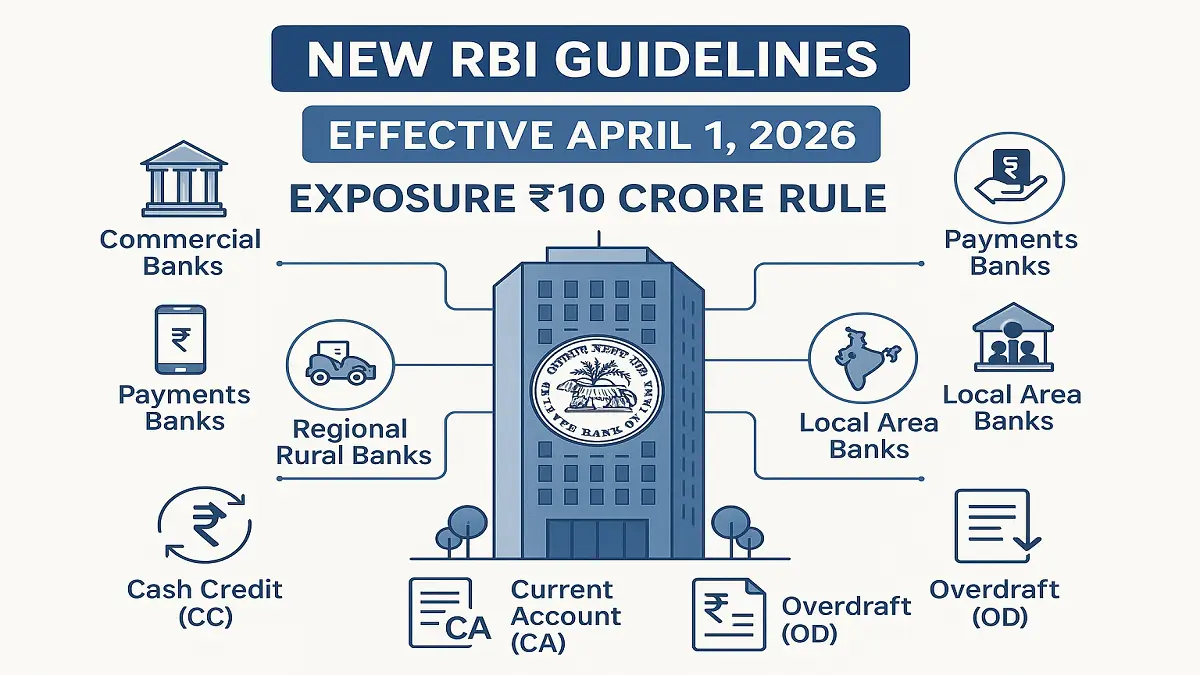
Reserve Bank of India (RBI) released its final directions on the ‘Maintenance of Cash Credit Accounts, Current Accounts and Overdraft Accounts by Banks’. These guidelines introduce important relaxations while continuing with a principle-based regulatory framework aimed at improving credit discipline and transparency.
The directions are highly relevant for banking awareness, financial regulation, and competitive exams, as they clarify how different types of transaction accounts will be maintained across seven categories of regulated entities.
Background of the RBI Directions
Earlier, the RBI had issued draft norms on October 1, 2025, seeking stakeholder feedback. These draft rules focused on regulating the opening and maintenance of transaction accounts—especially Current Accounts (CA) and Overdraft Accounts (OD)—to prevent diversion of funds and ensure better monitoring of borrower exposure.
After reviewing feedback, the RBI finalized the norms with select relaxations, especially regarding Cash Credit (CC) accounts.
Regulated Entities Covered
The final directions apply to the following seven categories of regulated entities:
- Commercial Banks (CBs)
- Small Finance Banks (SFBs)
- Payments Banks (PBs)
- Local Area Banks (LABs)
- Regional Rural Banks (RRBs)
- Urban Co-operative Banks
- State Co-operative Banks
These entities collectively form the backbone of India’s banking system.
Effective Date of the Guidelines
- Effective from: April 1, 2026
- Banks are allowed to implement the directions earlier if they choose to do so in full.
Key Highlights of the RBI Guidelines
1. Cash Credit (CC) Accounts – Major Relaxation
The RBI has excluded Cash Credit (CC) accounts from restrictions applicable to other transaction accounts.
Why this change?
- CC accounts are working capital facilities
- They are linked to the value of current assets, such as inventory and receivables
- Unlike CA or OD accounts, CC accounts are need-based and asset-backed
New Rule
Banks can provide CC facilities freely, based on customer requirements
No restrictions apply, regardless of borrower exposure
This move provides greater operational flexibility to businesses, especially MSMEs.
2. Current Account (CA) and Overdraft (OD) Accounts
The RBI has categorized rules based on the aggregate exposure of the banking system to a borrower.
A. Exposure Less Than ₹10 Crore
-
If the total banking system exposure to a customer is below ₹10 crore:
No restriction on opening or maintaining CA or OD accounts
Any bank may offer these accounts based on customer needs
B. Exposure Equal to or More Than ₹10 Crore
For borrowers with aggregate exposure of ₹10 crore or more, stricter norms apply.
A bank may maintain a CA or OD account only if it satisfies either of the following conditions:
- Holds at least 10% share in the banking system’s total exposure to the borrower OR Holds at least 10% share in the banking system’s fund-based exposure to the borrower
This ensures that only meaningfully exposed lenders manage transaction flows, improving credit monitoring and risk control.
Other Important Provision
Remittance Window – No Change
Despite requests from stakeholders for relaxation, the RBI has retained the existing rule:
- Funds collected in collection accounts must be transferred to designated transaction accounts (CC/OD/CA)
- Timeline: Within two working days
This continues to support timely fund movement and transparency.
Why These Guidelines Matter
- Encourage better credit discipline
- Prevent fund diversion
- Simplify rules for small borrowers
- Provide operational ease for working capital financing
- Strengthen banking system oversight
For government job aspirants, these norms are important for exams related to:
- RBI & Banking Awareness
- Financial Regulation
- Economic Reforms
About the Reserve Bank of India (RBI)
- Governor: Sanjay Malhotra
- Headquarters: Mumbai, Maharashtra
- Established: April 1, 1935
- Role: Central bank responsible for monetary policy, bank regulation, and financial stability in India


 Canara Bank MCLR Rates Revised for Loan ...
 South Indian Bank EPF Payment Service La...
 Razorpay Launches AI Agent Studio For th...