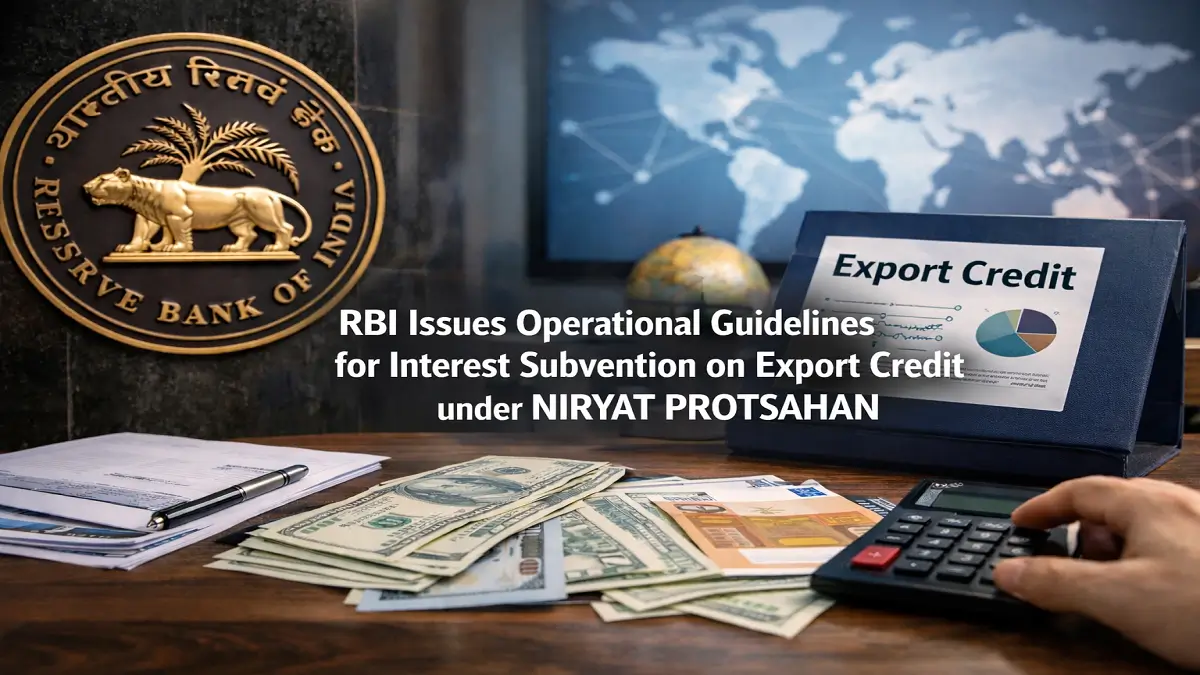
The Reserve Bank of India (RBI) has issued operational guidelines for extending interest subvention on pre- and post-shipment export credit under the Export Promotion Mission (EPM), specifically under its first component, NIRYAT PROTSAHAN.
The primary goal of this initiative is to improve access to affordable rupee export credit for MSME exporters by reducing the cost of borrowing. This move is expected to strengthen India’s export ecosystem and enhance the global competitiveness of small businesses.
Objective of NIRYAT PROTSAHAN – Interest Subvention
The Interest Subvention Component of NIRYAT PROTSAHAN is designed to lower the interest burden on MSME exporters. By offering interest support on export credit, the scheme aims to:
- Make export financing more affordable
- Improve liquidity for MSME exporters
- Encourage higher export activity and global market participation
This component directly addresses the financial challenges faced by small exporters in managing working capital during export cycles.
Eligible Lending Institutions
The RBI guidelines specify the institutions that can provide interest subvention benefits to exporters. These include:
- All Scheduled Commercial Banks (SCBs) (excluding Regional Rural Banks)
- Primary (Urban) Co-operative Banks (UCBs)
- State Co-operative Banks (StCBs)
- All-India Financial Institutions (AIFIs)
These institutions will extend the benefit of reduced interest rates to eligible MSME exporters.
Eligible MSME Exporters
To avail of the scheme, exporters must meet specific criteria:
- They must be manufacturer exporters or merchant exporters
- They must possess a valid Importer Exporter Code (IEC)
- They must have an MSME Udyam Registration Number (URM)
This ensures that only formally registered MSME exporters benefit from the interest support.
Interest Subvention Rate and Benefit Limit
Under the scheme, eligible MSMEs will receive:
-
Interest subvention of 7.5% per annum on both pre-shipment and post-shipment rupee export credit
However, there is a cap on the total benefit:
-
An MSME exporter can receive a maximum interest subvention benefit of ₹50 lakh during FY26
This cap ensures equitable distribution of benefits among a larger number of exporters.
Collateral Support Component
Apart from interest support, NIRYAT PROTSAHAN also includes a Collateral Support Component aimed at addressing collateral-related constraints faced by MSME exporters.
Role of CGTMSE
This component is implemented in partnership with the Credit Guarantee Fund Trust for Micro and Small Enterprises (CGTMSE), which provides guarantee coverage to reduce the need for collateral.
Guarantee Coverage Details
- Up to 85% guarantee coverage for Micro and Small Enterprises (MSEs)
- Up to 65% guarantee coverage for Medium exporters
- Maximum outstanding guaranteed exposure: ₹10 crore per exporter per financial year
This support helps MSME exporters secure bank loans even if they lack sufficient collateral.
Scope of RBI Guidelines
It is important to note that the RBI has issued operational guidelines only for the Interest Subvention Component of NIRYAT PROTSAHAN. Other components of the Export Promotion Mission will be governed by separate administrative frameworks.
About the Export Promotion Mission (EPM)
The Export Promotion Mission (EPM) is a major initiative aimed at boosting India’s exports and supporting MSMEs in global trade. It is jointly implemented by:
- Department of Commerce (DoC)
- Ministry of MSME
- Ministry of Finance (MoF)
- Directorate General of Foreign Trade (DGFT)
The mission has a total outlay of ₹25,060 crore for the period FY26 to FY31.
Two Key Sub-Schemes under EPM
1. NIRYAT PROTSAHAN
Focuses on improving access to affordable and diversified trade finance, including interest subvention and collateral support.
2. NIRYAT DISHA
Supports non-financial enablers such as:
- Market access
- Branding and promotion
- Regulatory compliance
- Logistics support
- Trade intelligence
Together, these components aim to create a comprehensive ecosystem for export growth.


 Now Get Home Loan From Anywhere: NHB Lau...
 India Extends Inflation Targeting Framew...
 RBI's This Domain Wins Global Recognitio...