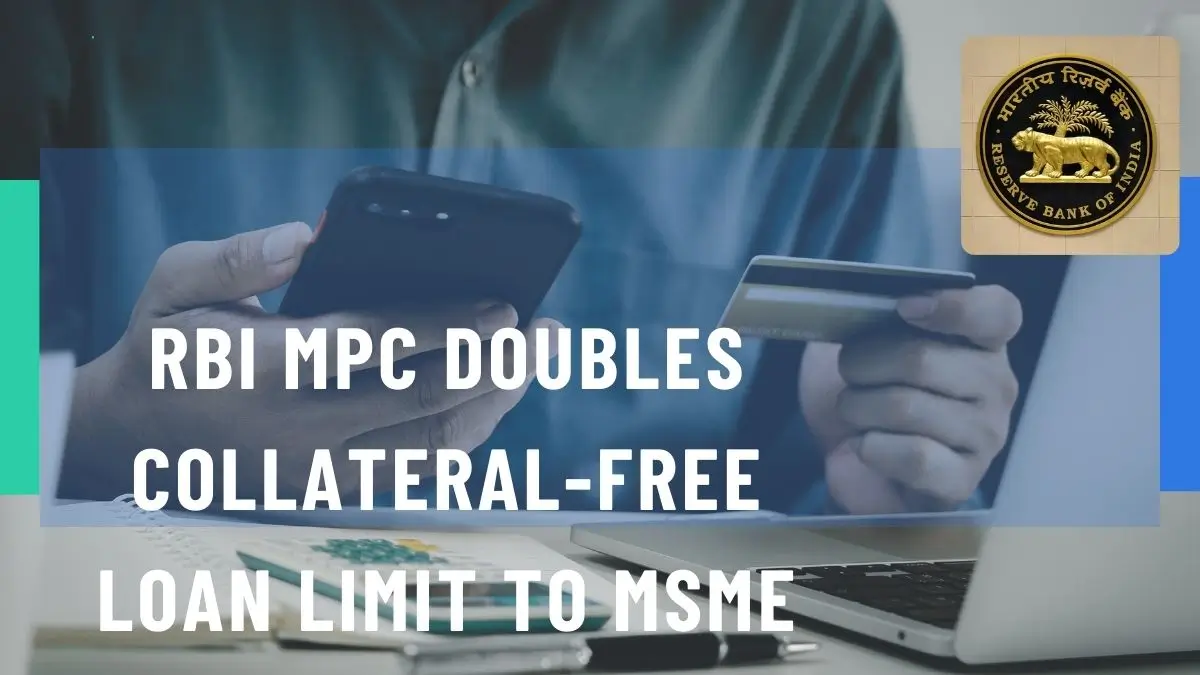
The RBI Monetary Policy Committee has made an important announcement that directly affects India’s small businesses. In its February 2026 policy meeting, the Reserve Bank of India decided to increase the limit of collateral-free loans for micro and small enterprises (MSEs) from ₹10 lakh to ₹20 lakh. This change will come into effect from April 1, 2026. The decision is aimed at adjusting loan limits for inflation and improving access to formal credit for small businesses that struggle to provide collateral.
RBI Monetary Policy Committee Decision Explained
- The RBI Monetary Policy Committee reviewed existing credit norms and found that the ₹10 lakh collateral-free loan limit, unchanged since 2010, had lost relevance due to inflation.
- As prices, input costs, and business expenses have risen over the years, small enterprises needed larger loan support.
- By doubling this limit to ₹20 lakh, the RBI MPC wants to ensure that loans remain meaningful in real terms.
- This decision applies to all eligible loans sanctioned or renewed on or after April 1, 2026, covering banks and regulated lenders under RBI norms.
Why RBI Increased Collateral-Free Loans for Small Businesses
- According to RBI Governor Sanjay Malhotra, the decision is essentially “indexing for inflation.”
- Small businesses today require higher working capital for raw materials, wages, logistics, and compliance costs.
- Many micro enterprises do not own property or assets to pledge as security.
- The enhanced collateral-free loans limit under the RBI Monetary Policy Committee framework reduces this barrier and encourages banks to lend more confidently to small borrowers through formal channels.
Impact on MSMEs and Employment Generation
- The RBI Monetary Policy Committee has repeatedly highlighted that MSMEs are the growth engine of the Indian economy.
- They contribute significantly to employment generation, exports, and local entrepreneurship.
- With higher collateral-free loans, small firms can expand operations, invest in technology, hire workers, and manage cash flows better.
- This move is expected to reduce dependence on informal moneylenders and strengthen financial inclusion.
- Improved credit access can also help small businesses survive economic slowdowns and market volatility.
What Types of Loans Will Be Covered Under the New Limit?
- The revised ₹20 lakh collateral-free loan limit will apply to all micro and small enterprise borrowers whose loans are sanctioned or renewed after April 1, 2026.
- It includes working capital loans, term loans, and other credit facilities covered under RBI guidelines.
- However, the final approval will still depend on the borrower’s credit profile, cash flow, and bank assessment.
- The RBI Monetary Policy Committee has clarified that this step strengthens last-mile credit delivery, especially for businesses with limited assets.
Key Summary at a Glance
| Aspect | Details |
| Why in News? | RBI Monetary Policy Committee increased collateral-free loan limit for MSEs |
| Old Limit | ₹10 lakh |
| New Limit | ₹20 lakh |
| Effective Date | April 1, 2026 |
| Main Objective | Inflation adjustment and improved MSME credit access |
| Beneficiaries | Micro and Small Enterprises |
| Key Authority | Reserve Bank of India |
Question
Q. The RBI increased collateral-free loans for micro and small enterprises to ₹20 lakh primarily to:
A. Reduce NPAs
B. Index loan limits to inflation
C. Promote large industries
D. Control fiscal deficit


 RBI Plans to Make TReDS Registration Eas...
 World Bank Raises India's FY27 Growth Fo...
 BoB Launches AI-based 'bob SAMVAD' Platf...