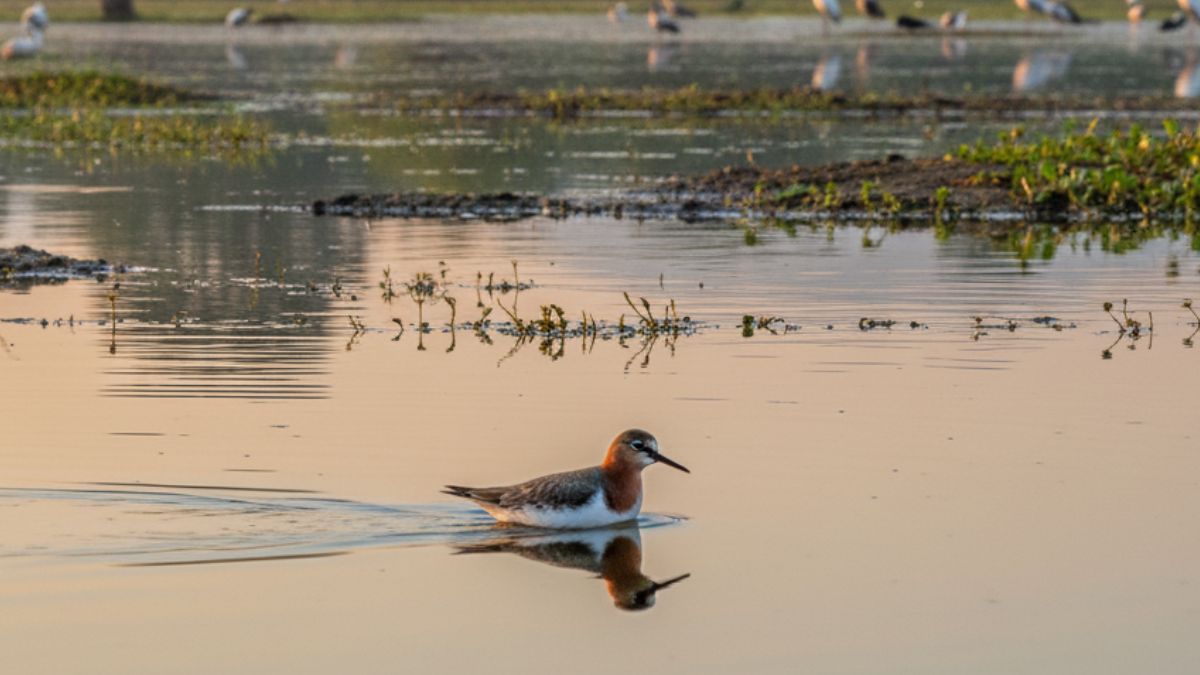
The recent sighting of the Red-necked Phalarope (Phalaropus lobatus) at Nanjarayan Bird Sanctuary in Tamil Nadu has created a buzz among ornithologists and wildlife enthusiasts. Known for its distinctive circular swimming pattern and vibrant breeding plumage, this Arctic-breeding shorebird is a rare visitor to India, making this observation ecologically significant.
About the Red-Necked Phalarope
Taxonomy and Distribution
- Scientific Name: Phalaropus lobatus
- Family: Scolopacidae (sandpiper family)
Distribution
- Breeding zones: Arctic and sub-Arctic tundra (60°–70° latitude)
- Wintering zones: Open oceans, including the Arabian Sea, coastal South America, Indonesia, and western Melanesia
Appearance and Behaviour
- Size: Small-sized shorebird
- Coloration (Breeding plumage)
- Chestnut-red coloring on the neck and sides
- Slim, straight black bill
- White face and underparts
Feeding Habit
- Feeds on tiny aquatic invertebrates and plankton
- Famous for spinning rapidly on water to stir up food from beneath the surface
Unique Breeding Traits
- Mating System: Polyandrous (females mate with multiple males)
- Parental Care: Males incubate eggs and care for the chicks
- This role reversal is rare in birds and adds to the species’ ecological intrigue.
Why the Sighting is Significant
The Nanjarayan Tank in Tiruppur, Tamil Nadu, is a freshwater wetland that has become a hotspot for migratory birds.
The Red-necked Phalarope’s presence here,
- Suggests favorable ecological conditions in Indian wetlands
- Highlights the migratory range extension and adaptability of the species
- Emphasizes the need for conservation of wetlands in South India
Conservation Status
- IUCN Red List: Least Concern
- Although globally stable, habitat degradation and climate change could impact long-distance migratory birds like the Red-necked Phalarope.
Takeaways
- First recorded sighting at Nanjarayan Bird Sanctuary, Tamil Nadu.
- Spins on water to catch prey—an uncommon feeding strategy.
- Female phalaropes are polyandrous; males raise the chicks.
- Winters at sea, unlike most shorebirds that remain on coastlines.
- Highlights the importance of Indian wetlands for global migratory biodiversity.


 UAE Introduces World's First 10G Interne...
 Meet MAI-Transcribe-1: Microsoft’s Fast,...
 What is Outer Space Treaty 1967? Princip...