
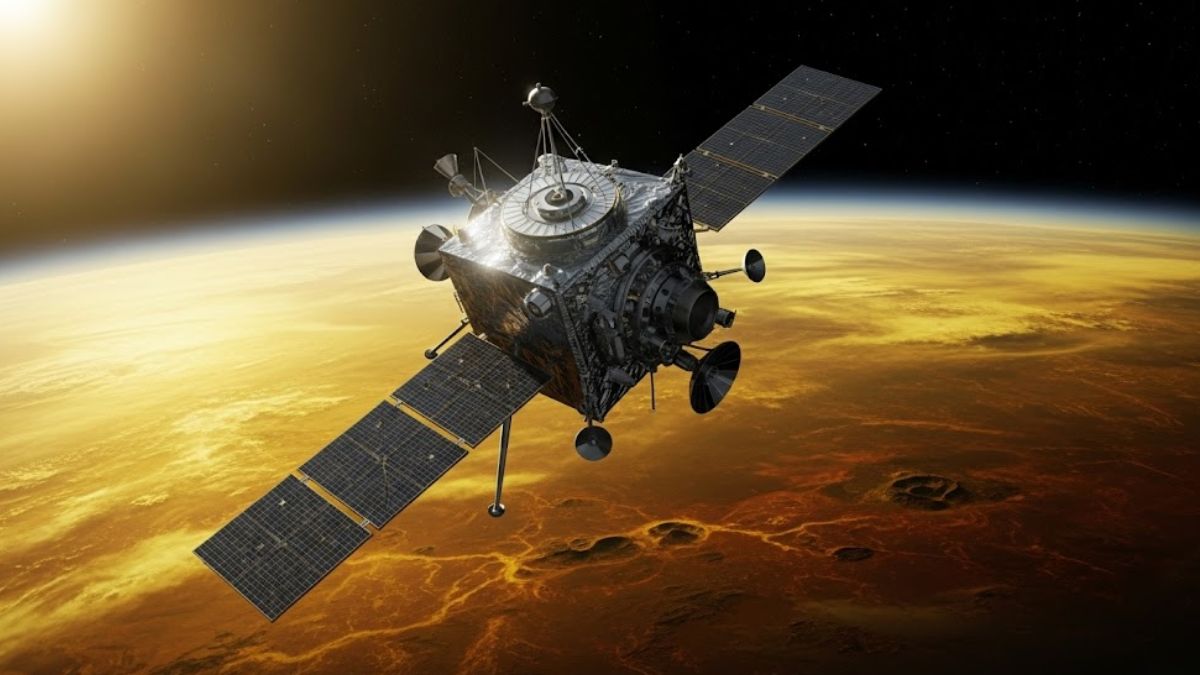
Russia has officially announced plans to return to Venus exploration with the ambitious Venera-D mission, scheduled for launch between 2034 and 2036. This long-awaited mission will include a lander, an orbital spacecraft, and a balloon probe, marking Russia’s return to interplanetary exploration after decades and reviving its historic Venera legacy.
The initiative is part of Russia’s new national space programme, and preliminary design work is set to begin in January 2026, according to Oleg Korablev from the Space Research Institute (IKI).
What is the Venera-D Mission?
The Venera-D (“D” stands for “Dolgozhivushaya,” meaning “long-lived”) mission is designed to provide comprehensive scientific data on Venus’s atmosphere, surface, and climate systems. It represents Russia’s most serious attempt to explore Venus since the Soviet-era Venera and Vega programs.
Mission Components
- Lander: To study surface composition, temperature, pressure, and possibly conduct soil analysis on Venus’s extremely harsh terrain.
- Orbital Spacecraft: Will capture high-resolution images, perform atmospheric studies, and relay data from other mission elements.
- Balloon Probe: To float in the upper atmosphere of Venus, measuring temperature, wind, and chemical composition over an extended period.
Timeline and Development
- Preliminary Design Phase: Starts in January 2026
- Duration: 2 years
- Involves collaboration with Lavochkin Association, a key Russian aerospace contractor
- Launch Window: Between 2034 and 2036
- Final launch date will be confirmed post-design phase
- To be launched aboard a Russian launch vehicle
This design and planning period is critical, given the technical challenges of landing and operating on Venus, one of the most hostile environments in the solar system.
Scientific Goals and Global Context
Venus has long intrigued scientists due to its runaway greenhouse effect, crushing surface pressures, and volcanic landscapes. Recent interest has been reignited globally following hypotheses about phosphine detection, a potential biosignature gas, although this remains under debate.
Venera-D’s Key Science Objectives
- Understand atmospheric dynamics and cloud chemistry
- Investigate the possibility of past or present volcanic activity
- Study climate evolution and compare it with Earth
- Search for traces of past habitability
Global Competition
- NASA’s VERITAS and DAVINCI+ missions are also targeting Venus
- ESA’s EnVision mission is planned for the early 2030s
- Russia’s Venera-D could join this new wave of Venus missions, marking renewed global interest in Earth’s twin planet


 Meet MAI-Transcribe-1: Microsoft’s Fast,...
 What is Outer Space Treaty 1967? Princip...
 What Is Mission Mitra? ISRO’s New Experi...











