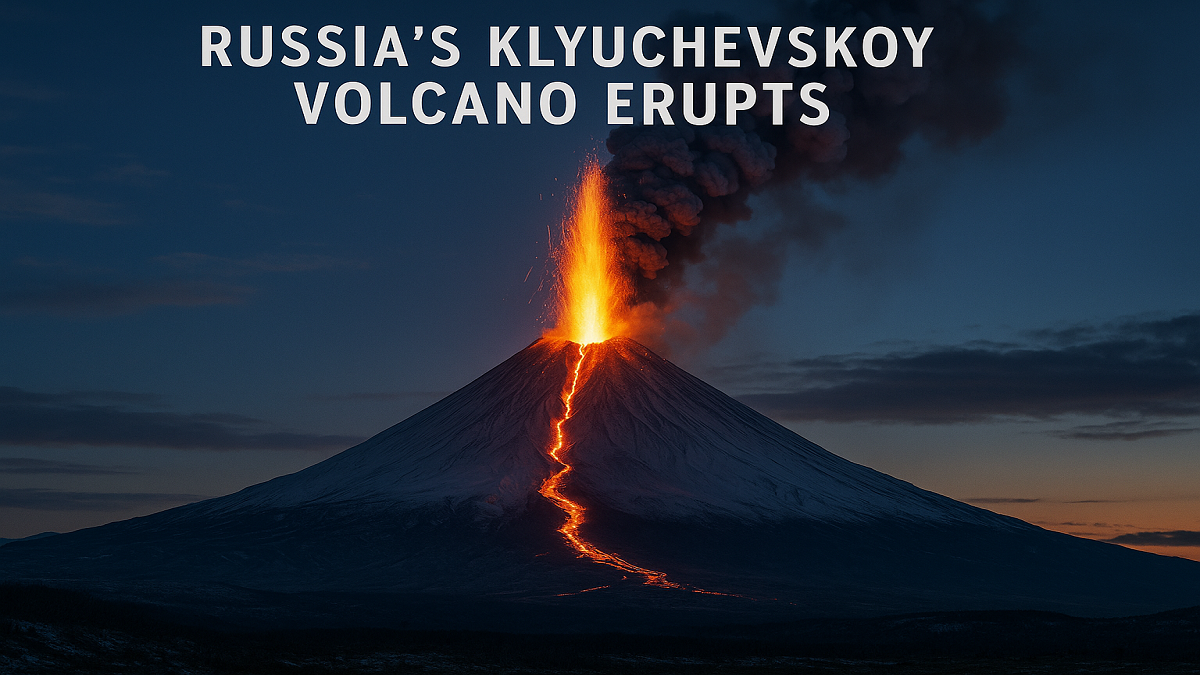
On Wednesday, July 30, 2025, the remote Kamchatka Peninsula in Russia’s far east witnessed two dramatic natural events — a powerful 8.8 magnitude earthquake followed by the eruption of the Klyuchevskoy volcano, the tallest active volcano in both Europe and Asia.
According to the Russian Geophysical Survey, the Klyuchevskoy began spewing lava just hours after the earthquake rattled the region. The eruption lit up the night sky with an orange blaze, while red-hot lava could be seen flowing down the volcano’s western slope.
The Eruption: Nature’s Fiery Spectacle
The Klyuchevskoy volcano, standing at 4,700 metres (15,000 feet), is known for its frequent activity, with at least 18 eruptions recorded since 2000, according to the Smithsonian Institution’s Global Volcanism Program.
Witnesses and monitoring stations reported:
-
A powerful glow above the volcano.
-
Explosions accompanied by ash and lava discharge.
-
Continuous lava flow descending the western slope.
The eruption, while visually stunning, poses little immediate danger to people as the surrounding area is sparsely populated. The nearest large settlement, Petropavlovsk-Kamchatsky, lies hundreds of kilometres away.
The Earthquake and Tsunami Alert
Earlier in the day, the 8.8 magnitude earthquake struck off Kamchatka’s Pacific coast, triggering tsunami warnings across the region and as far as Japan.
The quake’s immense force initially prompted evacuations in coastal areas, with residents moved to higher ground as a precaution. However, 11 hours later, Russian authorities lifted the tsunami warning after confirming that massive waves did not reach populated areas.
No Major Damage or Casualties
Historically, Klyuchevskoy’s eruptions have rarely caused major destruction or loss of life due to the remote location of the volcano. Similarly, this latest event has so far not resulted in casualties or significant infrastructure damage.
Scientists continue to monitor both the volcano and seismic activity in the region to detect any changes that could pose a greater risk.
Kamchatka: A Land of Fire and Earthquakes
The Kamchatka Peninsula lies in the Pacific Ring of Fire, a geologically active zone where tectonic plates collide, creating a hotspot for earthquakes and volcanic eruptions. The region is home to over 300 volcanoes, around 29 of which are active.
The Klyuchevskoy volcano remains a symbol of nature’s raw power, attracting both scientists and adventurers despite the dangers it presents.


 Blanka Vlasic Appointed Global Ambassado...
 Veteran Congress Leader and Former Union...
 INS Aridhaman Nuclear Submarine Joins In...