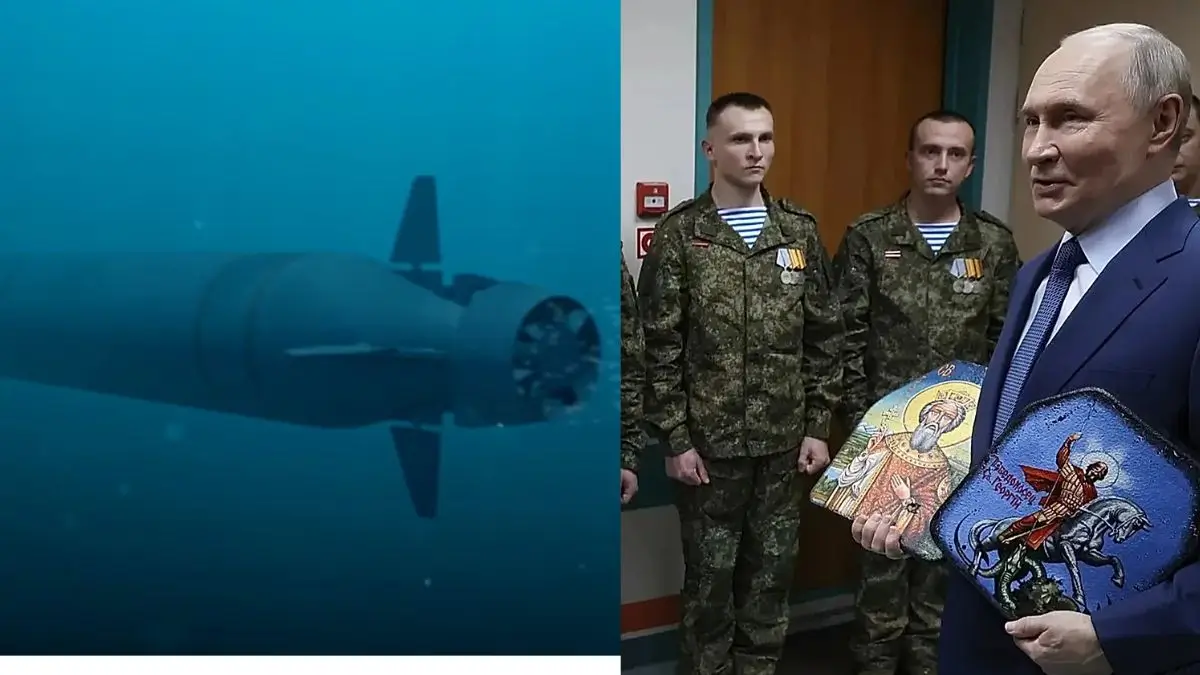
In a dramatic announcement on 29 October 2025, Russian President Vladimir Putin revealed that Russia had successfully tested Poseidon, a nuclear-powered and nuclear-armed unmanned underwater drone. According to Putin, the system is both “impossible to intercept” and capable of delivering devastating effects by triggering radioactive tsunamis near enemy coastlines. This signals a major development in strategic deterrence and maritime warfare.
What Is Poseidon?
- Poseidon, previously known as “Status-6”, is an autonomous underwater vehicle equipped with a miniaturized nuclear reactor.
- The weapon was tested while operating on nuclear power for the first time, which Putin described as a “huge success.”
- Unlike traditional submarines or missiles, Poseidon combines long-range underwater endurance with massive destructive potential.
Claimed Capabilities
President Putin stated that the Poseidon drone,
- Is powered by a nuclear reactor 100 times smaller than those in conventional submarines.
- Carries a warhead more powerful than Russia’s Sarmat intercontinental ballistic missile.
- Can travel at extreme depths and high speeds, evading current anti-submarine defense systems.
- Is designed to detonate near coastlines, causing radioactive tsunamis that could render large coastal cities uninhabitable.
- This sets it apart from existing strategic weapons in both purpose and effect.
Strategic Implications
Poseidon represents a shift in nuclear deterrence philosophy,
- It bypasses traditional missile defense systems by operating underwater at extreme depths and speeds.
- Its use against coastal regions could cripple urban centers and economic hubs, introducing a new layer of vulnerability.
- The announcement comes amid rising tensions over Ukraine and follows recent claims of a successful test of another nuclear weapon—the Burevestnik cruise missile—indicating a pattern of strategic signaling from Russia.
Regional and Strategic Impact
For countries like India and others in Asia, this development,
- Highlights the need to modernize naval detection systems and submarine tracking capabilities.
- Raises questions about coastal vulnerability and civil defense preparedness.
- Urges re-evaluation of nuclear doctrines, especially with autonomous, non-traditional delivery systems now entering the mix.


 WTO 14th Ministerial Conference Conclude...
 Former Suriname President Chandrikapersa...
 No Social Media for Kids Under 16: Indon...