
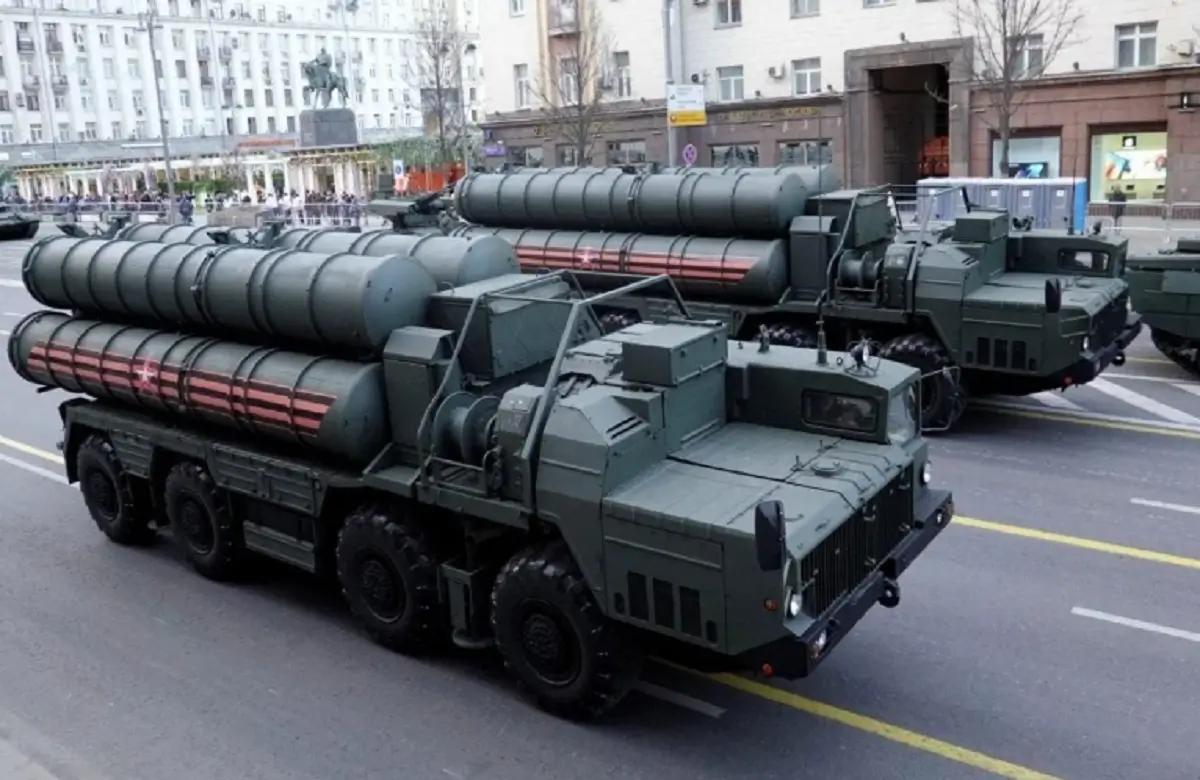
Russia’s S-500 Missile System, officially known as 55R6M “Triumfator-M” or Prometey, is shaping the future of global missile defence warfare. Entering service in 2021, it represents Russia’s most advanced mobile air and missile defence platform, capable of countering ballistic missiles, hypersonic threats, stealth aircraft, UAVs and low-orbit satellites.
Designed by Almaz-Antey for the Russian Space Forces, it complements the S-400 and A-235 defence systems, offering expanded reach into near-space interception.
Key Features of the S-500 Missile System
The S-500 stands out due to its futuristic design and multi-domain engagement capability.
1. Extended Engagement Range
- Can intercept targets at 600 km, making it one of the world’s longest-range air defence systems.
- Air-defence range is approximately 500 km.
2. Hypersonic Defence Capability
- Tracks and engages 10 hypersonic targets moving at 7 km per second.
- Designed to neutralize modern high-speed manoeuvring weapons.
3. Near-Space Interception
-
Target altitude capability reaches 180–200 km, enabling anti-satellite (ASAT) functions, unlike traditional air defence systems.
4. Faster Reaction Time
-
Responds under 4 seconds, significantly improving survivability against fast incoming projectiles.
5. Advanced Multi-Radar System
It integrates multiple cutting-edge radars, including:
- 91N6A(M) radar
- 96L6-TsP radar
- 76T6 and 77T6 engagement radars
These ensure long-range detection and reliable tracking.
6. Missile Types Used
The S-500 utilizes 40N6M, 77N6, and 77N6-N1 missile variants, each tailored for different threat profiles — including aircraft, ballistic targets, and satellites.
S-500 vs S-400: How Do They Compare?
Although the S-400 is already highly capable, the S-500 brings major enhancements.
| Parameter | S-400 | S-500 |
|---|---|---|
| Maximum Range | 380 km | 600 km |
| ASAT Capability | No | Targets low-orbit satellites |
| Response Time | <10 sec | 3–4 sec |
| Interception Altitude | 30–40 km | Up to 200 km (near-space) |
| Radar Power | Advanced but limited stealth detection | Superior multi-band radars |
| Hypersonic Interception | Limited | Mach 5–7 capable |
Thus, the S-500 represents a generational leap, especially in anti-ballistic and hypersonic defence.
S-500 Missile System and India: Strategic Interest
Recent Developments
During President Vladimir Putin’s December 2025 visit, reports suggest that the Indian Defence Minister may show interest in the S-500, amid broader India–Russia defence discussions.
Why India is Interested
- Russia indicated in September 2021 that India could be the first export customer.
- Performance of the S-400 in Operation Sindoor strengthened interest among strategic planners.
Challenges for India
However, several issues delay procurement:
- High procurement cost
- Complex maintenance requirements
- Specialised operator training needs
- Integration with Indian command-and-control networks
Thus, no final purchase decision has been made yet.
Negotiation Factors Ahead
Talks between Rajnath Singh and Russian Defence Minister Andrey Belousov may explore:
- Timely delivery of existing defence hardware
- Future roadmap for S-500 cooperation
Yet, export availability remains limited, meaning negotiations may take time.


 BRO's Project Chetak Turns 47: How It St...
 Indian Navy INS Aridaman: Features, Role...
 INS Taragiri Commissioned - What Makes T...











