
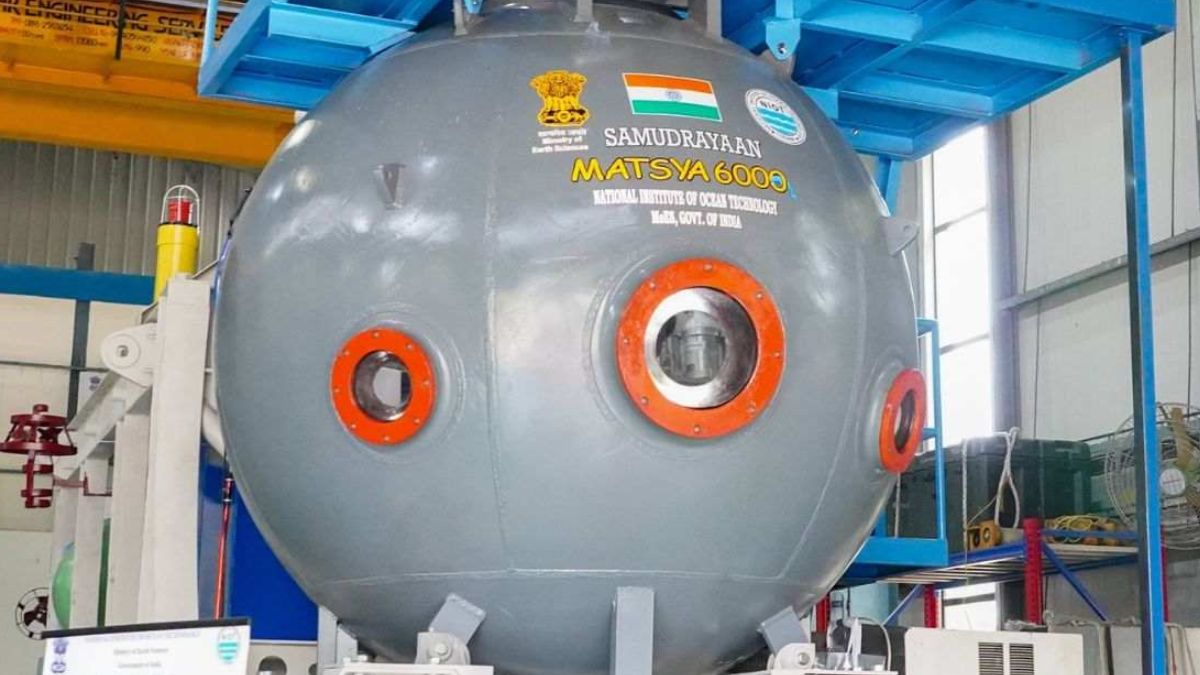
India is poised to make a significant leap in marine exploration with the launch of its first manned deep ocean mission, ‘Samudrayaan’, scheduled for 2026. Utilizing the indigenously developed submersible vehicle, MATSYA 6000, this mission aims to explore oceanic depths up to 6,000 meters, unlocking valuable insights into marine biodiversity and resource potential.
Why in News?
The announcement of the Samudrayaan mission highlights India’s growing capabilities in deep-sea exploration technology and marine research. With the mission launch slated within the next two years, it emphasizes India’s commitment to advancing its Blue Economy and joining the exclusive group of nations capable of manned deep ocean expeditions. This aligns with sustainable development goals and strategic interests in ocean resource management.
Aim and Objectives of Samudrayaan Mission
- To develop and deploy an indigenously designed manned submersible capable of deep ocean exploration at 6,000 meters.
- To collect deep-sea samples for scientific research, focusing on marine biodiversity, ocean geology, and chemistry.
- To explore living and non-living marine resources including minerals and polymetallic nodules.
- To demonstrate India’s advanced engineering capabilities in designing high-pressure underwater vehicles.
- To potentially pave the way for deep-sea tourism in the future.
- To strengthen India’s strategic position in global ocean research and diplomacy.
Background
- Samudrayaan is part of the larger Deep Ocean Mission (DOM), launched in 2021 by the Ministry of Earth Sciences.
- DOM has a budget of ₹4,077 crore over five years and is aligned with SDG-14 (Life Below Water).
- The National Institute of Ocean Technology (NIOT), Chennai, is spearheading the mission and technological development.
Key Features of MATSYA 6000
- It is a fourth-generation manned submersible vehicle, indigenously developed.
- Can carry three crew members to depths of 6,000 meters.
- Has an operational endurance of 12 hours and emergency endurance of up to 96 hours.
- Deployment and recovery of the submersible will be handled by India’s research vessel, Sagar Nidhi.
Significance and Impact
- Scientific Research: Deep-sea sample collection will enhance understanding of unexplored marine ecosystems and geological phenomena.
- Resource Exploration: Exploration of polymetallic nodules and minerals can boost India’s resource base.
- Technological Advancement: The mission showcases India’s capabilities in high-pressure ocean engineering.
- Strategic Importance: Enhances India’s position in ocean diplomacy and global maritime research.
- International Standing: Joins India with countries like the US, Russia, France, Japan, and China with manned deep-sea exploration abilities.
About the Deep Ocean Mission (DOM)
- DOM encompasses six components including manned submersible development, biodiversity exploration, mining, climate advisory services, marine biology research, and advanced ocean observation.
- It supports India’s Blue Economy by promoting sustainable exploration and utilization of ocean resources.
| Summary/Static | Details |
| Why in the news? | “Samudrayaan: India’s First Manned Deep Ocean Mission to Launch by 2026” |
| Mission Name | Samudrayaan |
| Launch Year | 2026 |
| Developed By | National Institute of Ocean Technology (NIOT) |
| Submersible Vehicle | MATSYA 6000 |
| Depth Capability | 6,000 meters |
| Crew Capacity | 3 persons |
| Operational Endurance | 12 hours |
| Emergency Endurance | 96 hours |
| Deployment Vessel | Sagar Nidhi |
| Budget (Deep Ocean Mission) | ₹4,077 crore (5 years) |
| Strategic Importance | Enhances India’s global ocean research status |
| Alignment | Supports SDG-14 (Life Below Water) |


 Meet MAI-Transcribe-1: Microsoft’s Fast,...
 What is Outer Space Treaty 1967? Princip...
 What Is Mission Mitra? ISRO’s New Experi...











