
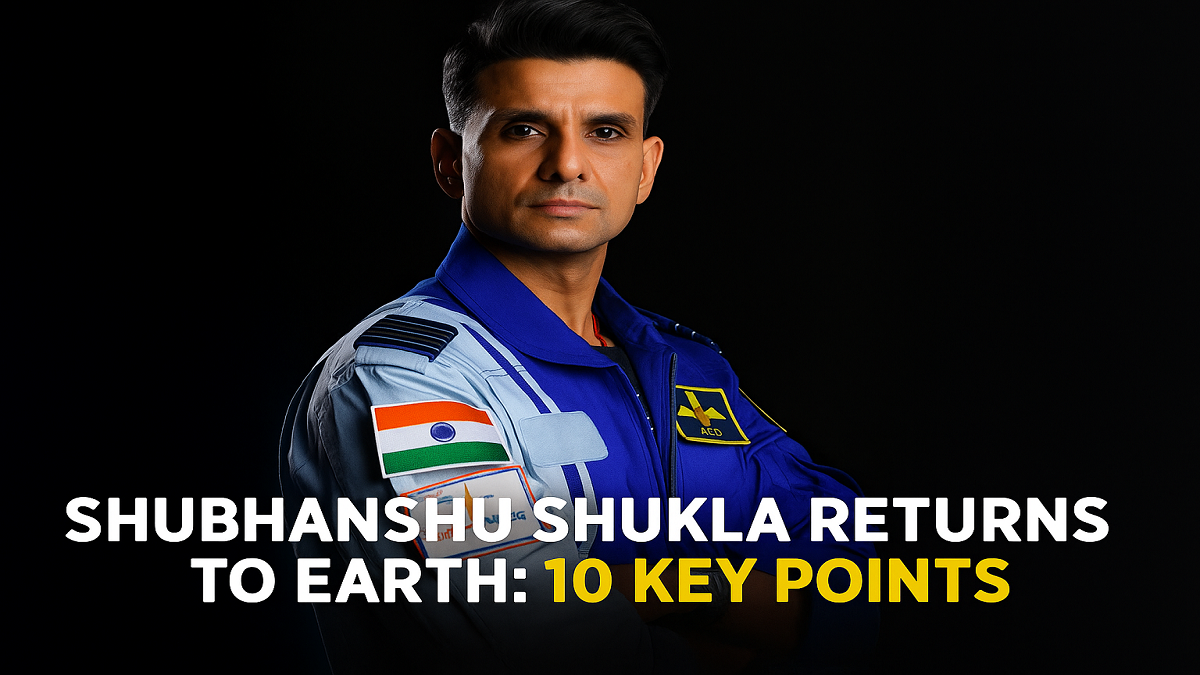
Why in the News
Group Captain Shubhanshu Shukla, an Indian Air Force officer and astronaut, successfully returned to Earth on 15th July 2025. He was part of the Axiom-4 mission, an international human spaceflight mission organized by Axiom Space, a private space company based in the United States.
Shukla and his three crewmates spent 18 days aboard the International Space Station (ISS). During this time, they completed 288 orbits around Earth. Shukla carried out several scientific experiments aimed at supporting future space missions and benefiting life on Earth.
His return marks an important milestone in India’s human spaceflight program and demonstrates India’s growing capabilities in space research and technology.
10 Key Takeaways:
1. Study of Space Microalgae
Purpose:
To explore the use of microalgae in producing essential life-support elements such as food, oxygen, and biofuels in space.
Details:
- Shukla studied how microalgae behave in microgravity, where gravity is extremely weak.
- He examined the resilience of microalgae and their ability to survive and grow without Earth-like conditions.
- One part of the experiment involved centrifugation of cyanobacteria, a type of algae that can produce energy through photosynthesis.
- Two different strains were compared to observe how microgravity affects their growth rates, cell structures, and chemical processes.
- The findings could help design life support systems for long-term missions to the Moon, Mars, or deep space.
2. Myogenesis Study
Purpose:
To understand how muscle cells behave in space and how the absence of gravity affects their growth and structure.
Details:
- The study is called Myogenesis, which refers to the formation and development of muscle tissue.
- Shukla conducted microscopic analysis of muscle cells and collected biological samples.
- Results from this study are important for designing countermeasures against muscle loss experienced by astronauts.
- The experiment could also provide insights for treating muscle-wasting diseases and age-related muscle weakness in elderly populations on Earth.
3. Sprouting of Methi and Moong Seeds
Purpose:
To investigate how plant seeds sprout and grow in microgravity.
Details:
- Shukla worked on a project involving methi (fenugreek) and moong (green gram) seeds.
- The goal was to see if seeds can germinate and form healthy sprouts in space.
- After sprouting, the seeds were stored at -80°C to preserve their structure and DNA.
- Once back on Earth, scientists will observe multiple generations of these seeds.
- Researchers will look for any changes in their genetics, nutrient content, and microbial environment.
- This research supports the goal of sustainable farming in space and may help improve crops grown in challenging environments on Earth.
4. Studies on Astronaut Health and Safety
Purpose:
To measure the effects of spaceflight on astronauts’ physical and mental health.
Details:
- Shukla and his fellow astronauts took part in a range of health studies.
- They used a device called the Rad Nano Dosimeter to monitor radiation exposure in space.
- The astronauts’ mental and cardiac health were also monitored regularly.
- The study included tracking how the human body adapts to temperature and how heat transfer occurs in microgravity.
- Shukla also underwent neuromuscular electrical stimulation therapy, a technique used to reduce muscle loss during long space missions.
5. Muscle Atrophy Investigation
Purpose:
To understand how muscles shrink and weaken in space.
Details:
- The experiment was carried out using the Life Sciences Glovebox, a sealed facility for handling biological materials.
- Shukla conducted tests to observe how microgravity affects muscle tissue over time.
- He also irrigated crop seeds to study how plant roots absorb water in space.
- These results can help improve exercise protocols for astronauts and support the development of space agriculture.
6. Study on Indian Strain of Tardigrades
Purpose:
To identify genes responsible for the extreme survival abilities of Tardigrades.
Details:
- Tardigrades, also called “water bears,” are tiny organisms known for surviving in extreme conditions, including space.
- Shukla studied the Indian strain of these organisms to understand what makes them so resilient.
- The goal is to discover genetic factors that could be useful in developing protective technologies for future astronauts and spacecraft.
7. Cyanobacteria Growth Study
Purpose:
To analyze how cyanobacteria can help in carbon and nitrogen recycling in space.
Details:
- Cyanobacteria were grown under microgravity conditions to study how they absorb nutrients and reproduce.
- This experiment may support the development of closed-loop systems in space habitats.
- Cyanobacteria were also studied for their potential as a nutrient-rich food source on long-duration missions.
8. Voyager Display Study
Purpose:
To study how astronauts interact with digital screens in space.
Details:
- The Voyager Display experiment was developed by IISc Bengaluru.
- It measured the stress and mental fatigue caused by screen usage in a weightless environment.
- The goal is to improve the design of user interfaces in spacecraft to reduce eye strain and fatigue.
9. Seed Resilience Trials
Purpose:
To test how different types of crop seeds respond to space conditions.
Details:
- Seeds tested included rice, cowpea, sesame, brinjal, and tomato.
- These seeds were exposed to microgravity to observe changes in growth, genetics, and resilience.
- Findings from this experiment may help develop climate-resilient crops for both Earth and space farming.
10. Axiom-4 Mission Overview
Mission Timeline:
- Launch Date: 25th June 2025
- Return Date: 15th July 2025
Key Features:
- The mission used SpaceX Dragon spacecraft launched by a Falcon 9 rocket.
- It was organized by Axiom Space, a private spaceflight company.
The crew included:
- Peggy Whitson (Commander, USA)
- Slawosz Uznanski-Wisniewski (Poland)
- Tibor Kapu (Hungary)
- Shubhanshu Shukla (India)


 What Is Mission Mitra? ISRO’s New Experi...
 NASA's Artemis II Mission Begins: First ...
 India's First Quantum Computer to be Lau...











