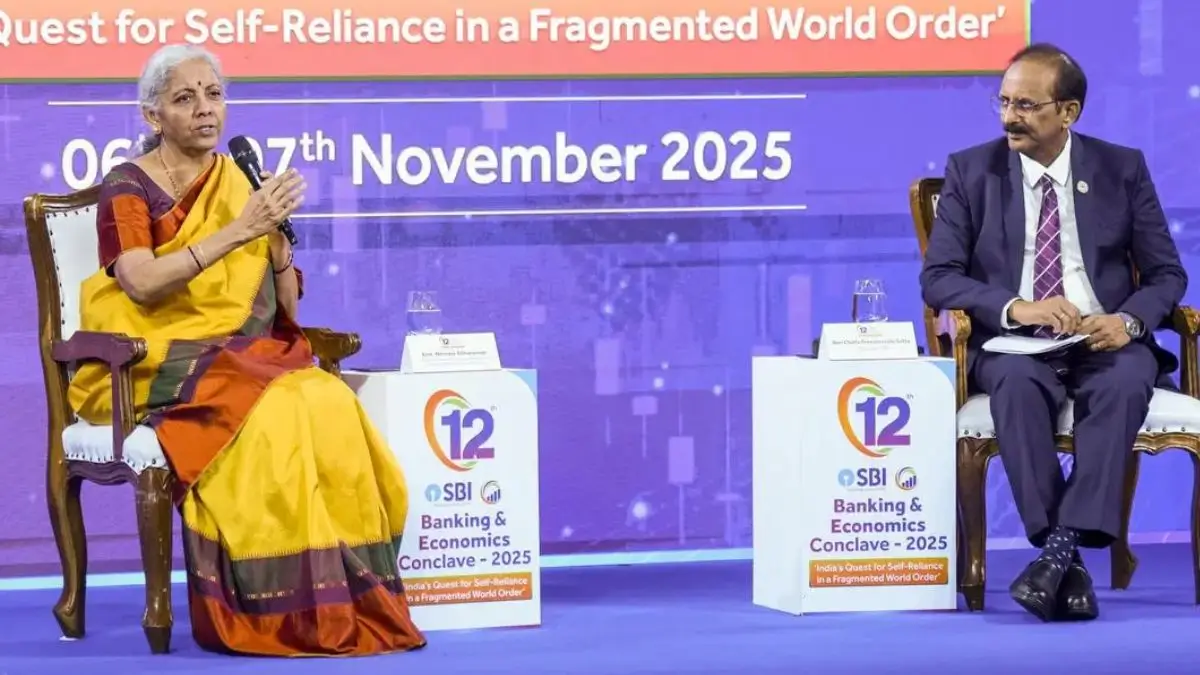
India is preparing for a new era of banking reform as Finance Minister Nirmala Sitharaman and RBI Governor Sanjay Malhotra express strong intent to build large, world‑class banks to match the country’s growing economic ambitions. From public sector bank mergers to easing regulatory frameworks, both leaders are setting the stage for a stronger, more competitive financial sector that can serve the evolving credit needs of the economy.
Finance Minister’s Vision: Scaling Up Indian Banks
Why India Needs Bigger Banks
Finance Minister Nirmala Sitharaman has strongly advocated for creating big, globally competitive banks to support India’s fast-growing economy. She pointed out that with rising demand across industries, especially after GST rate cuts, banks must be equipped to provide larger volumes of credit.
Government Strategy and Discussions
The Finance Minister confirmed that discussions are underway with the Reserve Bank of India and public sector banks to explore options for building banking scale. The objective is to enhance the sector’s ability to meet complex financing needs while ensuring greater financial inclusion.
Mergers and Ecosystem Development
Sitharaman highlighted that while consolidation through bank mergers is one route, the broader focus is on developing an ecosystem that supports growth, inclusion, and innovation in banking. The government’s past actions—reducing public sector banks from 27 in 2017 to 12 by 2020—serve as a model for the direction ahead.
Key Highlights from FM’s Address
Finance Minister Nirmala Sitharaman reiterated that India’s fast-growing economy demands strong, large-scale financial institutions capable of supporting industrial expansion, infrastructure development, and digital finance innovation.,
- Emphasis on world-class standards for Indian banks
- Focus on credit flow to industry, especially MSMEs and infrastructure
- Importance of local language and staff-connect at the branch level
- Exploration of further strategic disinvestment and consolidation
Background on Consolidation Efforts
Since 2017, India has reduced its number of public sector banks (PSBs) from 27 to 12 through a series of mergers aimed at improving efficiency and capital adequacy.
Recent Mergers Include,
- United Bank of India + Oriental Bank of Commerce → Punjab National Bank
- Syndicate Bank → Canara Bank
- Allahabad Bank → Indian Bank
- Andhra Bank + Corporation Bank → Union Bank of India
- Dena Bank + Vijaya Bank → Bank of Baroda
- Five associate banks of SBI + Bharatiya Mahila Bank → State Bank of India
These mergers have created stronger institutions capable of handling larger balance sheets and financing infrastructure projects on a global scale.
RBI Governor’s Perspective: Regulatory Support for Stronger Banks
Confidence in Current Banking Strength
RBI Governor Sanjay Malhotra reassured that India’s banks are now stronger and more resilient, having improved their capital positions, asset quality, and governance over the past decade. This strong foundation allows the RBI to support more flexible lending and consolidation strategies.
Easing of Norms to Boost Credit
The RBI has lifted curbs on bank financing of acquisitions, a move expected to stimulate private investment and allow banks to support larger business transactions. In addition, the regulator has raised caps on loans against IPO subscriptions to further promote market participation.
Balancing Freedom with Supervision
Governor Malhotra stressed that while regulation is necessary, the RBI does not intend to replace boardroom decision-making. Instead, it aims to enable banks to grow responsibly, using tools like risk weights, provisioning norms, and counter-cyclical buffers to maintain systemic stability.
Key RBI Measures
- Removal of restrictions on acquisition financing by banks
- Increase in IPO-related loan caps
- Call for more flexible but prudent regulation
- Confidence in risk management frameworks of banks
Policy Alignment: Government–RBI Synergy for Banking Transformation
The coordinated approach between the Finance Ministry and the RBI reflects a strong policy alignment toward banking sector transformation. Together, they aim to create,
- Globally competitive financial institutions
- Efficient capital allocation mechanisms
- Robust credit delivery systems
- Digitally integrated banking services
- Sustainable growth models that support India’s long-term economic goals
This synergy signals a new era in India’s financial sector where reform, innovation, and global competitiveness go hand in hand.


 SBI Launches Major Social Loan for Women...
 RBI Approves Ketan Merchant as Interim C...
 RBI Announces ₹1 Lakh Crore Bond Purchas...