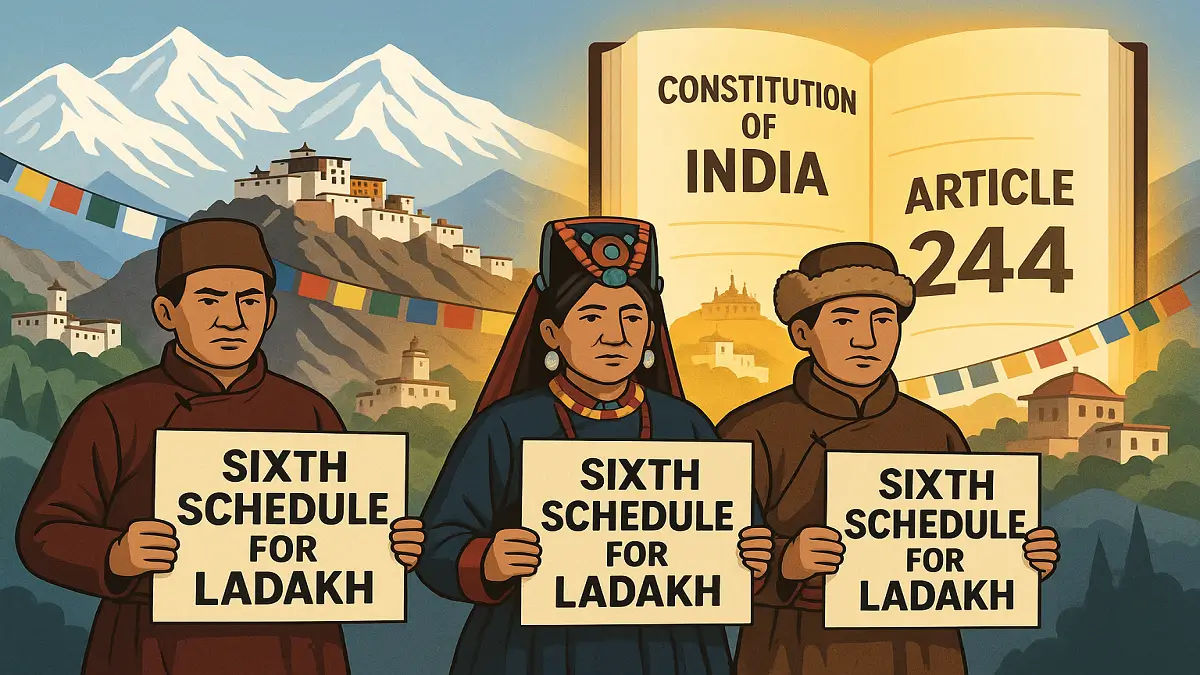
What is the Sixth Schedule?
Under Article 244 of the Indian Constitution, the Sixth Schedule allows for Autonomous District Councils (ADCs) in certain tribal areas (currently in Assam, Meghalaya, Tripura, Mizoram). These ADCs get legislative, executive, and judicial powers over local matters such as land, forests, water, village administration, social customs, and minor courts. The idea is to grant self-governance to tribal communities, protecting their culture, resources, and environment.
Why Ladakhers want Sixth Schedule status
| Reason | Explanation |
|---|---|
| Local autonomy & power | As a Union Territory (UT) without an elected legislature, many decisions in Ladakh are made by the central government and bureaucrats. Residents feel marginalized. |
| Protection of land & resources | Under Sixth Schedule, ADCs get authority over land, forests, and resource management. This is important in Ladakh, where environment and ecology are fragile. |
| Safeguard cultural identity | Ladakh has a predominantly tribal population (~97%). Sixth Schedule can help preserve distinct languages, customs, and social practices. |
| Legal/judicial powers | ADCs under Sixth Schedule can have their own local courts for certain cases among tribal communities. |
| Fulfill promises & demands | The demand for Sixth Schedule has been part of political promises in Ladakh. After becoming a UT in 2019, people feel their voice and rights got weaker. |
Challenges & constitutional constraints
- The Sixth Schedule is explicitly meant for certain northeastern states. Currently, no non-Northeast region has this status.
- Some officials argue that applying the Sixth Schedule outside the Northeast might conflict with existing constitutional design.
- For Ladakh to get it, the Parliament would need to pass a constitutional amendment or new legislation.


 Which Place is known as the Onion Hub of...
 Who were the Seven Sisters of Petroleum?...
 What is the State Flower of Florida? Che...