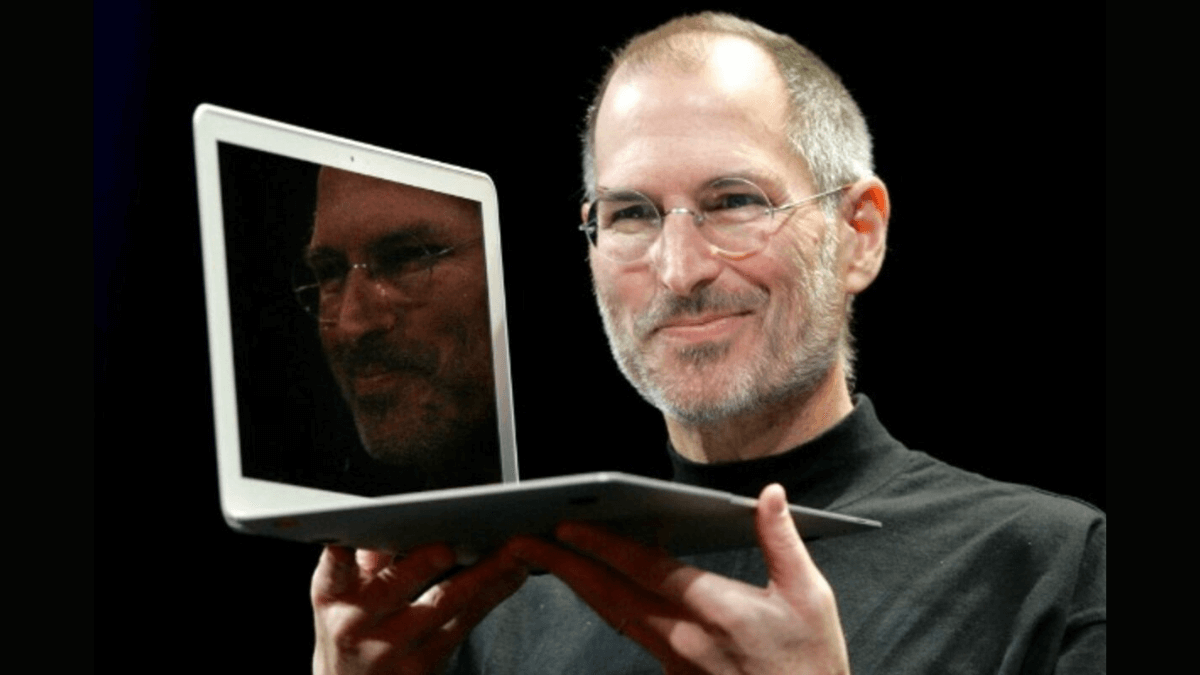
Steve Jobs was an American entrepreneur, inventor, and visionary who co-founded Apple Inc. He helped bring to the world the Mac, iPod, iPhone, iPad, and the App Store. He also founded NeXT and became the major shareholder of Pixar, the animation studio behind Toy Story. Jobs is remembered for turning bold ideas into products people love.
Early Life and Family of Steve Jobs
- Full Name: Steven Paul Jobs
- Born: February 24, 1955, San Francisco, California
- Adopted by: Paul and Clara Jobs
Jobs grew up in California’s Silicon Valley. His adoptive father, Paul, loved tools and machines and built a workbench for Steve. This hands-on start made Steve curious about electronics and design.
Schooling and Personlity
Jobs was smart but didn’t enjoy strict classrooms. He pulled pranks, got bored easily, and sometimes clashed with teachers. In high school (Homestead High) he met Steve Wozniak (“Woz”), a brilliant engineer. Jobs liked literature and art as much as electronics, which later shaped his “technology + design” way of thinking.
A Trip to India and Zen
In 1974, Jobs visited India seeking spiritual insight. He explored Zen Buddhism, learned meditation, and adopted a simpler lifestyle. This experience influenced his taste for simplicity, focus, and clarity—traits you can see in Apple’s product design.
Founding Apple
In 1976, Jobs, Wozniak, and Ronald Wayne started Apple in the Jobs family garage.
- Apple I: A bare circuit board for hobbyists.
- Apple II (1977): A colorful, easy-to-use home computer that became a big success and made Apple well known.
The GUI Vision and the Macintosh
After seeing ideas like the mouse and graphical user interface (GUI) at Xerox PARC, Jobs pushed Apple to build computers that were visual and friendly.
- Apple Lisa (1983): Too expensive, sold poorly.
- Macintosh (1984): First mass-market computer with a GUI and mouse. It launched with the famous “1984” TV ad. The Mac helped start desktop publishing when paired with the LaserWriter printer.
Leaving Apple and Starting NeXT
A power struggle with Apple’s leadership led Jobs to leave Apple in 1985. He then founded NeXT, building high-end computers for education and business. NeXT’s software later became the base for macOS and iOS.
In 1986, Jobs bought Pixar from Lucasfilm. Pixar made Toy Story (1995)—the first full-length computer-animated feature—and many hits after that.
Steven Jobs – Returning to Apple and the Big Comeback
Apple bought NeXT in 1997, bringing Jobs back as CEO. He simplified Apple’s product line and focused on a few great products:
- iMac (1998): Fun design, USB-only, easy internet—brought Apple back to profits.
- iTunes + iPod (2001): Made digital music simple and legal for everyone.
- iPhone (2007): A touchscreen smartphone that changed the mobile industry.
- App Store (2008): Let developers build apps; created a new economy.
- iPad (2010): Popularized tablets for media, work, and learning.
Jobs worked closely with designer Jony Ive, insisting on minimalism, quality materials, and intuitive interfaces. His slogan-like mantra: “Focus and simplicity.”
Leadership Style of Steve Jobs
Jobs was famous for:
- High standards: Demanded excellence and end-to-end control (hardware, software, stores).
- Product storytelling: Powerful keynotes that turned launches into events.
- Design first: Obsession with look, feel, and user experience.
- “Reality distortion field”: Strong persuasion that pushed teams beyond limits.
He could be tough, but many colleagues felt his pressure produced breakthroughs.
Health Challenges and Final Years of Steve Jobs
In 2003, Jobs was diagnosed with a pancreatic neuroendocrine tumor (a rare cancer). He had surgery in 2004 and later a liver transplant (2009). Despite health struggles, he led Apple through its most important launches. Jobs resigned as CEO in August 2011, became chairman, and passed away on October 5, 2011, at age 56.
Awards and Honors Presented to Steve Jobs
- 1987 – Jefferson Award for Public Service
- 1985 – National Medal of Technology
- 1989 – Entrepreneur of the Decade (Inc.)
- 1991 – Howard Vollum Award (Reed College)
- 2004–2010 – Time 100 Most Influential People (five times)
- 2007 – Most Powerful Person in Business (Fortune)
- 2007 – California Hall of Fame
- 2012 – Grammy Trustees Award
- 2012 – Edison Achievement Award
- 2013 – Disney Legend
- 2017 – Steve Jobs Theater (Apple Park)
- 2022 – Presidential Medal of Freedom
Legacy and Impact
- Technology: Helped shape personal computing, music players, smartphones, tablets, and digital stores.
- Design culture: Proved that design and user experience can be a company’s main advantage.
- Pixar & media: As Pixar’s leader, he helped transform animation and later became Disney’s largest individual shareholder when Disney acquired Pixar.
- Inspiration: His life shows the power of focus, taste, risk-taking, and never settling.
Key Innovations of Steve Jobs
- Apple II (1977): Early home-computer hit
- Mac (1984): GUI for the masses
- NeXT (1988): Platform whose software evolved into macOS/iOS
- Pixar (1995–): Toy Story and a new era of animation
- iMac (1998): Design-led PC revival
- iPod + iTunes (2001): Digital music revolution
- iPhone (2007) & App Store (2008): Mobile computing era
- iPad (2010): Mainstream tablets


 Which Country is the Largest Producer of...
 Weekly Current Affairs One Liners (09th ...
 Health Ministry Grants Lifetime Validity...