
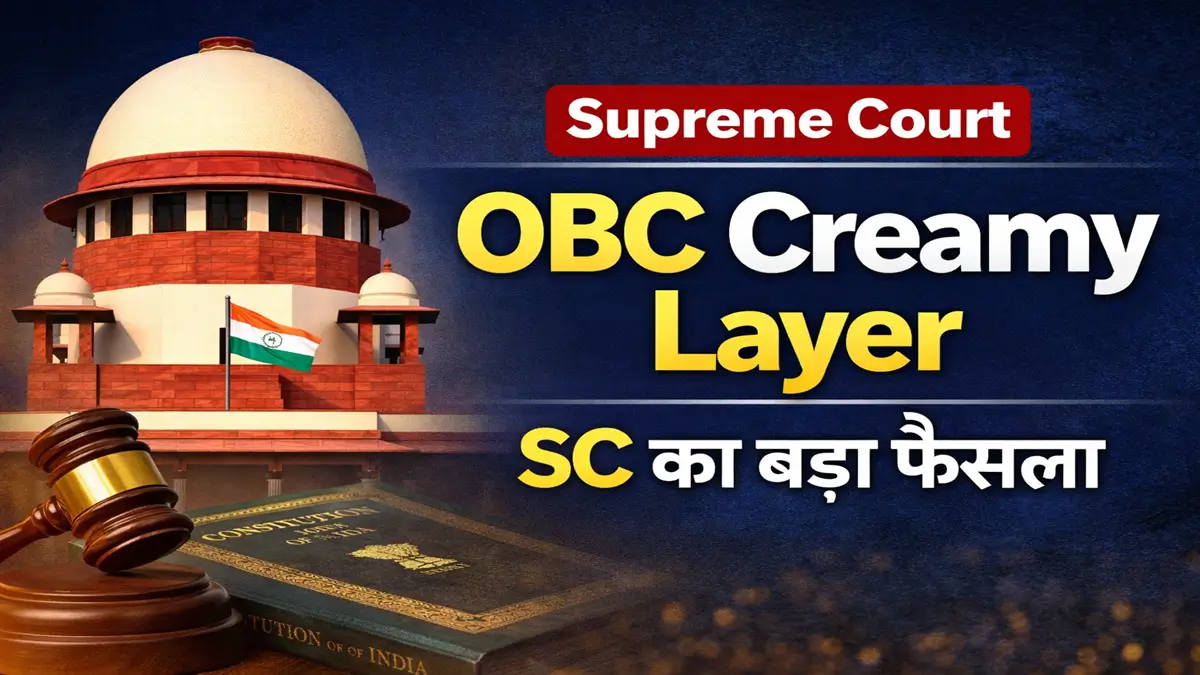
The Supreme Court of India has delivered an important judgment regarding the “creamy layer” exclusion in the Other Backward Classes (OBC) reservation system.
The Court clarified that parental income alone cannot be used as the sole criterion to determine creamy layer status. Authorities must also consider the nature of employment, social status, and position held by the parents while determining whether a candidate falls within the creamy layer category.
The judgment aims to ensure that reservation benefits reach genuinely disadvantaged sections within the OBC community.
What is the Creamy Layer in OBC Reservation?
The term “creamy layer” refers to the economically and socially advanced members of the OBC community who are excluded from reservation benefits.
The concept of creamy layer was introduced by the Supreme Court in the 1992 Indra Sawhney judgment, which dealt with the implementation of Mandal Commission recommendations.
Currently:
- The income limit for identifying the creamy layer is ₹8 lakh per year.
- Individuals falling under the creamy layer are not eligible for the 27% OBC reservation in government jobs and educational institutions.
Why Did the Supreme Court Issue This Clarification?
The issue arose due to disputes regarding how creamy layer status was determined for children of employees working in Public Sector Undertakings (PSUs), banks, and private companies.
Earlier, some rules relied mainly on parental income, which sometimes led to differences in treatment between government employees and employees in other sectors.
The Supreme Court observed that income alone cannot determine social advancement, and therefore multiple factors must be considered while deciding creamy layer status.
Key Observations of the Supreme Court
The Court made several important observations regarding the creamy layer rule.
Income Cannot Be the Only Criterion
The Court stated that income alone cannot decide whether someone belongs to the creamy layer.
Parental Occupation Must Be Considered
Authorities should also examine the position, rank, and nature of the parents’ employment.
Equal Treatment Across Sectors
Children of PSU, private sector, and government employees should not be treated differently when determining creamy layer status.
Purpose of Reservation
The goal of excluding the creamy layer is to ensure that reservation benefits reach the most socially and educationally backward groups.
What Could Change After This Judgment?
The Supreme Court’s clarification may influence how OBC reservation eligibility is determined in government recruitment and educational admissions.
Possible outcomes include:
- A more comprehensive evaluation of creamy layer status
- Consideration of both income and social position of parents
- Revised guidelines for determining eligibility for OBC reservation benefits
This may lead to greater fairness in the implementation of reservation policies.
Difference Between Creamy Layer and Non-Creamy Layer
| Category | Creamy Layer | Non-Creamy Layer |
|---|---|---|
| Reservation Eligibility | Not eligible | Eligible |
| Income Level | Above ₹8 lakh annually | Below ₹8 lakh annually |
| Social Status | Relatively advanced | Socially and economically backward |
| OBC Quota Benefit | Not available | Available |
Importance of the Creamy Layer Concept
The creamy layer principle ensures that reservation benefits are distributed fairly within backward communities.
Without this exclusion, economically stronger families within the OBC category might repeatedly benefit from reservations, preventing truly disadvantaged groups from receiving opportunities.
Therefore, the concept helps maintain social justice and equitable representation in education and employment.


 Jan Vishwas Amendment Bill 2026 Passed: ...
 India's First Digital Census 2027 Begins...
 PM Modi Launches Kaynes Semiconductor Pl...











