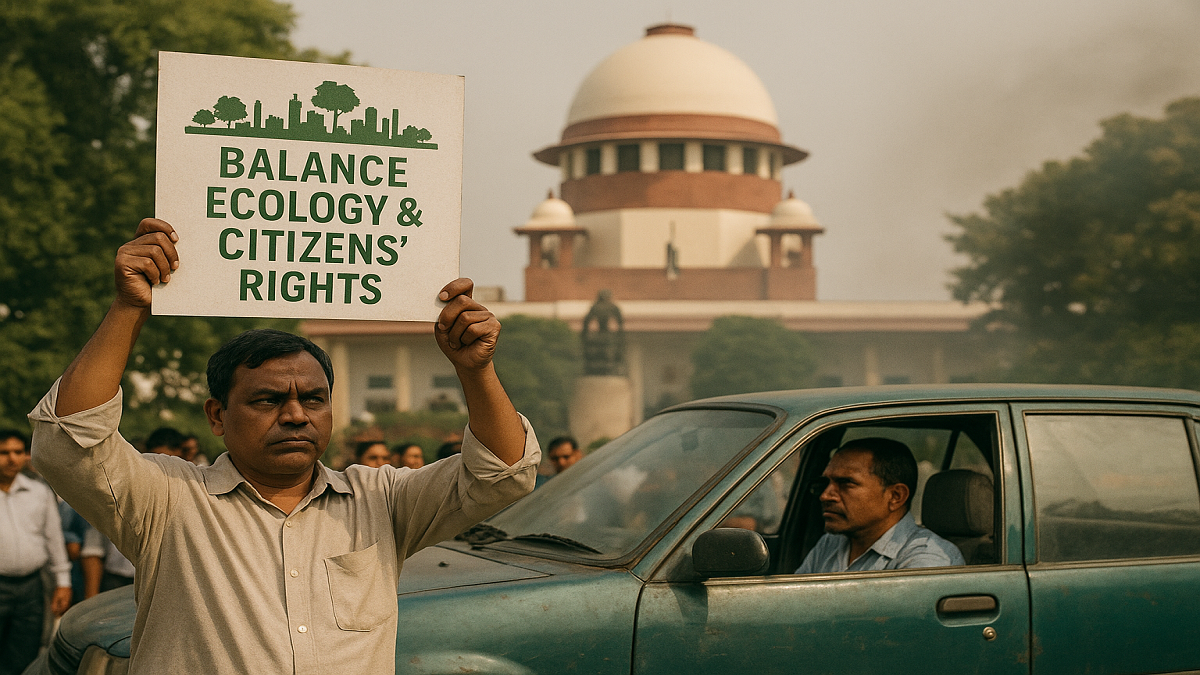
The Supreme Court has recently provided temporary relief to vehicle owners in the Delhi–National Capital Region (NCR) by halting immediate enforcement of the ban on:
- Diesel vehicles older than 10 years
- Petrol vehicles older than 15 years
This decision will remain in force while the court reviews a plea filed by the Delhi government seeking to reconsider the existing ban.
Background: Why the Ban Was Imposed
The National Green Tribunal (NGT) in 2015 ordered a blanket ban on older vehicles in Delhi–NCR as a measure to curb severe air pollution levels.
-
Blanket ban means a rule applied universally without exceptions — in this case, all diesel vehicles over 10 years old and petrol vehicles over 15 years old were prohibited, regardless of their actual emissions or condition.
-
The Supreme Court upheld this decision in 2018, making it legally enforceable.
Delhi Government’s Stand
The Delhi government now argues that this age-based ban is outdated and unfair, causing practical hardships for responsible vehicle owners.
They believe:
- Pollution levels should be measured scientifically, based on actual emissions, not just vehicle age.
- Technological advancements such as:
- BS-VI emission standards
- Wider coverage of Pollution Under Control (PUC) testing
- Stricter monitoring of emission norms make an outright age-based ban unnecessary.
A graded, technology-driven policy should replace the current ban, factoring in:
- Actual emission levels
- Vehicle mileage and condition
- Regular fitness tests
- Retrofitting options like CNG or electric conversion
What the Delhi Government Wants the Court to Do
- Direct the Centre or the Commission for Air Quality Management (CAQM) to conduct a scientific study on the relevance of the ban.
- Create a balanced policy that both protects the environment and respects citizens’ rights.
Significance of the Supreme Court’s Interim Order
- For now, no coercive action (such as penalties or vehicle seizures) will be taken against owners whose vehicles are older than the current legal age limit.
- This case has broader implications for policy-making in environmental law, showing how legal frameworks must adapt to technological progress and social realities.
Why This is Important for Exams
This case is a live example of:
- Environmental governance vs individual rights
- The role of judicial review in modifying or reassessing old policies
- The need for evidence-based policymaking in India. It can be linked to UPSC topics like Environment & Ecology, Polity, Science & Tech, and Governance.


 E20 Petrol India 2026: Nationwide Rollou...
 NCERT Gets ‘Deemed University’ Status: W...
 India Ranks 3rd Globally in Renewable En...