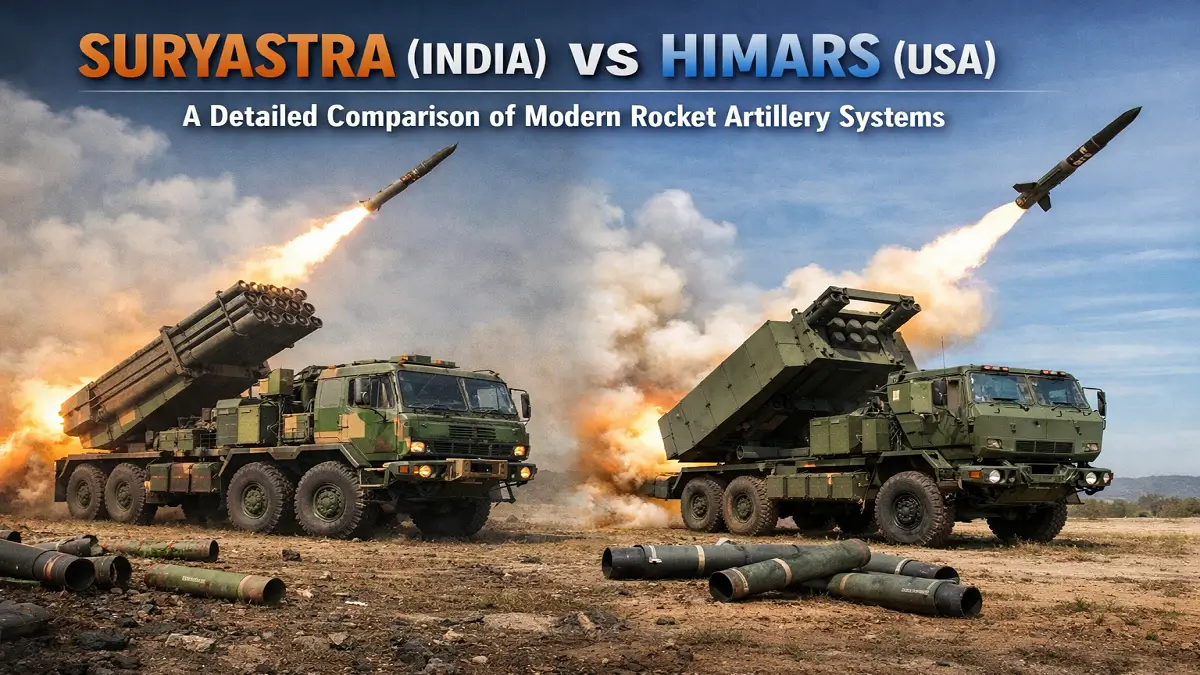
Modern artillery has moved far beyond traditional cannons. Today’s militaries rely on rocket artillery that combines precision, mobility, and long range to shape battlefield outcomes. Two such systems drawing attention are India’s Suryastra and the U.S. Army’s HIMARS. This article offers a deep, structured, and easy-to-understand comparison to help you grasp their designs, capabilities, and strategic importance.
1. What Are Suryastra and HIMARS?
Suryastra: India’s Versatile Rocket Launcher
Suryastra is India’s first indigenous modular rocket artillery system, developed by NIBE Limited in partnership with Elbit Systems of Israel. Designed to be a multi-calibre universal launcher, it can fire different rocket and missile types from a single platform. The goal is to enhance India’s precision firepower and reduce reliance on imports.
HIMARS: The U.S. Precision Rocket System
HIMARS stands for High Mobility Artillery Rocket System, produced by Lockheed Martin for the U.S. Army and allied forces. It is a high-mobility, wheeled rocket launcher mounted on a standard military truck chassis. HIMARS has seen extensive use in conflicts such as Iraq, Afghanistan, and Ukraine, proving its operational value in diverse combat environments.
2. Design and Mobility
Suryastra
- Modular Architecture: Designed to fire rockets and missiles of different calibres (e.g., 122 mm to larger tactical missiles) without changing the platform core.
- Flexible Mounting: Can be integrated onto various 4×4, 6×6, and 8×8 wheeled vehicles, enhancing tactical mobility across terrains.
- Universal Launcher Concept: Reduces logistical complexity by supporting multiple munitions from a single launcher.
HIMARS
- Single-Pod Launcher: Typically carries one launcher pod that can hold multiple rockets (e.g., six guided rockets) or one larger tactical missile.
- High Mobility: Mounted on a light tactical truck, enabling rapid movement and “shoot-and-scoot” operations to evade counterfire.
- Standardisation: Used widely by NATO and U.S. partners, simplifying training and logistics across allied forces.
3. Range and Precision Capabilities
| Feature | Suryastra | HIMARS |
|---|---|---|
| Typical Range | Up to 300 km (with appropriate missiles) | 15–92 km (GMLRS rockets), up to 499 km with PrSM missiles (approx.) |
| Precision (CEP) | High accuracy, typically within a few meters | Very high accuracy, often <5 m CEP depending on munition |
| Munition Types | Multiple calibre rockets & tactical missiles | Guided rockets (GMLRS) & advanced tactical missiles (PrSM/ATACMS) |
Explanation:
- CEP (Circular Error Probable) measures how close projectiles land relative to their intended target—a lower number means higher precision.
- HIMARS benefits from a family of GPS-guided munitions, while Suryastra’s design supports precision via guidance kits integrated into its rockets.
4. Flexibility and Mission Roles
Suryastra’s Operational Roles
Suryastra is intended for:
- Deep-strike precision fires against high-value targets far behind enemy lines.
- Multi-target engagement due to its ability to carry and fire various missiles.
- Flexible deployment in plains, deserts, and mountainous terrain.
HIMARS’ Operational Roles
HIMARS excels at:
- Direct fire support for ground forces.
- Precision barrage strikes on key infrastructure or concentrated enemy positions.
- Coordinated operations within joint force networks due to integrated targeting systems.
5. Combat Use and Field Performance
Suryastra
Still in early induction with the Indian Army, Suryastra has completed successful trials demonstrating range and accuracy. Its deployment is expected to significantly enhance India’s long-range firepower, especially along contested borders.
HIMARS
HIMARS has a proven combat record. It has been actively used in real combat operations, consistently demonstrating effective precision fire, rapid repositioning, and integration with command and control networks. This real-world use validates both its reliability and operational value.
6. Strategic Importance
Why Suryastra Matters for India
- Indigenisation: Reduces dependence on foreign weapons, in line with national defence priorities.
- Force Multiplier: Enhances strike capability without heavy, bulky systems.
- Operational Flexibility: One launcher for multiple munition types improves logistics and battlefield adaptability.
Why HIMARS Matters for the U.S. and Allies
- Combat Proven: Performance in multiple theatres confirms tactical value.
- Networked Warfare: Integrates with modern battlefield communications for coordinated operations.
- Export Success: Used by partner nations, supporting interoperability in allied operations.
7. Key Differences at a Glance
| Aspect | Suryastra | HIMARS |
|---|---|---|
| Origin | India (with Israeli technology cooperation) | United States |
| Launcher Type | Universal multi-calibre system | Single-pod precision rocket system |
| Mobility | Flexible vehicle options | Wheeled tactical truck |
| Operational Status | New/Induction phase | Widely used in multiple conflicts |
| Range Diversity | Up to ~300 km (varies) | ~15–499 km (munitions dependent) |


 Indian Air Force to Equip MiG-29 Jets wi...
 Indian Navy Hosts IONS Maritime Exercise...
 Indian Army Gets First Batch of Prahar L...