
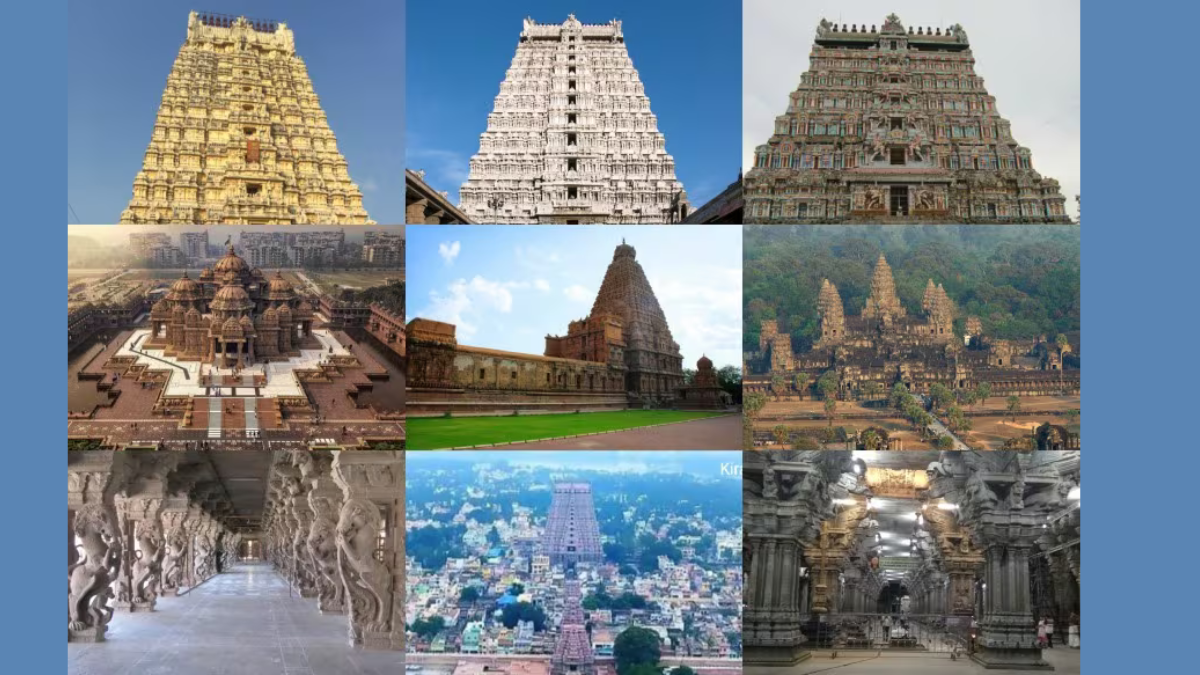
Temples are not just places of worship—they often rise majestically toward the sky as symbols of devotion and artistic achievement. Whether through soaring gopurams in South India, Himalayan shrines perched high in the mountains, or modern spiritual complexes, temples around the world reach impressive heights. Let’s explore the 10 tallest temples in the world, described in simple, reader-friendly language.
Top-10 Tallest Hindu Temples in the World
Murudeshwar Temple, located in Karnataka, India, stands as the tallest temple in the world, with an impressive height of 249 feet, followed by Ranganathaswamy Temple and Annamalaiyar Temple.
Here is the list of top-10 tallest Hindu temples in the world by 2025:
| Rank | Temple Name | Height |
| 1. | Murudeshwar Temple, Karnataka | 249 ft. |
| 2. | Ranganathaswamy Temple, Srirangam | 239.5 ft. |
| 3. | Annamalaiyar Temple, Tiruvannamalai | 216.5 ft. |
| 4. | Srivilliputhur Andal Temple | 193.5 ft. |
| 5. | Ulagalantha Perumal Temple | 192 ft. |
| 6. | Ekambareswarar Temple | 190 ft. |
| 7. | Kallazhagar Temple | 187 ft. |
| 8. | Kasi Viswanathar Temple, Tenkasi | 180 ft. |
| 9. | Sarangapani Temple, Kumbakonam | 171 ft. |
| 10. | Meenakshi Amman Temple, Madurai | 170 ft. |
Murudeshwar Temple, World’s Tallest Temple
The Murudeshwar Temple in Karnataka is famous for its 20-storey gopuram, rising to 249 feet. Built in the 16th century and expanded by later dynasties, it is dedicated to Lord Shiva as Sri Mridesa Linga. The temple stands near the Arabian Sea, creating a beautiful scenic backdrop. Visitors can take a lift to the top for breathtaking views. It is one of India’s most photographed temple towers and an important spiritual destination.
Ranganathaswamy Temple, Srirangam, Tamil Nadu
The Ranganathaswamy Temple in Srirangam is dedicated to Lord Vishnu and has a gopuram that reaches 239.5 feet. It is the largest functioning Hindu temple in the world. Built during the Chola dynasty, it was later rebuilt after floods. This temple is one of the most sacred Divya Desams and attracts millions of devotees each year. The grand gopuram, decorated with colorful sculptures, is an iconic landmark of Tamil Nadu.
Annamalaiyar Temple, Tiruvannamalai, Tamil Nadu
The Annamalaiyar Temple, dedicated to Lord Shiva, has a gopuram that rises to 216.5 feet. Located at the foot of Arunachala Hills, it is a major pilgrimage site. Built between the 9th and 13th centuries by the Cholas and later expanded by Vijayanagar rulers, the temple is known for its annual Karthigai Deepam festival. Its tall eastern tower is a striking example of Dravidian architecture and spiritual devotion.
Srivilliputhur Andal Temple, Tamil Nadu
The Srivilliputhur Andal Temple stands at 193.5 feet and is dedicated to Lord Vishnu and the saint-poetess Andal. Built during the Vijayanagar Empire, it is recognized for its towering gopuram, which is also the official emblem of Tamil Nadu. The temple is one of the 108 Divya Desams and is admired for its intricate sculptures and Dravidian style. It attracts devotees from across the country, especially during Andal’s festival.
Ulagalantha Perumal Temple, Thirukovilur, Tamil Nadu
The Ulagalantha Perumal Temple in Thirukovilur has a gopuram of 192 feet. Dedicated to Lord Vishnu in his Vamana (Trivikrama) form, it is one of three temples honoring this avatar. Built during the medieval Chola period and improved by the Vijayanagar Empire, the temple features beautiful carvings and sacred halls. It holds great significance among Vaishnavites and is part of the revered Divya Desams.
Ekambareswarar Temple, Kanchipuram, Tamil Nadu
The Ekambareswarar Temple is dedicated to Lord Shiva and has a towering gopuram of 190 feet. Originally built by the Pallavas and later rebuilt by the Cholas, it was completed under Krishnadevaraya of Vijayanagar. The temple is one of the Panch Bhoota Sthalams, representing the element earth. It is also home to a sacred mango tree believed to be more than 3,500 years old, attracting thousands of visitors.
Kallazhagar Temple, Madurai, Tamil Nadu
The Kallazhagar Temple has a seven-storey gopuram that rises 187 feet. Dedicated to Lord Vishnu as Kallazhagar, it is famous for its Chithirai Festival, where the deity is taken to the Vaigai River. Built between the 6th and 9th centuries by the Pandyas and later expanded by the Nayaks, this temple combines rich history with colorful celebrations, making it a major pilgrimage site in Tamil Nadu.
Kasi Viswanathar Temple, Tenkasi, Tamil Nadu
The Kasi Viswanathar Temple in Tenkasi features a gopuram that reaches 180 feet. Built by the 13th-century Pandya king Parakrama Pandyan, it is dedicated to Lord Shiva and Goddess Ulagamman. Later renovated by the Madurai Nayaks, it has seven tiers and beautiful stone carvings. The temple is a spiritual center and a fine example of traditional Tamil temple architecture.
Sarangapani Temple, Kumbakonam, Tamil Nadu
The Sarangapani Temple has an eleven-storey gopuram standing 171 feet high. Dedicated to Lord Vishnu as Sarangapani and Goddess Lakshmi as Komalavalli, it is one of the Divya Desams. Built by the Cholas and later expanded by the Vijayanagar rulers, the temple is a hub for Vaishnavite worship. Its tower is adorned with colorful sculptures and detailed carvings.
Meenakshi Amman Temple, Madurai, Tamil Nadu
The Meenakshi Amman Temple has a gopuram rising to 170 feet. Dedicated to Goddess Meenakshi and Lord Sundareswarar, it was built in the 6th century by Pandya king Kulasekara Pandya. Destroyed during the Delhi Sultanate invasion, it was later rebuilt by the Vijayanagar Empire and expanded by the Madurai Nayaks. Known for its artistic beauty, it is one of the most visited temples in India.


 Who is known as the Father of Mobile Pho...
 Which is the Highest Airport in the Worl...
 Which Country is the Largest Exporter of...











