
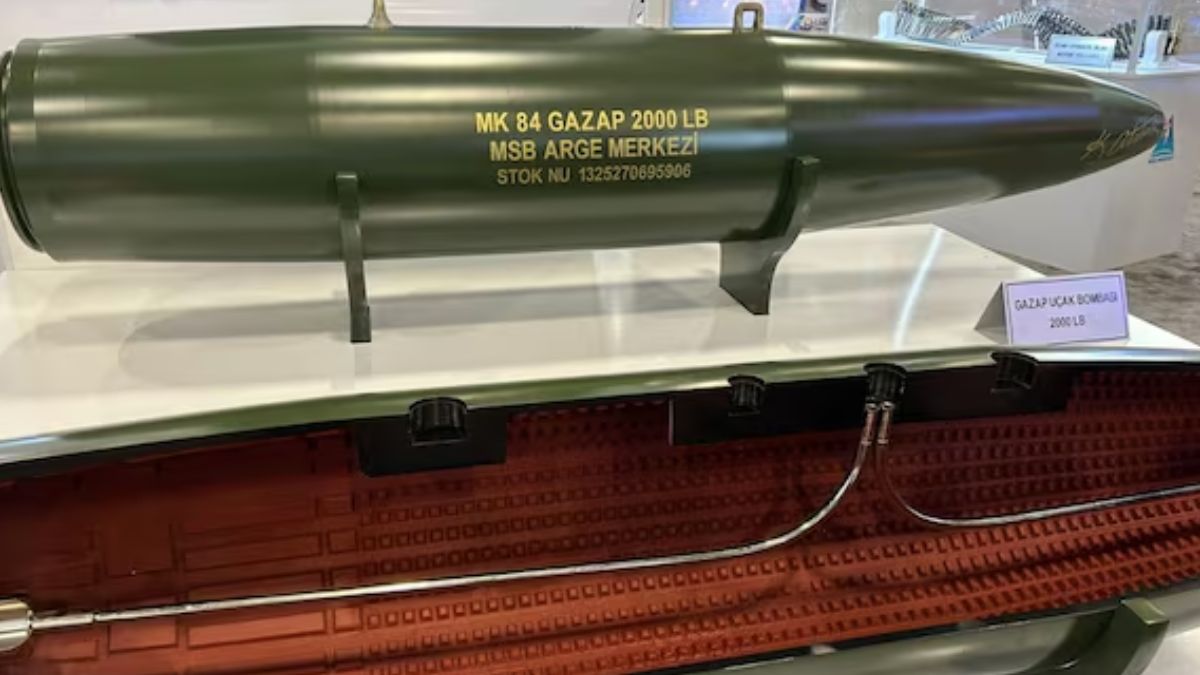
Turkey has unveiled its most powerful non-nuclear bomb, named Gazap (meaning Wrath in Turkish), at the 17th International Defence Industry Fair (IDEF) 2025 in Istanbul. Weighing 970 kilograms, the bomb represents a major leap in Turkey’s defence technology and has been described as one of the most lethal conventional weapons ever built.
Features and Capabilities of Gazap
The Gazap bomb is a fragmentation-based thermobaric weapon capable of dispersing an extraordinary 10.16 fragment explosions per metre, far surpassing the traditional standard of one fragment every three metres. This results in a massive kill zone with unprecedented precision. According to its chief designer Nilufer Kuzulu, the bomb contains nearly 10,000 controlled particles, dispersing within a one-kilometre radius, making it three times more powerful than standard MK-series bombs.
Testing and Thermobaric Power
Military trials of Gazap showcased its devastating impact. When dropped from an aircraft, it produced an intense explosion, creating shockwaves and a smoke cloud spanning 160 metres. Its thermobaric properties allow it to reach temperatures of up to 3,000°C, enough to melt steel and concrete. This immense heat, combined with extreme overpressure, makes Gazap one of the deadliest conventional arms, capable of vaporising everything within its range.
Aircraft Compatibility and Future Expansion
The bomb is fully compatible with F-16 fighter jets and F-4 Phantom aircraft, two key assets of the Turkish Air Force. Defence officials have indicated that future modifications could make Gazap deployable from drones, increasing its versatility on the battlefield.
NEB-2 Ghost: Another Game-Changer
Alongside Gazap, Turkey also introduced the NEB-2 Ghost (Hayalet) — another 970-kilogram bomb designed for deep penetration strikes. Unlike conventional bunker-busters, the NEB-2 can penetrate seven metres of ultra-strong concrete (C50 grade), compared to 2.4 metres of C35 concrete by US-made missiles. Its delayed explosion mechanism — extending from 25 milliseconds to 240 milliseconds — allows it to burrow deeper before detonating, amplifying its destructive impact.
Strategic and Global Implications
The unveiling of Gazap highlights Turkey’s growing ambition to become a global leader in advanced weapons technology. By investing heavily in domestic research and development (R&D), Ankara aims to reduce reliance on foreign defence imports. Defence analysts note that Gazap is a weapon just short of nuclear capability, redefining the boundaries of conventional warfare.
Controversy and Legal Standing
While thermobaric bombs are among the deadliest conventional weapons, international law does not explicitly ban their use against enemy positions — though targeting civilians remains prohibited. Historically, thermobaric weapons were first conceptualised in World War II, later used in Vietnam, and more recently deployed in the Russia-Ukraine conflict. Their humanitarian impact, however, remains a matter of international concern.


 Preeti Saran Re-Elected as UN Committee ...
 Global Trade Hits New High in 2025: Key ...
 Iran–US Ceasefire: Iran’s 10 Conditions ...











