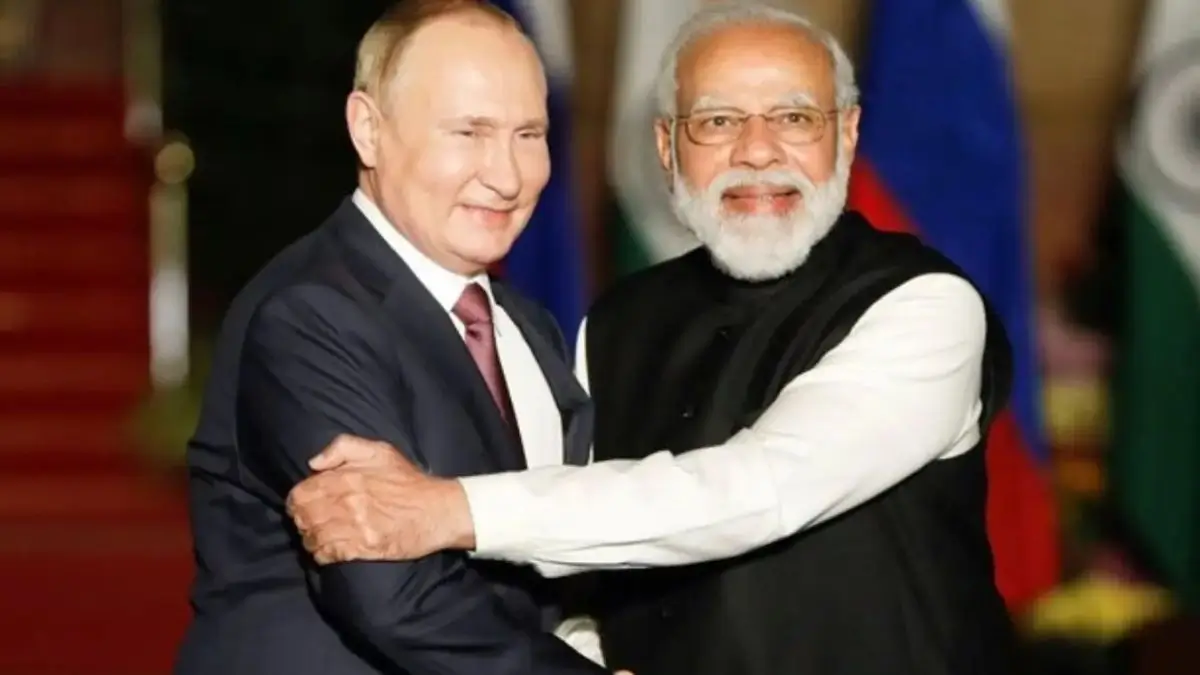
In a major diplomatic development, Russian President Vladimir Putin will visit India on 4–5 December 2025 for the 23rd India–Russia Annual Summit, marking a crucial moment in the long-standing and strategic partnership between the two countries. This visit, coming at the invitation of Prime Minister Narendra Modi, is expected to reaffirm and elevate bilateral cooperation across key sectors like defence, trade, energy, and global diplomacy. This will be Putin’s first visit to India since 2021, and notably, the first since the onset of the Russia–Ukraine conflict in 2022.
Background
India and Russia have shared strong diplomatic ties since 1947, which significantly deepened during the Cold War. The relationship was formally elevated with the Declaration on Strategic Partnership in 2000, followed by an upgrade to a “Special and Privileged Strategic Partnership” in 2010, reflecting high trust and multi-sectoral cooperation.
Annual summits, held alternately in both countries since 2000, form the backbone of this institutional engagement and are critical for reviewing progress and setting new goals.
Objective of the Visit
President Putin’s upcoming visit is aimed at reinforcing the multi-dimensional ties between India and Russia. The key objectives include,
- Reviewing ongoing bilateral projects and agreements
- Setting a strategic roadmap for future cooperation
- Enhancing dialogue on regional and global issues of mutual concern
- Strengthening cooperation in defence, energy, trade, and technology
President Droupadi Murmu will also host a banquet in honour of the Russian leader, reflecting the ceremonial and diplomatic importance of the visit.
Significance
This summit holds considerable strategic importance for both nations, particularly due to recent geopolitical changes,
- It is President Putin’s first India visit post-Ukraine conflict, showing continuity in ties despite global tensions
- Reaffirms India’s balanced foreign policy and strategic autonomy
- Russia continues to be a vital partner in India’s defence modernisation, energy security, and space exploration
- The summit reinforces both countries’ interest in a multipolar world order and non-Western platforms like BRICS and SCO
Key Areas of Discussion
The summit is expected to involve discussions across several vital sectors,
- Defence cooperation, particularly the S-400 air defence system, and potential new deals
- Enhanced energy collaboration, with long-term oil and gas supply partnerships
- Increasing bilateral trade, targeting US$100 billion by 2030
- Technological and scientific cooperation, especially in nuclear energy and space
- Strengthening local currency trade mechanisms (rupee–ruble) to reduce dependence on the US dollar
Exchange of views on Ukraine, Indo-Pacific, BRICS, and UN reform
Other Recent Developments
Ahead of the summit,
- External Affairs Minister S. Jaishankar met President Putin on 19 November during the SCO Council of Heads of Government
- On 18 November, he also met Russian Foreign Minister Sergey Lavrov to review summit preparations and bilateral cooperation
- India opened two new Consulates General in Russia, signalling deeper diplomatic engagement and outreach
- These interactions demonstrate active diplomatic coordination and high-level preparedness for the summit.
Static Facts and Data
- India–Russia diplomatic relations began in 1947
- Strategic Partnership signed in 2000, upgraded to Special and Privileged Strategic Partnership in 2010
- Annual Summit mechanism established in 2000, held every year (except pandemic years)
- Russia is India’s second-largest arms supplier
- India–Russia trade in FY 2024–25 reached US$68.7 billion
- Both countries aim to reach US$100 billion in bilateral trade by 2030
- Russia is a key player in India’s civil nuclear programme, including the Kudankulam plant
- Both nations are members of BRICS, SCO, G20, and the UN

 Which Banks Rule the World in 2026? Top ...
 List Of Outcomes Of Finland President Vi...
 Deadly Cassava Virus Threatens Africa’s ...