
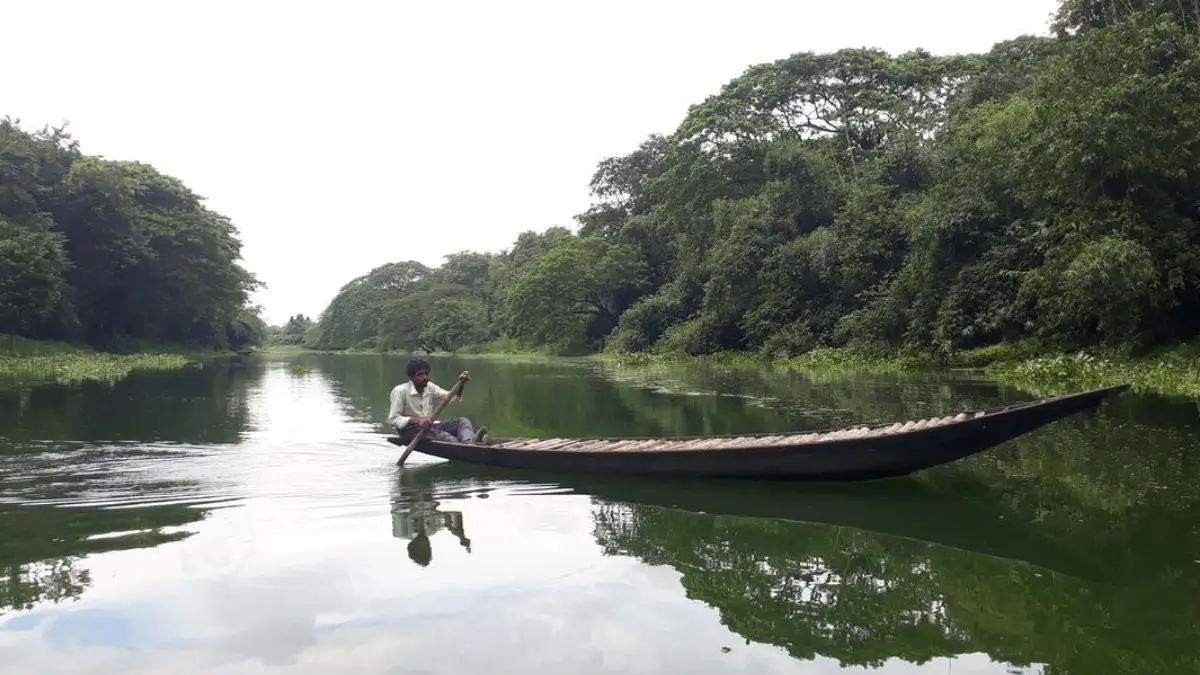
The Government of West Bengal has signed a memorandum of understanding (MoU) with German development agency GIZ and the State Mission for Clean Ganga (SMCG) to prepare basin-based masterplans for the Ichhamati and Jalangi rivers. The agreement, signed on February 23, 2026 which marks the first structured basin level river planning initiative in the state. While experts have welcomed the move and activists stress that implementation and community consultation will determine its success.
Basin-Based Masterplan for Ichhamati and Jalangi Rivers
The project falls under the State’s ‘Nodi Bandhan’ initiative which is announced in the 2025-26 budget with an allocation of ₹200 crore. The objective is to develop comprehensive, basin-based masterplans for river sub basins across West Bengal.
Out of the state’s 39 river sub basins, Ichhamati and Jalangi have been selected first.
The tripartite agreement involves,
- Deutsche Gesellschaft für Internationale Zusammenarbeit (GIZ)
- State Mission for Clean Ganga (SMCG)
- West Bengal’s Irrigation and Waterways Department
The initiative aligns with the broader goals of the National Mission for Clean Ganga.
Scope of the Masterplans: What Will Be Done?
According to officials, the basin-based masterplan for the Ichhamati and Jalangi rivers will focus on,
- Ensuring increased water flow through dredging.
- Diverting surplus water from other basins.
- Removing pollution and environmental hazards.
- Minimizing riverbank erosion.
- Enhancing groundwater recharge.
- Flood mitigation measures.
- Boosting irrigation supply.
The planning process is expected to be completed within one year, after which implementation will begin upon regulatory approvals.
Why Ichhamati and Jalangi Are at Risk
Ichhamati River
The Ichhamati river flows for nearly 200 km between India and Bangladesh and forms part of the international boundary.
Key challenges include,
- Severe siltation and stagnation.
- Rampant pollution from Basirhat, Hasnabad and Taki.
- Industrial and domestic waste discharge.
- Water hyacinth infestation.
- Eutrophication due to excessive nutrients.
- Decline in fisheries and local livelihoods.
The river is also a vital source of sediment for the Sundarbans delta.
Jalangi River
The Jalangi river, a distributary of the Ganga (Padma in Bangladesh), flows through Murshidabad and Nadia before merging with the Bhagirathi-Hooghly.
Major concerns include,
- Heavy siltation reducing water flow.
- Municipal sewage discharge in Krishnanagar.
- Industrial effluents.
- Toxic heavy metals like nickel and iron.
- Severe riverbank erosion.
Experts warn that shifting of the Padma channel has accelerated siltation at the offtake point and turning sections of the river shallow and nearly non-functional outside the monsoon.
Transboundary River Management Challenges
Both Ichhamati and Jalangi are transboundary rivers, meaning that actions upstream in Bangladesh influence water flow and quality in India.
Some concerns include,
- Polluted water inflow from across the border.
- Reduced upstream water discharge.
- Lack of coordinated international river governance.
Sustainable revival will require diplomatic and hydrological coordination beyond state-level planning.
Implementation: The Real Test Ahead
River experts have welcomed the masterplan initiative but cautioned that implementation remains the key challenge.
Kalyan Rudra, river expert and chairman of the State Pollution Control Board, noted that water flow in these rivers is gradually receding due to upstream changes.
Local activists have raised concerns about,
- Encroachments along riverbanks.
- Illegal fencing of river stretches.
- Waste dumping.
- Hyacinth overgrowth.
- Lack of enforcement of environmental norms.
India’s Transboundary Rivers by Neighboring Countries
India-Bangladesh (54 rivers shared)
| River | Key Facts/Issues |
| Ganga (Padma in Bangladesh) | Tributaries: Left – Gomti, Ghaghara, Gandak, Kosi; Right – Yamuna, Son, Punpun, Damodar. |
| Ghaghara | Origin: Tibetan Plateau; joins Ganga near Patna; high monsoon discharge. |
| Son | Flows 487 miles from Kaimur Range; joins Ganga above Patna. |
| Teesta | Originates in Himalayas; flows through Sikkim & West Bengal; Bangladesh seeks fair water allocation. |
| Feni | 1,147 km² catchment; 535 km² in India; bridge: Maitri Setu links India & Bangladesh. |
| Kushiyara | Distributary of Barak; starts in Assam, tributaries from Nagaland & Manipur. |
| Brahmaputra (Jamuna in Bangladesh) | Origin: Chemayungdung glacier (Tibet); tributaries: Subansiri, Kameng, Manas, Dhansiri; joins Ganga in Bangladesh to form Padma. Meghna Formed by Surma & Kushiyara; meets Padma in Chandpur. |
India-China
- Brahmaputra/Yarlung Tsangpo: Eastern side; tributaries Subansiri & Lohit.
- Indus River System: Western side; tributaries include Sutlej.
- Agreements: 2 MoUs for hydrological info from China.
India-Pakistan
- Indus River System: Includes Indus, Sutlej, Chenab, Jhelum, Beas, Ravi.
- Treaty: 1960 Indus Waters Treaty: Allocates western rivers (Indus, Chenab, Jhelum) to Pakistan, eastern rivers (Beas, Ravi, Sutlej) to India.
India-Nepal
- Major rivers: Kosi, Gandak, Rapti, Narayani, Kali/Sharda.
Question
Q. The Ichhamati river is a transboundary river between India and,
A. Nepal
B. Bhutan
C. Bangladesh
D. Myanmar


 What Is the Telangana–Deakin University ...
 How NARIT AI Will Help Gujarat Police Ha...
 What Is Kalai-II Hydro Project? Cabinet ...











