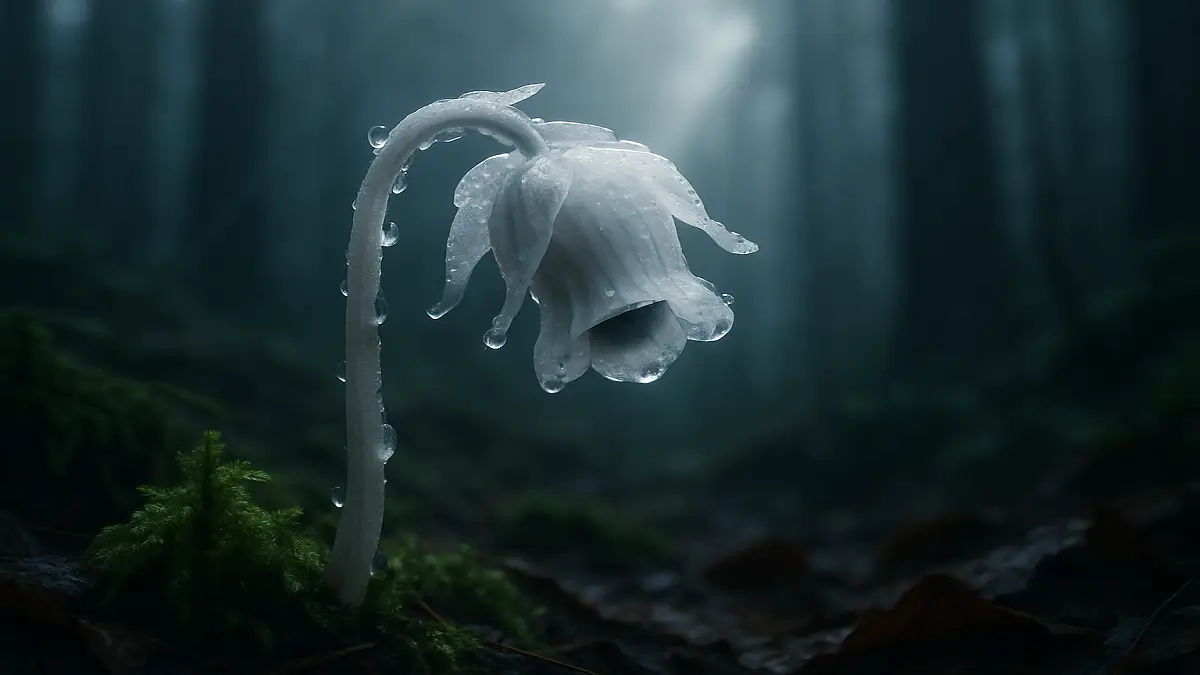
The ghost flower, scientifically known as Monotropa uniflora, is one of nature’s most mysterious plants. Also called the Indian pipe plant, ghost plant, corpse plant, or ice plant, it stands out for its translucent white or pinkish-white color. Unlike most plants, it lacks chlorophyll, the green pigment essential for photosynthesis.
Occasionally, rare red-tinted ghost flowers can be spotted, adding even more intrigue to this already extraordinary species.
Why Ghost Flowers Don’t Need Sunlight
Most plants use sunlight to produce food through photosynthesis. But the ghost flower has evolved differently. Instead of making its own food, it hijacks nutrients from underground fungi networks—which themselves are connected to nearby tree roots. This unique three-way relationship allows the ghost flower to steal carbon and nutrients indirectly from trees via the fungi, functioning as a parasitic plant. Because of this unusual survival strategy, ghost flowers thrive in dark, shaded forests where sunlight rarely penetrates—turning these deep woods into their natural sanctuary.
Pollination: Bumblebees to the Rescue
Even though ghost flowers seem lifeless and eerie, they depend on nature for reproduction. Bumblebees are the main pollinators of Monotropa uniflora. The flowers bloom in summer to early autumn, releasing a faint scent that attracts these bees to transfer pollen between blossoms.
Why You Won’t Find Ghost Flowers in Your Garden
Despite their captivating appearance, ghost flowers cannot be easily cultivated. Their entire survival depends on a specific underground fungal system—a network almost impossible to replicate in a garden setting. That’s why these plants are best admired in their wild habitats, often seen poking through forest leaf litter in summer or autumn after rainfall.
A Symbol of Nature’s Hidden Wonders
The ghost flower reminds us of the complex interdependence in ecosystems. It proves that not all plants follow the sunlight—some thrive in darkness, sustained by unseen networks beneath our feet.
So, if you ever spot a pale, pipe-like plant glimmering in a shadowy forest, you’ve likely encountered one of nature’s most hauntingly beautiful marvels—the ghost flower.


 Which City is known as the City of Thous...
 Which State has the Most River in India?
 Top-10 Polluted Countries in the World a...