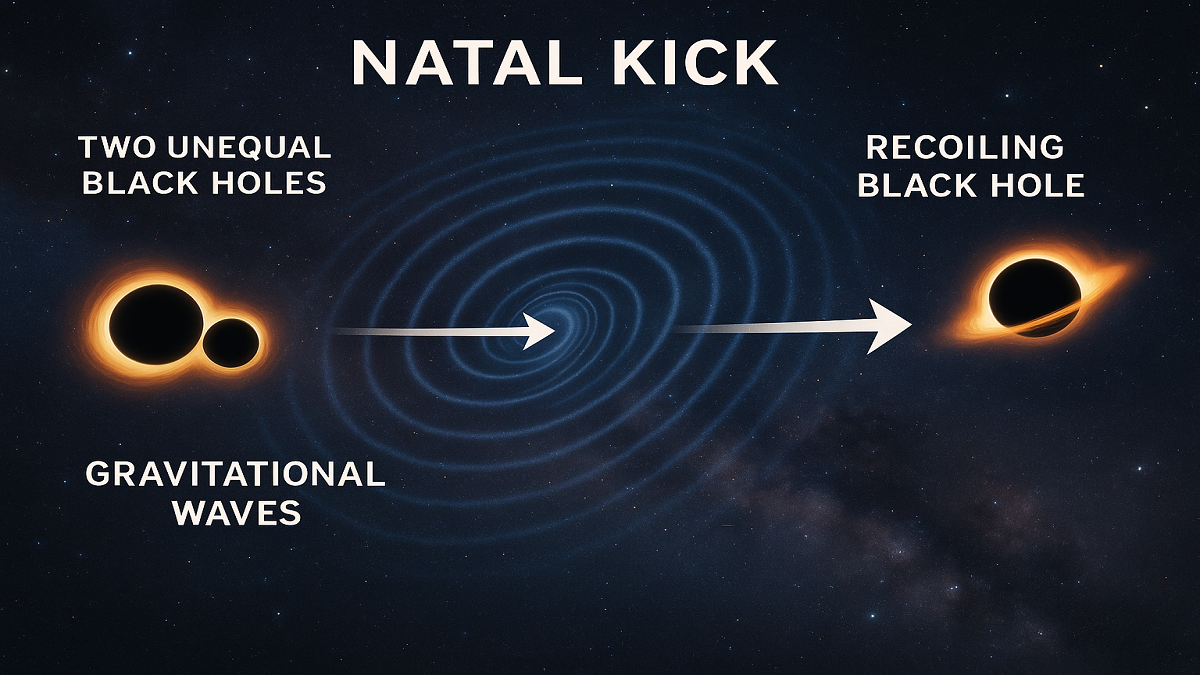
The universe is full of mysteries. Recently, scientists achieved a first-ever breakthrough: they measured the speed and direction of a “natal kick” — a powerful push that a newborn black hole gets after a collision. This discovery helps us better understand how black holes grow, move, and shape the universe.
What Happened During the Black Hole Collision?
In 2019, researchers detected a gravitational wave signal called GW190412. It came from two black holes colliding billions of light-years away.
Normally, when two black holes merge, the result is a bigger, heavier black hole. But in this case, the two colliding black holes were unequal in size — one was about 29.7 times the Sun’s mass and the other was 8.4 times the Sun’s mass.
Because of this imbalance, the new black hole was kicked like a football. This push, called a natal kick, sent it speeding through space at nearly 179,600 kilometres per hour (111,600 miles per hour). That’s so fast that the black hole likely escaped from the star cluster where it was born.
What Exactly is a Natal Kick?
- A natal kick is the recoil or push a black hole receives after two black holes merge.
- It happens because gravitational waves (ripples in space-time) carry away energy unevenly when the two colliding black holes are of different sizes or spins.
- The imbalance causes the new black hole to move in the opposite direction, just like a rocket recoiling when it fires.
How Did Scientists Measure It?
When black holes collide, they send out gravitational waves. These waves carry information about:
- The masses of the black holes,
- Their spins,
- And the direction of movement after the merger.
By studying the signal GW190412 from Earth using detectors like LIGO in the US and Virgo in Italy, scientists could calculate the speed and direction of the kick. This was the first time a natal kick had been measured directly, instead of just simulated on computers.
Why is This Discovery Important?
Understanding natal kicks is very important for astronomy:
- Black Hole Growth: If a new black hole is kicked out of its cluster, it cannot merge again. This limits how massive black holes grow over time.
- Supermassive Black Holes: These giants can be billions of times heavier than the Sun. Natal kicks may explain why some galaxies have them while others don’t.
- Mapping the Universe: Gravitational waves give scientists a new way to track the life cycle of black holes, alongside visible light observations.
What’s Next?
Astrophysicists now want to:
- Observe more black hole collisions,
- Combine gravitational wave data with light observations,
- And understand how small black holes evolve into cosmic giants.
As one researcher put it, this is one of the rare cosmic events we can fully reconstruct. Each new discovery opens another window into the mysteries of the universe.


 Meet MAI-Transcribe-1: Microsoft’s Fast,...
 What is Outer Space Treaty 1967? Princip...
 What Is Mission Mitra? ISRO’s New Experi...