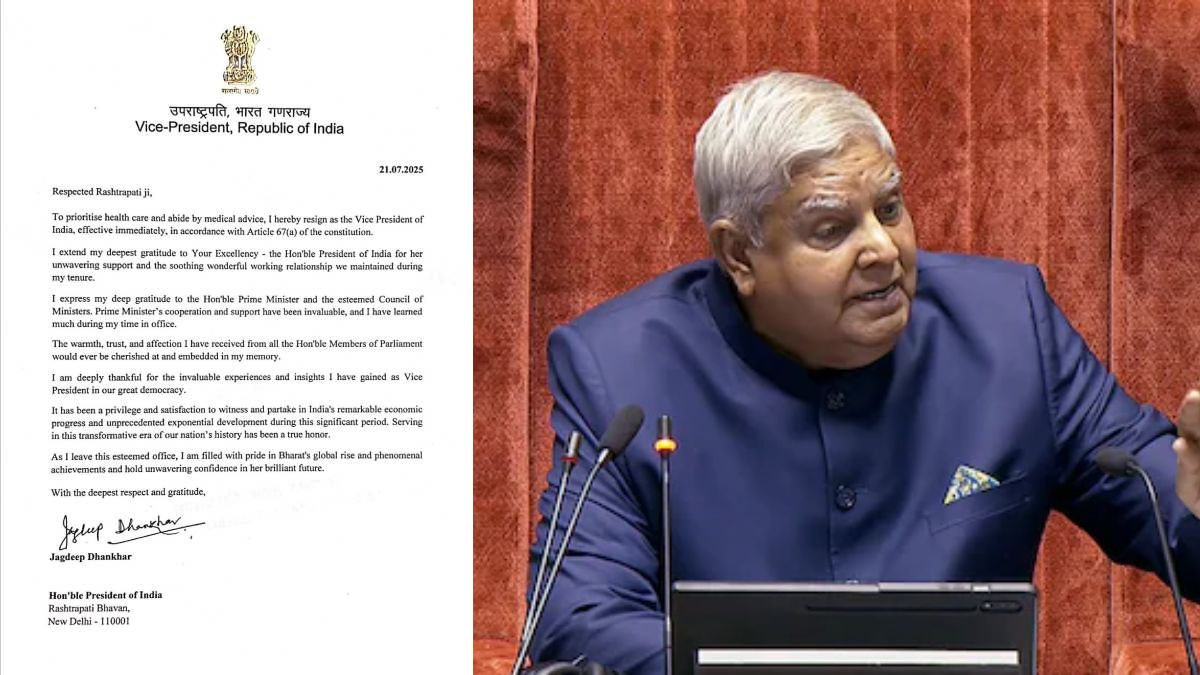
Article 67(a) of the Indian Constitution provides the legal foundation for the resignation of the Vice President of India. This provision came into focus with the resignation of Vice President Jagdeep Dhankhar on July 21, 2025, three years into his term. The clause ensures a clear constitutional process for stepping down from one of the country’s highest offices, thereby maintaining institutional continuity and stability.
Background
The Vice President of India is the second-highest constitutional authority and also serves as the ex-officio Chairman of the Rajya Sabha. The office was created under Article 63 of the Constitution, and the conditions for resignation or removal are laid out in Article 67. Clause (a) of this article specifically addresses resignation, allowing the Vice President to relinquish office through a written communication to the President.
Significance
The inclusion of Article 67(a) is significant because it offers a voluntary and transparent mechanism for resignation, avoiding ambiguity in high offices. This constitutional clarity is essential for ensuring smooth transitions and avoiding any power vacuum in the Rajya Sabha, which plays a crucial role in India’s bicameral parliamentary system.
Key Provisions of Article 67
Article 67 has three key clauses,
- Clause (a): The Vice President may resign by submitting a written letter to the President. The resignation takes immediate effect upon acceptance.
- Clause (b): The Vice President may also be removed from office by a resolution passed by a majority in the Rajya Sabha and agreed to by the Lok Sabha, with at least 14 days’ notice.
- Clause (c): Even after the five-year term ends, the Vice President remains in office until a successor takes charge, preventing institutional gaps.
Succession Process
Following a resignation, Article 68(2) mandates that a new Vice President must be elected within 60 days of the vacancy. The Election Commission announces the election schedule, and the electoral college—comprising both Lok Sabha and Rajya Sabha members, including nominated members—conducts the vote using proportional representation with the single transferable vote system.
Impact
Vice President Dhankhar’s resignation sets a constitutional precedent and demonstrates the functioning of Article 67(a) in real-time. Until a new Vice President is elected, Deputy Chairman Harivansh Narayan Singh will preside over the Rajya Sabha. This event reinforces the importance of procedural mechanisms in India’s constitutional framework.


 India Withdraws Its Plan to Host COP33 S...
 IIM Rohtak Wins BIMTECH's 'Hermes' Dialo...
 Gurgaon Tops the List of India's Most Po...