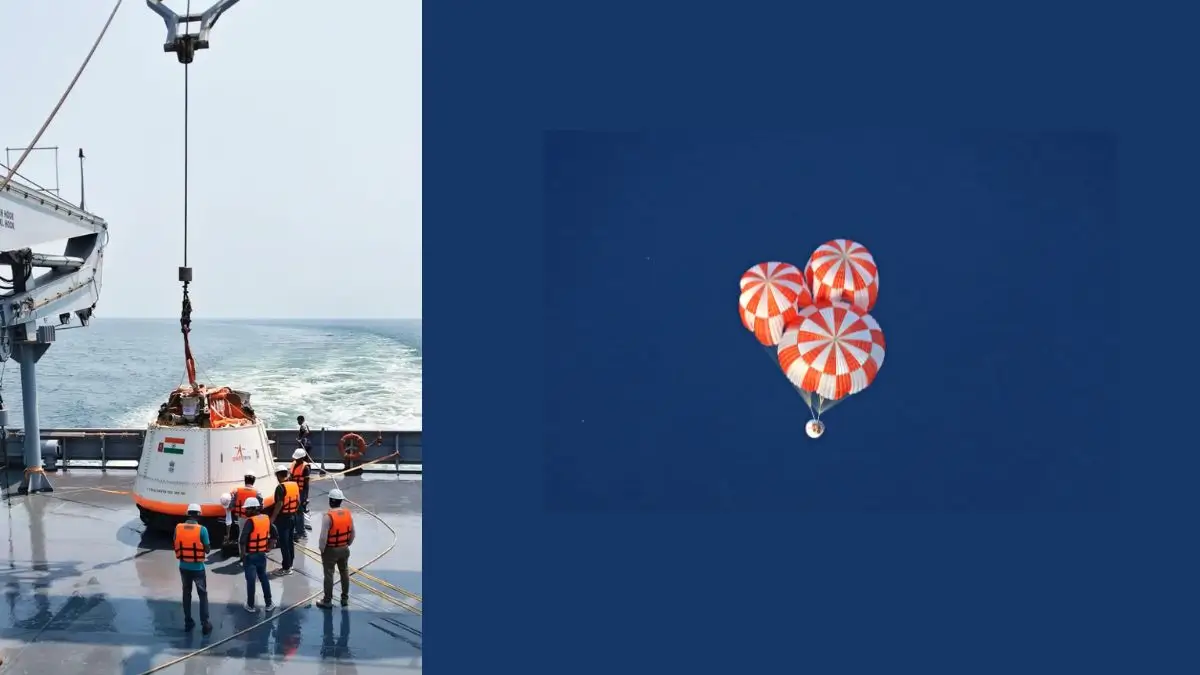
The second Integrated Air Drop Test (IADT-02) for Gaganyaan mission was successfully conducted at Satish Dhawan Space Centre, Sriharikota on April 10, 2026. This important test is part of preparations for the India’s first human spaceflight mission which is Gaganyaan. The simulated crew module was dropped from the height of about 3 km using a Chinook helicopter and validating the parachute-based landing system and recovery operations.
Key Highlights of IADT-02 Test
The IADT-02 test was focused on to evaluating the safe descent and the landing capability of the crew module. A 5.7 tonne simulated Crew Module which matching the weight of the module planned for the Gaganyaan G1 uncrewed mission was used in this exercise.
This module was lifted by the Chinook helicopter of the Indian Air Force and it released over a designated sea drop zone near Sriharikota.
This ensured real world conditions for testing recovery and descent mechanisms.
To ensure the safety during descent a complex parachute deployment system was tested.
The test validated the,
- Deployment of the 10 parachutes of four different types
- Also the precise sequencing of parachute opening
- Controlled reduction in the velocity before splashdown
Parachute System: The Core of Crew Safety
This parachute system plays the important role to ensuring the astronaut safety during re-entry and landing.
During the IADT-02 test this parachutes were deployed in a carefully timed sequence and it gradually slowing the module.
This staged deployment is vital because after the sudden deceleration could damage the module or can harm astronauts.
This system will be ensuring the smooth and controlled descent which allows for the safe splashdown in the sea.
After the success of this test it can be stated that ISRO’s deceleration technology is reliable and mission-ready and which is the main requirement before sending humans into space.
Successful Recovery Operation with Defense Forces
After splashdown of the Crew Module in to the sea it was successfully recovered by the Indian Navy and which is shows the seamless coordination between multiple agencies.
This mission also have the active participation from the Defense Research and Development Organization (DRDO) and it is highlighting the joint effort across India’s defense and space ecosystem.
This coordination in recovery is important because in the actual mission and the astronauts will rely on quick and precise rescue operations after landing in the sea.
Why This Test Matters for Gaganyaan Mission
The success of IADT-02 marks the significant milestone towards the India’ human spaceflight ambitions. It also brings the ISRO closer to launching the Gaganyaan G1 uncrewed mission which will test systems before the astronauts are sent to space.
This test demonstrates,
- The readiness of crew escape and landing systems.
- Reliability of the parachute deployment mechanisms.
- The efficiency of multi-agency coordination for recovery.
About Gaganyaan Mission
The Gaganyaan mission is India’s ambitious plan to send the astronauts into the low Earth orbit and safely to return them back on the earth. It also represents a major leap in India’s space capabilities.
Key objectives of the mission include,
- To demonstrating the human spaceflight capability.
- Also by developing life support and safety systems.
- Enhancing the technological self-reliance in space missions.


 India's First Indigenous Quantum Computi...
 UAE Introduces World's First 10G Interne...
 Meet MAI-Transcribe-1: Microsoft’s Fast,...