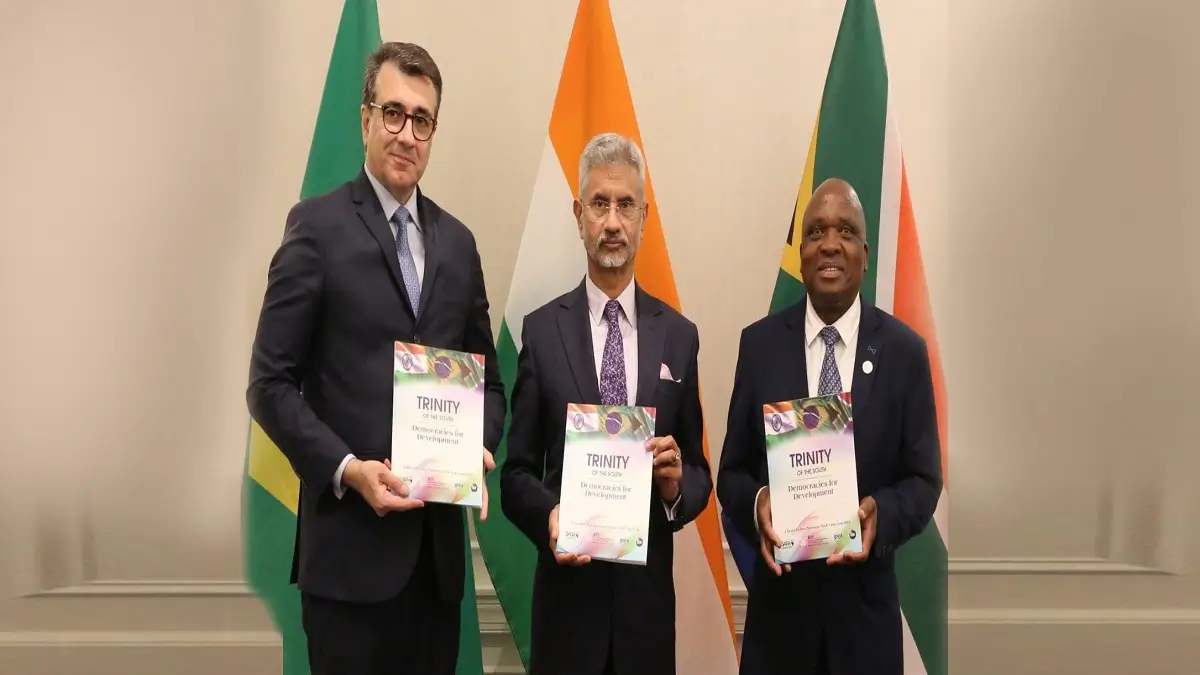
On the sidelines of the G20 Summit in Johannesburg, Prime Minister Narendra Modi held a trilateral meeting with the Presidents of Brazil and South Africa to strengthen the IBSA Dialogue Forum. The leaders discussed cooperation in areas such as climate-resilient agriculture, digital innovation, counter-terrorism, UN reforms, and broader Global South priorities.
What is the IBSA Forum?
The IBSA Dialogue Forum is a tripartite platform comprising India, Brazil, and South Africa—three major democracies from Asia, South America, and Africa. It was formalised through the Brasilia Declaration on 6 June 2003.
Importantly, IBSA has no headquarters or permanent secretariat, making it a flexible, consultative grouping driven by shared values of democracy, development, and dialogue.
Key Areas of Cooperation:
- Political Consultation: Coordination on regional and global political matters.
- Trilateral Collaboration: Sectoral working groups and people-to-people engagement.
- South-South Development: Implementation of projects via the IBSA Fund.
IBSA Fund and Development Projects
Established in 2004 and operational from 2006, the IBSA Fund aims to support poverty and hunger alleviation in developing nations, especially Least Developed Countries (LDCs). So far, it has allocated USD 53.27 million to 46 projects in 34 countries, demonstrating a model of effective South-South cooperation.
Military Cooperation: IBSAMAR
IBSA also conducts joint maritime military exercises under the name IBSAMAR. The 8th edition of IBSAMAR was held in October 2024 off the coast of South Africa, showcasing defence collaboration and strategic trust among the three nations.
2025 Initiatives Proposed by India
India proposed several forward-looking initiatives during the 2025 G20 Summit:
- A National Security Advisers (NSA)-level Dialogue for regular discussions on security and counter-terrorism.
- A new IBSA Fund for Climate-Resilient Agriculture to help Global South nations adapt to climate change.
- A Digital Innovation Alliance to share India’s successful digital platforms like UPI, CoWIN, and cybersecurity frameworks.
How IBSA Supports India’s Global Interests
Voice of the Global South
IBSA serves as a collective voice for the Global South, promoting inclusive development, democratic governance, and fair global rules. It allows India to lead Global South initiatives without the influence of China, unlike forums such as BRICS or SCO.
Push for UN Reforms
A major goal of IBSA is to push for multilateral reform, especially at the United Nations Security Council (UNSC). All three countries are candidates for permanent membership, and IBSA amplifies India’s demand for a more representative global governance structure.
Promoting Democracy and Shared Values
IBSA unites countries with multi-ethnic, democratic structures, reinforcing India’s position as a “Democratic Anchor” of the Global South. It contrasts India’s approach with China’s authoritarian model, enhancing India’s soft power.
Development Leadership through the IBSA Fund
The IBSA Fund allows India to support development in health, education, and agriculture across the Global South. Unlike China’s debt diplomacy, the fund presents India as a trusted and responsible development partner.
Global Strategy and Digital Export
IBSA provides a platform for India to globalize key concerns such as cross-border terrorism, climate action, and trade reforms. It also enables India to export successful tools like UPI, Aadhaar, and Digital Public Infrastructure (DPI) to emerging economies.
Key Challenges Facing IBSA
Diverging Foreign Policy Alignments
Brazil’s shifting foreign policy and South Africa’s domestic instability limit strategic alignment. India’s deeper security partnerships contrast with Brazil and South Africa’s relatively non-aligned or China-friendly approaches.
Overlap with BRICS Agenda
IBSA’s focus areas—UN reforms, development, energy—are already part of BRICS, which now includes China and new members like Egypt and UAE. As BRICS becomes more action-oriented, IBSA risks fading into irrelevance.
Economic Competition and Low Trade
Although IBSA economies share common sectors like agriculture and services, intra-IBSA trade remains low due to weak logistics and connectivity. Instead of complementing each other, the countries sometimes compete for similar markets.
Institutional Weakness
IBSA lacks a permanent secretariat, which affects continuity. Projects face bureaucratic delays due to differing national systems and limited institutional capacity.
Future Pathways for IBSA Cooperation
To strengthen its relevance, IBSA must:
- Focus on Niche Areas: Such as democratic governance, digital public goods, and climate-resilient development. India’s digital success stories can serve as global models.
- Create a Permanent Secretariat: A small core body can ensure project tracking, implementation, and institutional memory.
- Launch an IBSA Business Council: To explore trade complementarities and boost economic integration.
- Act as a Caucus within BRICS: Coordinate joint positions to balance China’s dominance and push for democratic values in global forums.
- Revive and Expand the IBSA Fund: Use it to launch impactful projects in vulnerable nations, showcasing effective and ethical South-South development.


 Russia and China Veto UN Resolution to R...
 France Hosts One Health Summit Under G7 ...
 Newcastle Disease Spread in Europe 2026:...