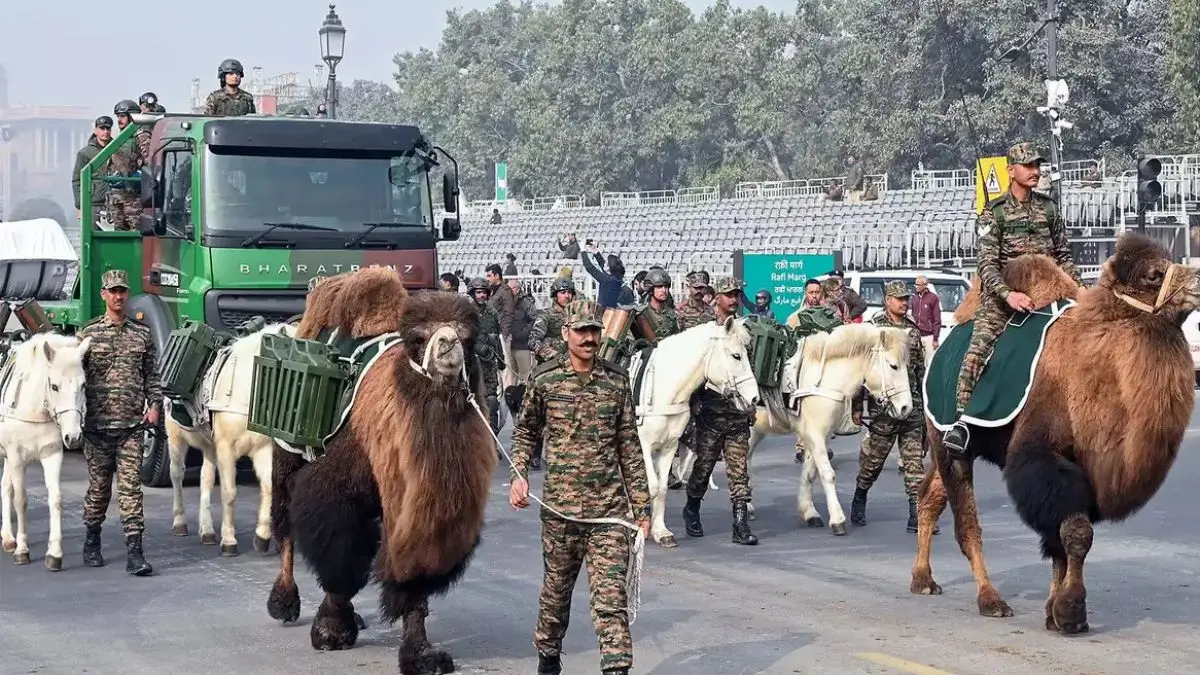
In a unique and symbolic moment during the 77th Republic Day Parade, India showcased an extraordinary element of its natural and strategic heritage. For the first time ever, double-humped Bactrian camels from Ladakh marched down Kartavya Path, drawing national attention. Named Galwan and Nubra, these camels represented not just tradition, but resilience, biodiversity, and India’s evolving high-altitude defence preparedness.
Why in News?
Bactrian camels from Ladakh made their historic debut at the Republic Day Parade 2026, highlighting their rarity, ecological importance, and emerging role in India’s high-altitude military logistics.
Ladakh’s Rare Double-Humped Camels
- Bactrian camels, locally called Mundri camels, are native to the cold desert ecosystem of Ladakh.
- India has only about 365 Bactrian camels, with the majority found in the Nubra Valley.
- These camels are uniquely adapted to survive in one of the harshest climates on Earth, where temperatures fall below –30°C, oxygen levels are low, and vegetation is sparse.
- In such conditions, mechanical transport often fails, making these animals invaluable.
Biological Adaptations for Extreme Altitudes
- Bactrian camels are biologically designed for high-altitude and arid terrain.
- They can carry loads of 150–170 kilograms and travel 10–12 kilometres daily at altitudes of 14,000–15,000 feet.
- Their two humps store fat-based energy, allowing survival without food for two to three weeks
- . As the fat is consumed, the humps shrink.
- Remarkably, they can withstand temperatures as low as –40°C and even consume snow for hydration during winter months.
Military Trials and Strategic Importance
- Recognising their potential, extensive trials were conducted by the Defence Institute of High Altitude Research (DIHAR) under the Defence Research and Development Organisation (DRDO).
- Tests at altitudes of around 17,000 feet confirmed that Bactrian camels outperform mules and ponies in extreme cold terrain.
- As a result, standard operating procedures have been developed for feeding, healthcare, breeding, and load management to support their operational deployment in border areas.
From the Silk Route to Modern Border Strategy
- Historically, Bactrian camels were the backbone of the ancient Silk Route, a 6,400-kilometre trade network connecting Central Asia, China, Mongolia, and India.
- They transported silk, tea, spices, and metals across hostile landscapes.
- Their appearance at the Republic Day Parade symbolised this ancient legacy while underscoring modern relevance.
- Along the Line of Actual Control (LAC), animals remain silent, non-jammable, fuel-independent, and reliable, reinforcing India’s strategy of blending traditional resilience with modern military planning.
Key Summary at a Glance
| Aspect | Details |
| Species | Bactrian Camel (Double-humped) |
| Local Name | Mundri Camel |
| First Parade Appearance | Republic Day 2026 |
| Native Region | Nubra Valley, Ladakh |
| Estimated Population in India | 365 |
| Strategic Role | High-altitude logistics |
Question
Q. Bactrian camels, recently seen in the Republic Day Parade, are native to which Indian region?
A. Thar Desert
B. Rann of Kutch
C. Nubra Valley
D. Spiti Valley


 After 10 Years, Great Indian Bustard Chi...
 Jewar Airport Opens: 10 Key Facts About ...
 India’s Unemployment Rate Falls to 6.5% ...